
How Sportsbooks Work
A breakdown of how sportsbooks set odds, price the vig, manage risk, and stay regulated, built for bettors who want to know exactly where their money goes.

Sportsbooks work by pricing odds so the implied probabilities on both sides of a sports bet add up to more than 100%, guaranteeing a built-in margin called the vig. That margin, combined with risk management across thousands of bets, is how a sportsbook profits regardless of who wins the game.
How Sportsbooks Work: Key Takeaways
- Sportsbooks build a profit margin, called the vig, directly into the odds rather than charging a separate fee.
- A standard -110/-110 market carries roughly a 4.5% hold, but props and parlays can run far higher.
- Odds move in response to betting volume, not just game analysis, as books try to balance liability on both sides.
- Licensed sportsbooks operate under state or national regulation, which sets rules for payouts, data security, and fair pricing.
- Understanding hold and vig is the fastest way to quickly learn how to bet on sports and spot which bets actually offer value.
Quick Facts Box
| Category | Detail |
|---|---|
| Difficulty Level | Beginner to intermediate |
| Estimated Time to Learn | 15 to 20 minutes |
| Best Suited For | New bettors who want to understand pricing before placing wagers |
| Related Topic | Betting types and how odds formats differ across markets |
Why Does Understanding How Sportsbooks Work Matter?
Understanding how sportsbooks work matters because it changes how you evaluate every line you see. A bettor who knows the odds already include a margin stops chasing even-money bets and starts hunting for genuine value. This knowledge separates disciplined bettors from those who bet on instinct alone.
How Do Sportsbook Odds Compare Across Bet Types?
| Bet Type | Typical Odds Format | Typical Hold |
|---|---|---|
| Point Spread | -110 / -110 | Around 4.5% |
| Moneyline | Varies by favorite/underdog | 3% to 6% |
| Player Props | Varies widely | 6% to 10% |
| Parlays | Compounded across legs | 15% to 30%+ |
Hold is low on efficient markets like NFL spreads at around 4.5% and high on parlays and futures, often 15% to 30% or more, with player props in between around 6% to 10%.
What Is A Sportsbook And How Does It Take Bets?
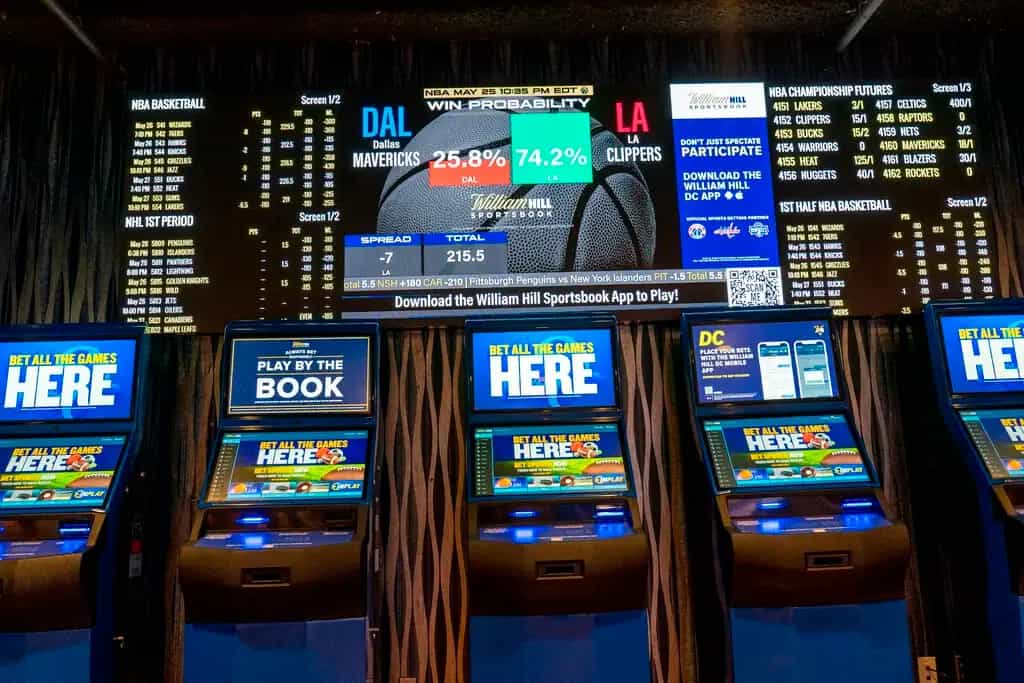
A sportsbook is a licensed business that accepts wagers on sporting events and pays out winners based on odds it sets before and during the game. It offers multiple ways to bet on the same event, including spreads, moneylines, totals, and props, and each format carries its own structure for how odds and payouts are calculated. The book profits by pricing every option so it never has to pay out more than it collects across balanced action.
How Do Sportsbooks Set Odds And Adjust Lines?
Sportsbooks set odds by assigning an implied probability to each possible outcome, then adjusting that number as bets come in on either side. When a sportsbook sets a line, it assigns a probability to each outcome, but when you add up the implied probabilities from both sides of a bet, they total more than 100%, and that extra percentage is the hold. Lines shift constantly once betting opens, and that movement accelerates once a game kicks off, which is central to how odds update in real time once a contest is underway.
How Do Sportsbooks Make Money Through The Vig?
Sportsbooks make money through the vig, a commission baked directly into the odds rather than billed separately. Vig is the built-in margin that ensures the house profits regardless of outcome, which is why a standard coin-flip bet isn't priced at even money on both sides but instead priced at -110/-110, requiring a bettor to pay $110 to win $100 on a 50/50 proposition. On a standard -110/-110 market, the vig creates a 4.5% hold, meaning the book keeps $4.50 of every $100 wagered across both sides. That gap is invisible to casual bettors but decisive over thousands of wagers.
How Do Sportsbooks Manage Risk Across Their Book?
Sportsbooks manage risk by tracking liability on every outcome and shifting prices to attract balanced action on both sides of a bet. As money comes in, odds start to shift, because a book is always concerned with reducing exposure, so even the best prices must change to balance the potential payout on each side and let the house pay out winners while still profiting from the vigorish no matter what happens. Modern books lean on quantitative models to price markets fast, a shift that mirrors how data-driven risk management transformed pricing across professional sports. This is also why futures and player props carry wider margins than spreads. Thinner betting volume on niche markets means the book needs a bigger cushion to offset the risk of lopsided action. Sports books also manage their risk by setting betting limits and limiting regular winners in order to prevent professional bettors from getting too successful.
Are Sportsbooks Regulated And Who Oversees Them?
Sportsbooks operating legally in the United States are regulated at the state level, with each license governing payout rules, advertising standards, and data security. The U.S. Supreme Court overturned the Professional and Amateur Sports Protection Act in May 2018, opening the door to state-by-state legalization and regulation of sports betting. Regulators require licensed operators to segregate customer funds, verify age and location, and submit to regular audits, which is what separates a legal sportsbook from an offshore site with no accountability.
Sportsbook Examples: How Pricing Plays Out In Practice
Example 1: A balanced NFL spread. A book prices a spread at -110 on both sides. If bettors split their money evenly, the sportsbook collects $210 total, pays $200 back to whoever wins, and keeps $10 no matter which team covers.
Example 2: A lopsided moneyline. A heavy favorite draws far more action than the underdog. To limit its exposure, the book shortens the favorite's price and lengthens the underdog's, encouraging bettors toward the side it needs to balance liability. This kind of pricing discipline is one reason established operators such as the one profiled in a detailed review of Sports Interaction's platform and odds offering get scrutinized closely by bettors comparing books.
What Common Mistakes Do Bettors Make About How Sportsbooks Work?
A common mistake bettors make is assuming a 50% win rate turns a profit at standard odds. A 50% win rate at -110 odds actually loses money long-term, because breaking even at -110 requires clearing 52.4%, and turning a real profit means beating that number consistently. Another mistake is treating line movement as pure reflection of team strength, when it frequently reflects where money is landing rather than new information about the game. Bettors also underestimate how much higher the vig runs on parlays and props compared to straight spreads, which quietly erodes long-term returns.
How Do Sportsbooks Compare To Betting Exchanges And Prediction Markets?
| Feature | Traditional Sportsbook | Betting Exchange | Prediction Market |
|---|---|---|---|
| Who sets the price | The operator | Other bettors | Market supply and demand |
| Built-in margin | Vig on every bet | Commission on winnings | Fees vary by platform |
| Regulation | State-licensed | Varies by jurisdiction | Often outside gaming regulation |
Traditional sportsbooks differ from exchanges and prediction markets mainly in who sets the price and how the margin is collected. Prediction market platforms handling sports bets have expanded rapidly outside of state regulatory guardrails, drawing scrutiny from regulators over how those platforms are licensed and taxed. Odds formats also vary by region, and the growing overlap between American and European pricing conventions is reshaping how bettors compare value across platforms.
Bodog Insight: What Should Bettors Take From How Sportsbooks Work?
Sportsbooks work by turning probability into profit, pricing every market so the house holds an edge before a single ball is thrown or kicked. That edge, the vig, is small on a single bet but compounds relentlessly across a season of wagers. Bodog's take is simple: the sharpest bettors aren't the ones who avoid the vig entirely, since that's impossible, but the ones who shop for the lowest hold and understand exactly what they're paying for on every ticket.
How Sportsbooks Work FAQs
What is the vig in sports betting?
Why are odds usually -110 on both sides of a spread?
A -110/-110 market gives the sportsbook a 4.76% hold, historically the rate at which books can balance action on both sides while still making a reliable profit, and it's been the standard price in US sportsbooks for decades.
How much money do sportsbooks actually keep?
Sportsbooks earn revenue through hold percentage, the share of total wagers retained as gross gaming revenue after paying out winners, and the U.S. national hold averaged 10.15% in 2025, meaning sportsbooks kept roughly $10.15 of every $100 wagered.
Do sportsbooks lose money if too many people bet on the same team?
Yes, if a book fails to adjust prices and one side wins big, it can take a loss on that specific event. Sportsbooks limit this exposure by shifting odds as action piles up, which is why prices move throughout the week.
Are sportsbooks legal everywhere in the United States?
Legal sports wagering has expanded to 34 states and Washington, D.C. as of 2026, though rules on bet types and tax rates vary significantly by state.
What is hold percentage and how is it different from vig?
The hold is the percentage of total money wagered that a sportsbook expects to keep after paying winners, and it's closely tied to the overround, or how much the odds sum over 100%, though actual hold depends on how evenly action is split.
Continue Learning
- Betting types: a breakdown of spreads, moneylines, totals, and props and how each one is priced.
- How to hedge a bet: a practical guide to locking in profit or limiting losses on an existing wager.
- Why people love betting on sports they barely understand: a look at the psychology driving casual betting behavior.
- A week of sports betting with AI: the ultimate edge: an inside look at how AI tools are changing betting research.
Sources & Review
- OddsShopper: How Do Sportsbooks Make Money? The Vig And The Hold
- Pikkit: What Is Vig in Sports Betting? Vigorish Explained
- nfelo: Sportsbook Hold Calculator
- Legal Sports Report: Sportsbooks Make More Money From Slower Betting Growth In 2025
- RG.org: U.S. Sports Betting Statistics
- Sports Handle: Legal US Sports Betting Revenue, Handle And State Tax Database
Arthur Crowson got his start in traditional newspapers before making the jump to digital media, where he's spent the last ten years writing about poker, finance, crypto, gambling, and emerging tech. Over that time, he's developed a knack for spotting the moments when markets, technology, and gambling pull in the same direction. His work has appeared in publications like PokerListings, CryptoVantage, ValueWalk, and PokerScout.
More Articles like this
Do NHL Stars Lose Their Edge After Signing Huge Contracts?
Do NHL stars really take their foot off the gas after a big payday? We analyzed 29 major contracts to find out.
By Charlon Muscat
Five Iconic World Series Moments Since the Brewers' Appearance
The Brewers are back in the World Series after 44 years. From Bill Buckner's error to the Cubs ending their curse, plenty has happened since 1982.
By Bill Gelman
LeBron to Giannis: Ranking 5 NBA Offseason Stunners
LeBron to Philly, Giannis to Miami, and Wemby staying put. Which NBA offseason move will pay off the most?
By Bill Gelman
NFL Fans Spend $900 to Watch Games. WWE Fans Pay Even More
Think watching every NFL game is expensive? WWE fans would argue otherwise.

By James Guill
How Bad Is It? Ranking the NHL's Original Six by Fan Misery
Nearly 60 years without a Stanley Cup is just the beginning. We rank the NHL's Original Six teams by how much misery their fans have endured.
By Bill Gelman
Why Does Everybody Hate Us? 10 Most Hated Sports Teams Ever
Some teams always win; others get caught breaking the rules. Either extreme is a surefire way to become universally hated, as these 10 sports teams can attest to.
By Stuart Hughes