

The Lines Between US and European Betting Are Blurring
The old-skool divide between bold American betting and Europe’s disciplined value approach appears to be merging, just in time for the 2026 FIFA World Cup.

Historically speaking, the gap between how Americans and Europeans approached sports betting couldn’t have been more different – until recently, that is.
Perhaps built upon the winner-takes-all ethos found in American leagues such as the NFL, NBA, and MLB, on the whole, US bettors have always targeted bigger, flashier wins. Meanwhile, it’s fair to say Europeans are a lot more subdued, having traditionally opted to focus on value bets and incremental profits over time.
However, an intriguing trend is beginning to surface on both sides of the Atlantic, so we thought we’d take a deeper dive into why American and European sports betting cultures appear to be falling into alignment.
US and European Gamblers: Jackpot Focused Vs. Battle-Tested Tactics
It would be unfair to start by not first acknowledging that the US sports betting sector is still in its relative infancy, having only been legalized in 2018. Meanwhile, EU countries such as the UK have allowed sports betting for more than 60 years, so there is some credibility to the belief that modern-day American bettors simply lack the decades-old, tried-and-tested discipline of Europeans.
US vs European Betting Habits
| Feature | US Style | European Style |
|---|---|---|
| Bet types | Parlays/ accumulators | Singles-focused wagers |
| Market maturity | Relatively new | Long-established |
| Betting approach | Entertainment-driven play | Strategy and value focus |
| In-play betting | Rapidly growing adoption | Standard widely used |
| Risk tolerance | Higher variance acceptance | More controlled staking |
However, as anyone who’s ever placed a bet will probably admit, their first wager was likely to be a long-shot punt, shooting for a big payout rather than playing it safe, right? So, despite the rapid rise of US sports betting, it would be fair to assume US bettors initially undertook this same methodology, attempting to turn modest stake amounts into big returns by favoring multi-game parlays and other higher-risk wagers.
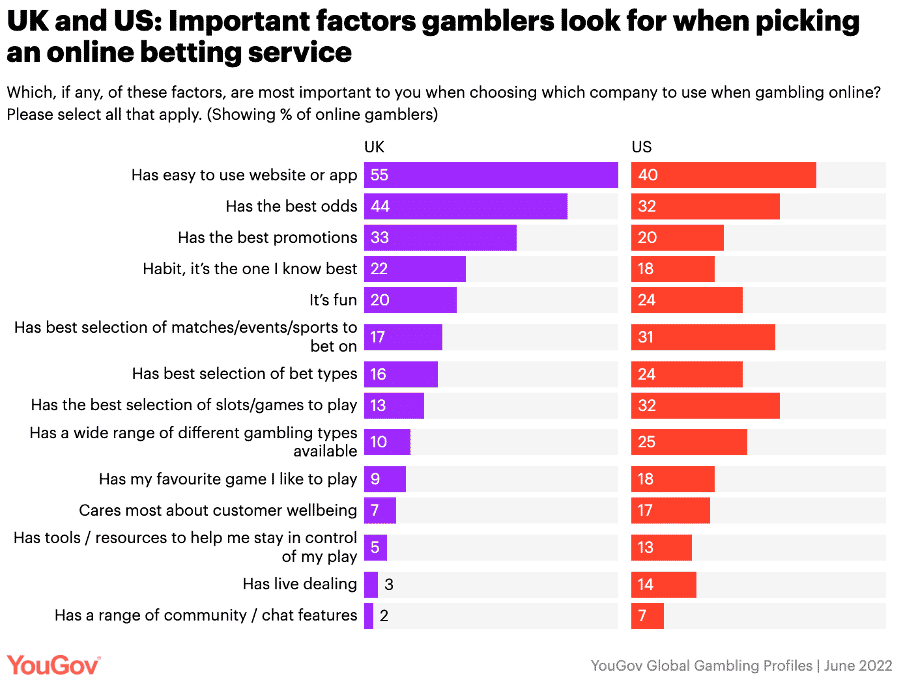
On the flip side, Europe’s more mature betting culture has always centered on sports like soccer and horse racing, where single bets and a propensity to find value are considered second nature. A factor that was clearly evident in a 2022 YouGov survey that asked US and UK bettors what they look for when choosing a betting company.
Source: YouGov
Here, American gamblers revealed they were more than twice as likely to opt for entertainment-driven experiences, with 25% seeking out a wider choice of gambling features, compared to 10% in the UK. In direct contrast, UK bettors were decidedly more tuned in to selecting a sportsbook based on the competitiveness of the odds (44% vs 32% in the US) and its promotional offers available (33% vs 20% in the US).

How American Betting Is Rapidly Evolving
With all that said, it was to be expected that there would eventually be a cultural shift in the US as bettors began to move on from seeing betting purely as an entertaining byproduct of watching a sporting event. A point proven in a recent WSN 2026 sports betting census, which suggested that US bettors were increasingly becoming more financially motivated in their approach to betting.
Whereas before many US gamblers viewed betting as the chance to land a big payout, such as picking a Kentucky Derby trifecta – punters now are becoming increasingly more sophisticated in their methodologies, relishing statistical modeling, pre-game line shopping, and implementing proven bankroll management strategies. This is conceivably why – with the help of advancements in mobile technologies and the availability of deeper statistical insights - in-play betting has also gained traction, outpacing pre-game wagering in the US for the first time in 2026, accounting for 52% of total handle.
At the same time, younger bettors, particularly Gen Z and Millennials, are also entering the marketplace, bringing with them habits shaped from playing fantasy sports, which is more akin to an analytics-driven logic of assessing value. The result of this appears to be the catalyst behind the recent deviation among US bettors toward a more strategic way of thinking when it comes to wagering on sports. For more, here's why the TikTok effect is taking over sports betting.

How Europe’s Influence Has Helped Shape the US Market
Make no mistake, the US’s migration towards a more European disposition hasn’t been truly organic either. Instead, it was an engineered initiative by EU operators who have decades of experience refining their sportsbook’s product offerings up their sleeve.
You see, when firms like Flutter Entertainment (owner of FanDuel) and Entain (partnered with BetMGM) entered the American market, they didn’t just invest, they also exported their time-tested pricing models, user experiences, and formats that they knew would take off in the US.
Pivotal Advancements in Sports Betting Features
- Richer Live in-play betting experiences
- Augmented stats, data, and odds integrated into real-time live feeds
- Same game parlays (SGP) & bet builders
- Broader sportsbook markets with more niche betting selections
- Cash-out functionally
- Enhanced personalized promotions and targeted offers
Despite being deliberately tailored to appeal to American sports fans, these augmented practices have allowed bettors to gain better insights into sharper odds movements and deeper in-play markets that were not as prevalent prior to the EU’s integration into the US market.
Incidentally, these sweeping product line introductions are also intentionally designed to maximize sportsbook revenues, while allowing firms to standardize their technology stacks across all their platforms. Whether this is across individual states or harmonizing their US interfaces with their domestic markets back home, the ability to synchronize these product offerings helps to drive up consumer engagement, which in turn fosters stronger retention metrics among bettors.

The Rise of Same Game Parlays and Bet Builders — A Hybrid Betting Culture
It’s not only US bettors whose wagering patterns and strategies appear to be changing - for their part, Europeans are beginning to lean into the American betting culture too. Likely driven by the universal appeal of US sports’ stat-rich leagues, including the NFL and NBA, both sets of bettors seem to have fallen in love with same game parlays and bet builder apps.
Universally appealing to US punters, this relatively new form of betting also plays into the hands of traditionally sharp European bettors, having honed their disciplined odds-focused approach to wagering over the years. Credited with adding an extra layer of excitement to any sporting matchup, 90% of American bettors have already admitted to having placed a SGP, with 41% stating it is now their preferred method of betting, which would explain why the format has become the most heavily advertised betting promotion on both sides of the pond.
The Role of Media, Technology, and Social Media
Looking in from the outside, there are several factors in play that are helping to drive this convergence of these two geospatial betting mindsets.
Firstly, the notable advancements in technology, such as mobile sportsbook apps, AI-driven statistical analysis, and, not to mention, the ease and availability of watching live-streamed sports broadcasts, have certainly helped. Then, we must also consider the emergence of prediction markets such as Kalshi and Polymarket, which successfully introduced a trading-style mindset to sports betting that clearly resonates with both European and American bettors.
Social media, too, has played a role in fusing the two differing approaches, with online tipsters and data-centric apps specifically influencing consumer behavior as bettors seek out potential edges from the bevy of self-appointed experts. Furthermore, when you consider the degree to which the US and European markets consume these same data and media feeds, it’s easy to see why there has been a merging in betting habits across the board.
All The Signs Are Pointing To A Unified Approach to Wagering
Given the degree of cross-betting on sports on either side of the Atlantic, the growing influence of European sportsbooks' product lines, and the extensive tech landscape that encourages the sharing of ideas and wagering strategies, it’s no wonder the gap between the two continental styles has already narrowed.
Whether it’s a shared love of SGPs or the subtle adoption by American punters switching to the decimal odds format, the overriding goal of both demographics will undoubtedly see a continuing focus on more analytical, value-based decision-making. Throw in the fact that the US will stage the bulk of the 2026 FIFA World Cup, and you can safely assume that the world's biggest sporting tournament will only accelerate this convergence even further.
Stuart Hughes is a London-based freelance journalist covering sports, travel, lifestyle, and technology. He’s worked with brands like Lenovo, Best Western, and Frontier Airlines, bringing a global perspective shaped by years of travel.
More Articles like this
Does a 4-0 NFL Start Mean You're Playoff Bound?
A 4-0 start can put your team on the fast track to the playoffs, but history shows that even Super Bowl champions don't always start strong.
By Marcus Mosher
The 8 Greatest Sports Movies Ever Made, Ranked
Rocky isn't No. 1 by default. We ranked the eight greatest sports movies ever made, from a boxing warhorse to a table tennis fever dream, weighing critical scores against what actually stuck.
By Cole Rush
Which Sports Punish Losing Teams the Most?
From a punishing relegation to first draft pick optimism, discover which sporting leagues have the highest penalties for a losing season and those that feel comparatively lenient.

By Stuart Hughes
MLB Playoff Byes Aren't the Advantage You Might Think
Since baseball went to its current 12-team playoff format, the results show that bye teams only hold a slight Division Series advantage over Wild Card winners.

By Bill Gelman
McKenna, Martone Lead 5 NHL Rookies to Watch
Gavin McKenna and Porter Martone enter as the favorites, but a deep 2026-27 rookie class gives the Calder Trophy race plenty of potential challengers.

By Bill Gelman
Parlaymint Wants to Turn Parlays Into a Team Sport
Parlaymint turns the group parlay into a social sport, giving every bettor one pick, a share of the payout and potentially the entire bill if their leg is the only one that loses.
By Charlon Muscat