

Prediction Markets: Guides, Platforms, Reviews & News
Explore prediction market platforms, regulation, sports markets, independent reviews, industry news, trends, analysis, and expert guides.

Top Prediction Markets
.webp)
Prediction markets let people trade contracts based on the outcomes of real-world events, from sports and elections to economics, entertainment and other major events. Contract prices change as participants trade, providing a constantly updated view of what the market thinks is likely to happen.
The category has expanded rapidly, with prediction market platforms offering an increasingly broad range of event contracts and different approaches to trading, fees, regulation and market access. That growth has also raised new questions about where these platforms are available, how they are regulated and how the prediction market industry is evolving.
Bodog covers the prediction market landscape through platform comparisons, independent reviews, educational guides, news and market analysis.
New to the category? Start with our guide to how prediction markets work. You can also compare the best prediction market apps or explore our prediction market reviews.
Prediction Markets Explained
Prediction markets allow participants to trade contracts tied to the outcome of future events, including sports, elections, economic decisions and financial milestones. Prices move as participants buy and sell, giving each market a changing view of how likely an outcome is considered to be.
Unlike a traditional sportsbook bet, some prediction market positions can also be traded before an event is settled. The exact trading model, contract structure, fees and settlement rules can vary by platform.
To see how prediction markets compare with traditional sports betting, including differences in pricing, trading, liquidity, fees and regulation, read our complete guide to prediction markets vs sportsbooks.

Examples of Active Prediction Markets
Prediction markets cover far more than elections. Here are real-world examples of active markets across major categories:
Elections and Politics Prediction Markets
Political markets are the highest-profile and highest-volume category available on prediction markets. Kalshi currently lists contracts on all 435 House seats and 33 Senate seats for the 2026 midterms, plus the 2028 presidential election, key governor races, Supreme Court decisions, and government shutdown probabilities. During the 2024 presidential election, Polymarket processed over $3.6 billion in trading volume on the Trump vs. Harris race alone. This was more than all U.S. sportsbooks combined on any single event that year.
Markets priced Trump at 60%+ probability weeks before polls showed a clear lead, and called the result hours before television networks on election night.
Economic Indicators Prediction Markets
Traders bet on economic outcomes that directly affect financial markets: whether the Federal Reserve will raise, cut, or hold interest rates; whether CPI will exceed a specific threshold; whether GDP growth will beat or miss consensus; and whether a government shutdown will occur before a deadline. In 2025, probability movements on Kalshi and Polymarket anticipated Fed rate decisions by one to two weeks before official announcements.

Sports Prediction Markets
Prediction market sports contracts work a lot like sportsbook bets. You’ll find options like team winners, player props, and over/unders, but with some important differences. These platforms also offer parlays (combo bets) and player props alongside political and economic markets, giving you a variety of ways to engage.
Culture and Entertainment Prediction Markets
Some platforms let you bet on fun stuff like who will win Oscars or Grammys, which celebrity will be the most searched on Google this quarter, or social media milestones. These markets usually have less action but are great for casual traders and newcomers to prediction markets.
Cryptocurrency Prediction Markets
On Polymarket, you can bet on whether Bitcoin, Ethereum, or other cryptocurrencies will hit certain price targets by specific dates. These markets often serve as a barometer for the overall mood in the crypto world.
Still unsure of how prediction markets operate? Read our guide to reading prediction market odds.
Why Prediction Markets Can Be Useful Forecasting Tools
Prediction markets can provide useful signals about the likelihood of future events because their prices combine the views of many participants into a continuously changing forecast. As traders respond to new information, market prices can adjust quickly rather than waiting for the next poll, report or expert prediction.
Financial incentives can also affect the quality of those forecasts. Participants have a reason to trade based on what they believe will actually happen rather than simply expressing a preference or opinion. When markets attract enough informed participants and trading activity, that process can bring different sources of information together in one market price.
That doesn't mean prediction markets always get it right. Low liquidity, limited participation, unexpected events and incorrect assumptions can all produce inaccurate signals. A contract trading at a high probability is still a forecast, not a guarantee.
This combination of information aggregation, incentives and continuous price movement helps explain why prediction markets are increasingly used to track expectations around sports, politics, economics and other real-world events.
Prediction Markets vs. Polls
Prediction markets and opinion polls both attempt to forecast outcomes, but they work in fundamentally different ways.
| Feature | Prediction Markets | Opinion Polls |
|---|---|---|
| Method | Financial exchange; traders buy/sell contracts | Survey; respondents answer questions |
| Incentive | Real money at stake (profit/loss) | No financial incentive |
| Update Speed | Real-time, continuous | Days to weeks (field time + analysis) |
| Sample | Self-selected traders | Designed random sample |
| Bias Risk | Narrative-driven (2022 "Red Wave") | Non-response bias, social desirability bias |
| 2024 Election Accuracy | Called Trump weeks early; 95% by midnight | Showed dead heat through election day |
| Transparency | Order book visible; prices public | Methodology varies; aggregation differs |
Prediction Markets vs. Sports Betting
Prediction markets and sports betting share a surface similarity — both involve wagering on outcomes — but the underlying structure is different.
| Feature | Prediction Markets | Sports Betting |
|---|---|---|
| Model | Peer-to-peer exchange (trader vs. trader) | House model (bettor vs. sportsbook) |
| Pricing | Market-driven supply and demand | Oddsmaker-set lines with built-in vig |
| Scope | Politics, economics, sports, culture, crypto | Primarily sports |
| Regulation | CFTC (federal commodities law) | State gaming commissions |
| Minimum Age | 18+ | 21+ (most states) |
| Position Exit | Sell contracts anytime at market price | Limited cash-out options |
| House Edge | None — platform charges fees on trades | Built into every line (vig/juice) |
Popular Prediction Market Sites
The best prediction market platforms dominating the US landscape are: Kalshi, Polymarket, Crypto.com, Novig, and Robinhood, with differences in market selection, trading models, fees, availability and regulatory structure.
Some focus primarily on event contracts, while others offer prediction markets alongside financial or other trading products. Available markets can include sports, politics, economics, cryptocurrency, entertainment and other real-world events.
Bodog tracks the major platforms as the industry develops. See our prediction market reviews for individual platform analysis, or compare our best prediction market platforms to see how leading options differ.
Prediction Market Risks and Criticisms
Prediction markets can provide useful signals about future events, but they have limitations. Market manipulation, insider information, low liquidity, contract disputes and regulatory uncertainty can all affect how reliable or accessible a market is.
Prediction Market Manipulation
Because prediction market prices are influenced by trading activity, participants with significant capital may be able to move the price of a contract, particularly when liquidity is low. This can temporarily make an outcome appear more or less likely without a corresponding change in the underlying event.
Other traders may respond when they believe a contract is mispriced, but there is no guarantee that prices will immediately correct. Prediction market prices should therefore be viewed as market-based forecasts rather than definitive probabilities.
Liquidity and Market Quality
A prediction market is only as informative as the trading activity behind it. Popular contracts may attract substantial participation, while niche markets can have fewer traders and wider gaps between available prices.
Lower liquidity can make prices more volatile and make it harder to enter or exit a position at the expected price. It can also make a market's implied probability less useful as a broader forecast.
Regulation and Legal Uncertainty
Prediction markets occupy an evolving regulatory environment, particularly in the United States. Some event-contract platforms operate within federal commodities regulation, while regulators and other authorities continue to debate how certain contracts — particularly those involving sports — should be treated.
Availability can therefore vary by platform, market type and location, and regulatory developments can change which contracts are offered. Users should check a platform's current eligibility requirements and applicable rules before participating.
Prediction Market Insider Trading
Insider trading has become one of the most closely watched issues surrounding prediction markets. The concern is straightforward: some event contracts involve government decisions, corporate developments or geopolitical events where certain participants could possess material information before it becomes public.
The issue attracted increased political attention in 2026 following controversial trading around events in Venezuela. Rep. Ritchie Torres subsequently introduced legislation aimed at restricting federal officials from trading prediction market contracts when they possess material nonpublic information.
Prediction market platforms can also impose their own restrictions. Kalshi prohibits trading based on certain nonpublic information and has taken enforcement action against users for violations. At the federal level, the CFTC has authority to pursue certain forms of trading involving misappropriated confidential information under commodities law.
Prediction markets nevertheless raise an unusual question: informed trading is part of what makes markets useful for forecasting, so where should the line be drawn between well-informed participants and people unfairly profiting from privileged information?
That debate becomes particularly complicated for markets involving government policy, corporate decisions, economic announcements and geopolitical events. As prediction markets expand into more categories, defining and policing that boundary is likely to remain an important regulatory issue.

Regulatory Uncertainty with Prediction Markets
Prediction markets face an evolving regulatory environment in the United States, particularly when event contracts involve sports, politics and other subjects traditionally associated with gambling.
At the federal level, certain prediction market platforms operate under CFTC oversight and commodities law. At the state level, however, regulators have challenged whether some event contracts should instead be treated as gambling and subject to state licensing requirements. That disagreement has resulted in enforcement actions and legal disputes over the boundaries between federal and state authority.
For users, this means access to prediction markets and individual contract types can vary depending on the platform and location. The regulatory picture is also changing as courts, regulators and lawmakers continue to address how event contracts should be treated.
For the latest developments, state-by-state considerations and a deeper explanation of the regulatory framework, read our Are Prediction Markets Legal? guide.
The Future of Prediction Markets
Prediction markets have expanded beyond their academic and experimental roots, with event-contract data increasingly appearing in financial markets, media coverage and corporate forecasting. Their next stage of growth is likely to depend on regulation, institutional adoption and how new technologies change the way markets are created and analyzed.
Financial and Institutional Adoption
Prediction market data is increasingly being treated as another source of information about future events. Financial institutions, media organizations and professional traders can use market probabilities alongside polls, economic indicators and other forecasting tools to track changing expectations.
Prediction markets also have applications beyond public trading platforms. Companies have experimented with internal markets that allow employees to forecast outcomes such as sales, product launches and project deadlines. These systems are designed to aggregate information from across an organization rather than relying entirely on traditional top-down forecasts.
Policy and Public Forecasting
Prediction markets could also play a larger role in forecasting political, economic and policy outcomes. Markets can aggregate different expectations into probabilities that change as new information becomes available, potentially giving researchers, journalists and policymakers another signal to consider alongside polls, models and expert analysis.
How far this develops will depend partly on regulation. Questions surrounding federal oversight, state gambling laws and which types of event contracts can be offered continue to shape the industry's development.
AI and Prediction Markets
Artificial intelligence could change both who participates in prediction markets and how market information is analyzed. AI systems can process large volumes of news, economic data and other information quickly, potentially allowing automated trading systems to respond to developments as they occur.
AI may also be used to help identify potential markets, analyze probabilities and assist with resolving outcomes. At the same time, greater automation introduces new questions around market integrity, transparency and the influence of automated participants.
The combination of human forecasting, market incentives and increasingly capable AI systems could make prediction markets a more important source of real-time forecasting data — although how significant that role becomes remains to be seen.
The Bottom Line on Prediction Markets
Prediction markets have developed into a growing way to forecast real-world events, bringing together market prices, financial incentives and the collective expectations of participants. They now cover everything from sports and elections to economics, cryptocurrency and entertainment, while attracting increasing attention from traders, media organizations and regulators.
They are not perfect forecasting tools. Market prices can be affected by liquidity, participant behaviour, unexpected events and the information available to traders. Questions around regulation, market manipulation and insider trading also remain important as the industry develops.
As prediction markets continue to expand into new events and attract more participants, their role as both trading platforms and forecasting tools is likely to keep evolving. How significant that role becomes will depend on market participation, regulation and whether these platforms can maintain useful, trustworthy markets as they grow.
Prediction Market FAQs
What are prediction markets?
Prediction markets are online platforms where participants trade contracts based on the outcome of future events. The price of each contract reflects the market's collective estimate of the probability that the event will occur.
How do prediction markets work?
Traders buy and sell contracts tied to specific outcomes, such as election results or economic indicators. Contract prices fluctuate based on supply and demand, representing the aggregated belief of all participants. When the event concludes, contracts settle at $1 if the event happens or $0 if it does not. To learn more, read our guide: Prediction Markets Explained.
Are prediction markets legal?
The legal status of prediction markets varies. In the U.S., real money prediction markets are regulated by the Commodity Futures Trading Commission (CFTC). While federal regulators have become more relaxed over time, some state regulators still challenge these platforms, leading to ongoing legal complexities.
What types of events can I bet on in prediction markets?
Prediction markets cover a wide range of topics, including elections, financial markets, sports, pop culture, climate events, and more. Some platforms offer markets on current events, economic indicators, and entertainment awards.
What is the difference between prediction markets and sports betting?
Prediction markets operate as peer-to-peer exchanges where traders set prices by bidding against each other, without a house edge. Sports betting typically involves betting against a sportsbook that sets odds and includes a built-in commission. Prediction markets also allow traders to sell contracts before event settlement.
Can prediction markets be manipulated?
While prediction markets can be subject to manipulation attempts, the self-correcting nature of markets generally limits the impact. However, low-liquidity markets are more vulnerable. Insider trading is a concern since there are no specific insider trading laws for prediction markets in the U.S.
Are prediction market winnings taxable?
Winnings from prediction markets are usually treated as ordinary income and subject to taxation. Platforms often provide tax forms reporting net profits. Tax treatment may vary by jurisdiction and is subject to change as regulations evolve.
What are the risks of participating in prediction markets?
Participants face financial losses due to the speculative nature of contracts. Prediction markets may encourage gambling-like behavior, which can be addictive. Additionally, shifting laws and platform rules can affect investments.
How accurate are prediction markets compared to polls?
Prediction markets often outperform traditional opinion polls in forecasting election outcomes due to real-time updates and financial incentives that encourage truthful information aggregation. However, they are not infallible and sometimes fail to predict outcomes accurately.
What is a decentralized prediction market?
A decentralized prediction market operates on blockchain technology, allowing peer-to-peer trading without a central operator. These markets use smart contracts for settlement and can offer increased transparency but raise ethical and regulatory concerns.
More Articles like this
Kalshi Wants Margin Trading. What Could Go Wrong?
Kalshi’s proposed margin system would let eligible traders put up less than the full value of some positions, freeing capital for other trades while also introducing a new layer of leverage and risk.

By Charlon Muscat
Kalshi, Polymarket Starting to Price the Midterms as Blowout
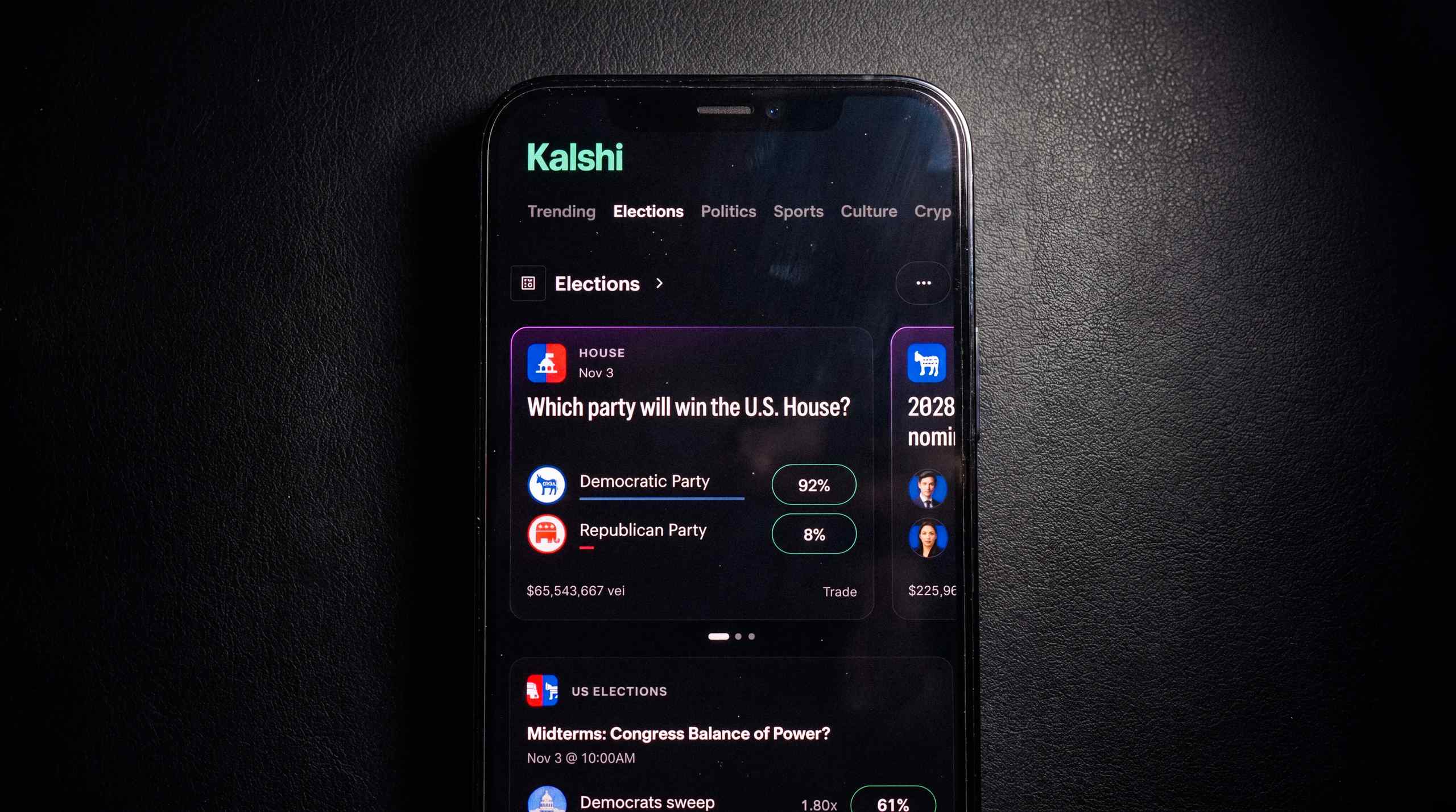
With just over five weeks to go, Kalshi and Polymarket now heavily favor Democrats for the House and give them the edge in the Senate.
By Stuart Hughes
Kalshi’s NFL Volume Is Exploding. Should Sportsbooks Be Worried?
The NFL season is barely underway, but prediction markets have already handled multiple billions in football trading volume. Is that enough to make sportsbooks nervous?

By Charlon Muscat
Best Prediction Market Apps of 2026
Compare the best prediction market apps and platforms for sports, politics and other events, ranked by market selection, fees, liquidity, user experience and availability.

By James Guill
Prediction Markets vs Sports Betting: Key Differences
Prediction markets vs sports books: odds, vig, trading vs fixed bets, legality by state, combos vs parlays. Which is better for sports bettors?

By Arthur Crowson
Sydney Sweeney to LeBron: Prediction Markets Bet on Star Power
Sydney Sweeney just became an equity partner at Novig. She joins a growing list of A-listers cashing massive checks from prediction markets, including LeBron James, Timothée Chalamet and many others.

By Cole Rush


