
.png)
How Do Prediction Markets Work?
Learn how prediction markets turn real-world events into tradable contracts, with examples explaining Yes and No positions, pricing, probabilities, trading and settlement.

Top Prediction Markets
.webp)
Prediction markets work by allowing people to buy and sell contracts based on whether a future event will happen. A market might ask whether a team will win a championship, the Federal Reserve will cut interest rates or a candidate will win an election. Traders then take positions based on which outcome they believe is more likely.
Most prediction market contracts have defined outcomes, often Yes or No, with prices changing as participants trade. A contract trading at $0.65, for example, can be interpreted as the market assigning roughly a 65% probability to that outcome. As new information becomes available and traders change their positions, the price can move accordingly.
If the contract resolves in your favour, it typically settles at $1; if it does not, it settles at $0. Depending on the platform and contract, you may also be able to sell your position before the event is decided rather than holding it until settlement.
Below, we'll break down each part of the process, from event contracts and market pricing to buying and selling, liquidity, payouts and settlement, using real-world examples.
How Prediction Markets Work: Simple Explanation
Short answer: You buy a contract tied to the outcome of a future event. In a typical Yes-or-No market, a winning contract settles at $1.00 and a losing contract settles at $0.00. Prices generally trade between $0.01 and $0.99 and can be interpreted as the market's implied probability of an outcome.
For example, a Yes contract trading at $0.65 suggests the market is pricing the outcome at roughly a 65% probability. If you buy at $0.65 and the contract settles at $1.00, your profit is $0.35 per contract. If it settles at $0.00, you lose the $0.65 you paid.
You don't necessarily have to wait for the event to end. Depending on the market and platform, you can sell your position before settlement as prices change.
That's the basic idea. Below, we'll break down exactly how contracts, prices, trading, probabilities, payouts and settlement work.
New to prediction markets? Start with our full guide to prediction markets.
Event Contracts Explained
Every prediction market starts with a clearly defined question tied to a verifiable outcome.
| Contract Question | Source for Resolution | Settlement Date |
|---|---|---|
| "Will the Fed cut rates at the March FOMC meeting?" | Federal Reserve press release | After the FOMC decision |
| "Will the Eagles win Super Bowl LXI?" | Official NFL results | After the game |
| "Will Bitcoin exceed $100,000 by Dec. 31?" | Price source specified in the contract rules | After the specified deadline |
| "Will there be a government shutdown before April 1?" | Source specified in the contract rulese | After the outcome or deadline is confirmed |
Yes and No Contracts
In a typical binary prediction market, each question has two possible positions: Yes and No. If the event happens according to the contract's rules, Yes settles at $1.00 and No settles at $0.00. If it doesn't happen, the opposite occurs.
The prices of the two sides reflect how traders are valuing each outcome. If Yes is trading around $0.65, for example, the market is broadly implying about a 65% probability of that outcome occurring, while No represents the opposing position.
Prices can change continuously as participants trade and new information becomes available. Actual prices available to buyers and sellers can also be affected by factors such as liquidity and the spread between bids and offers.
Every contract also needs clear resolution rules specifying how the final outcome will be determined. Platforms use different resolution processes and data sources, so traders should check those rules before opening a position.
Prediction Market Pricing
Short answer: A prediction market price can be interpreted as an implied probability. If a Yes contract is trading at $0.70, the market is broadly pricing that outcome at about a 70% chance of occurring. Prices change as participants buy and sell rather than being fixed by a traditional sportsbook oddsmaker.
How Prediction Market Prices Represent Probability
Binary prediction market contracts typically trade between $0.01 and $0.99 before settlement. That makes the relationship between price and implied probability relatively easy to understand: a contract trading at $0.40 represents roughly a 40% market-implied probability, while a contract at $0.75 represents roughly 75%.
Contract Price | Implied Probability | What It Means |
$0.10 | 10% | The outcome is considered unlikely |
$0.25 | 25% | The outcome is considered possible but unlikely |
$0.50 | 50% | The market is roughly evenly divided |
$0.75 | 75% | The outcome is considered likely |
$0.95 | 95% | The outcome is considered highly likely |
The conversion itself is simple: a price of 65 cents corresponds to roughly 65% implied probability.
That doesn't mean the market has determined that the true probability is exactly 65%. The price reflects what participants are currently willing to buy and sell the contract for, and factors such as liquidity and bid-ask spreads can affect the prices available at any given moment.
How Prediction Market Prices Move
Prediction market prices change as participants place orders and trades are executed. If demand for a Yes position increases, its market price can rise. If traders become less confident in the outcome or increase their selling activity, the price can fall.
New information can cause these changes quickly. An injury before a sporting event, an economic announcement, an election result or another unexpected development can cause traders to reassess an outcome and adjust the prices at which they are willing to trade.
This process is known as price discovery. Instead of one party deciding what an outcome is worth, the market price emerges from the interaction between buyers and sellers.
The displayed probability should therefore be understood as a changing market signal rather than a guarantee that an event will happen. For more on this, check out our guide on how to read prediction market odds.
Buying and Selling Prediction Market Contracts
Many prediction markets use an order book, similar to those used by financial exchanges, to match people who want to buy and sell contracts. Instead of a sportsbook setting a fixed price, participants submit orders showing the price at which they are willing to trade.
Two of the most common ways to trade are market and limit orders:
Buying and Selling Contracts
Prediction markets use an order book, similar to a stock exchange, where buyers and sellers post their prices
| Order Type | How It Works | Best For | Fees |
|---|---|---|---|
| Market Order | Attempts to buy or sell immediately at the best available prices | When completing the trade quickly matters more than getting an exact price | Taker fees apply |
| Limit Buy Order | Sets the maximum price you're willing to pay and remains open until it can be matched or is cancelled | Control — you want a specific price | When you only want to buy at a specific price or better |
| Limit Sell Order | Sets the minimum price you're willing to accept for contracts you're selling | When you only want to exit at a specific price or better | Maker fees |
A market order prioritizes execution, but the final price can differ from the price you first see if there isn't enough liquidity available. A limit order prioritizes price, but there is no guarantee it will be filled.
For example, suppose a Yes contract is trading around $0.60. You could place an order to buy immediately at the available market price, or set a limit order at $0.55 and wait to see whether another participant is willing to trade at that price.
Once you own a contract, you don't necessarily have to hold it until the event is resolved. If its market price changes, you may be able to sell your position before settlement to realize a profit or limit a loss.
Trading features, available order types and fees vary between prediction market platforms, so it's important to check the rules and costs that apply before placing an order.
The Order Book
An order book shows the prices and quantities that participants are currently willing to buy or sell. These open orders help determine the prices available when you enter or exit a prediction market position.
For example, suppose the highest bid for a Yes contract is $0.71 and the lowest ask is $0.74. The difference between them — $0.03 — is known as the bid-ask spread.
A narrower spread generally indicates that buyers and sellers are closer together on price, while a wider spread can make it more expensive or difficult to complete a trade at the price you want. The amount of trading activity and the number of contracts available at different price levels are both important parts of a market's liquidity.
This matters when placing larger orders. If there aren't enough contracts available at the best price, a market order may be filled across several price levels, resulting in a different average price than you initially expected.
How Selling a Prediction Market Contract Works
You don't necessarily have to hold a prediction market contract until the event is resolved. If other participants are willing to trade, you can generally close or reduce your position before settlement.
Suppose you buy a Yes contract for $0.40. New information later increases demand for Yes and the market price rises to around $0.65. If you're able to sell at $0.65, you realize a $0.25 profit per contract without waiting to see whether the event ultimately happens.
The opposite can happen too. If the market moves against your position, you may choose to sell at a lower price and accept a loss rather than risk the contract eventually settling at $0.00.
Exactly how positions are closed depends on the platform and its trading system. Prices, liquidity, spreads and fees can all affect the amount you ultimately receive when exiting a trade.
Settlement
How Settlement Works
| Step | Kalshi | Polymarket |
|---|---|---|
| 1. Event occurs | Source Agency data is published | Event outcome becomes known |
| 2. Resolution | Kalshi determines the outcome based on the filed contract terms | Anyone can propose an outcome by posting a $750 USDC bond |
| 3. Challenge period | None — Kalshi resolves centrally | 2-hour window; if disputed, the system resets and escalates |
| 4. Settlement | Winning contracts pay $1.00; losing contracts pay $0.00; no settlement fees | Winning tokens are redeemable for $1.00 USDC.e; losing tokens are worth $0.00 |
| 5. Payout | USD credited to your Kalshi account | USDC.e credited to your wallet |
How Prediction Markets Work: Example Trade
Short answer: Suppose you buy a Yes contract for $0.40. If the event happens and the contract settles at $1.00, you make $0.60 before applicable fees. If it doesn't happen and the contract settles at $0.00, you lose the $0.40 you paid. You may also be able to sell the contract before settlement if its market price changes.
Step-by-Step Prediction Market Example
The market: “Will the Fed cut rates at its next FOMC meeting?”
Current price: Yes = $0.40
You believe the Fed will cut rates, so you buy 100 Yes contracts at $0.40 each.
Detail | Value |
Contracts purchased | 100 Yes |
Price per contract | $0.40 |
Total cost | $40.00 |
Settlement value if Yes wins | $100.00 |
Max profit (event happens) | $60.00 ($1.00 − $0.40 = $0.60 × 100) |
Max loss (event doesn't happen) | $40.00 (your full stake) |
Scenario A: You're Right ✅
The Fed cuts rates and the contract resolves Yes. Your 100 contracts settle at $1.00 each, giving you a settlement value of $100.
You paid $40 for the position, so your gross profit is $60 before any applicable fees.
Scenario B: You're Wrong ❌
The Fed does not cut rates and the contract resolves No. Your 100 Yes contracts settle at $0.00.
Because you paid $40 for the position, your loss is $40.
Scenario C: You Sell Early 🔄
Now suppose you bought the same 100 contracts at $0.40, but new economic data changes expectations before the Fed meeting. The market price for Yes rises to $0.65.
If you're able to sell all 100 contracts at $0.65:
Detail | Value |
Purchase cost | $0.40 × 100 = $40.00 |
Sale value | $0.65 × 100 = $65.00 |
Gross profit | $25.00 |
You have realized a $25 gross profit before applicable fees without waiting for the contract to settle. If you sell the entire position, the eventual outcome of the Fed decision no longer determines the result of that trade.
Prediction Market Liquidity
Short answer: Liquidity describes how easily you can buy or sell prediction market contracts without significantly affecting the price. A liquid market generally has plenty of buyers and sellers, narrower bid-ask spreads and enough orders available to complete trades efficiently.
Markets with less liquidity can have wider spreads, fewer contracts available at each price and greater price movement when larger orders are placed.
What Determines Prediction Market Liquidity?
Several factors can indicate how liquid a prediction market is:
Factor | High Liquidity | Low Liquidity |
Trading activity | More active buyers and sellers | Fewer active participants |
Bid-ask spread | Buyers and sellers are closer on price | Larger gap between bids and asks |
Order book depth | More contracts available at multiple price levels | Fewer contracts available |
Execution | Orders are easier to fill near the expected price | Orders may take longer or fill across different prices |
Price impact | Larger trades have less effect on price | Individual trades can move the market more significantly |
Popular markets can attract greater liquidity because more participants are interested in trading them. Niche or newly created contracts may have less activity, although liquidity can change considerably over the life of a market.
Market Makers
Some prediction markets use market makers to help provide liquidity. Market makers place buy and sell orders, helping create available prices on both sides of the market and making it easier for other participants to trade.
Their activity can contribute to deeper order books and narrower spreads, but the role and structure of market makers varies by platform. Not every market will have the same level of liquidity simply because market makers are present.
Why Liquidity Matters
Liquidity affects both the price you see and the price at which you may actually be able to trade.
A narrower bid-ask spread generally reduces the difference between buying and selling prices. A deeper order book can also reduce slippage, which occurs when an order is filled at a different average price because there aren't enough contracts available at the initial price.
This becomes particularly important when trading larger positions. A market may display an attractive price for a small number of contracts but have insufficient depth to complete a larger order at that same price.
When liquidity is limited, limit orders can provide greater control over the price you're willing to accept, although there is no guarantee the order will be filled.
The Bottom Line on How Prediction Markets Work
Prediction markets turn expectations about future events into prices that can change as participants buy and sell contracts. In a typical binary market, those contracts are tied to clearly defined Yes or No outcomes, with prices providing a market-implied probability of what traders currently expect to happen.
Understanding the process comes down to a few core concepts: how contracts are defined, what their prices represent, how orders are matched, why liquidity matters and how positions are ultimately settled. Once those pieces are clear, the mechanics of prediction markets become relatively straightforward.
The important thing to remember is that market prices are constantly changing. They reflect what participants are willing to trade at that moment, not a guarantee of what will happen.
How Prediction Markets Work FAQs
What are prediction markets?
Prediction markets are platforms where participants buy and sell contracts based on the outcome of future events. These contracts pay out based on whether a specific event occurs, allowing the market price to reflect the collective probability of that event.
How do prediction markets work?
Participants buy binary contracts that pay $1 if the event happens and $0 if it doesn't. The price you pay represents the market's estimate of the event's probability. You can also sell contracts before the event settles to manage your position.
Are prediction markets legal?
In the United States, prediction markets are regulated by the Commodity Futures Trading Commission (CFTC). While federal regulators have become more relaxed over time, some platforms have faced legal challenges. State regulators may also have
What kinds of events can I bet on?
Prediction markets cover a wide range of topics, including elections, financial markets, sports, pop culture, and current events. The key is that the event has a clear, verifiable outcome.
Can I lose money in prediction markets?
Yes. Like any form of betting or trading, you can lose your entire stake if your prediction is incorrect. It's important to only bet money you can afford to lose.
How do prediction markets differ from traditional betting?
Prediction markets aggregate information from many participants, reflecting collective wisdom. Unlike traditional sportsbooks, prediction markets typically have no built-in house edge, making prices more efficient. Learn more in our prediction markets vs sports betting guide.
What is liquidity in prediction markets?
Liquidity in prediction markets refers to how easily you can buy or sell contracts without affecting the price. High liquidity means tighter spreads and more reliable prices, while low liquidity can lead to higher costs and price volatility.
What platforms offer prediction markets?
Popular platforms include Polymarket, Kalshi, PredictIt, and the Iowa Electronic Markets, each with different focuses and regulatory statuses. To learn more, read our best prediction market platforms guide.
James Guill is an experienced iGaming journalist with a diverse background spanning IT, poker, and online gambling media. With over 20 years in the industry, he’s covered a wide range of gaming topics and has been featured in outlets like USA Today and G4 TV.
More Articles like this
Kalshi Wants Margin Trading. What Could Go Wrong?
Kalshi’s proposed margin system would let eligible traders put up less than the full value of some positions, freeing capital for other trades while also introducing a new layer of leverage and risk.

By Charlon Muscat
Kalshi, Polymarket Starting to Price the Midterms as Blowout
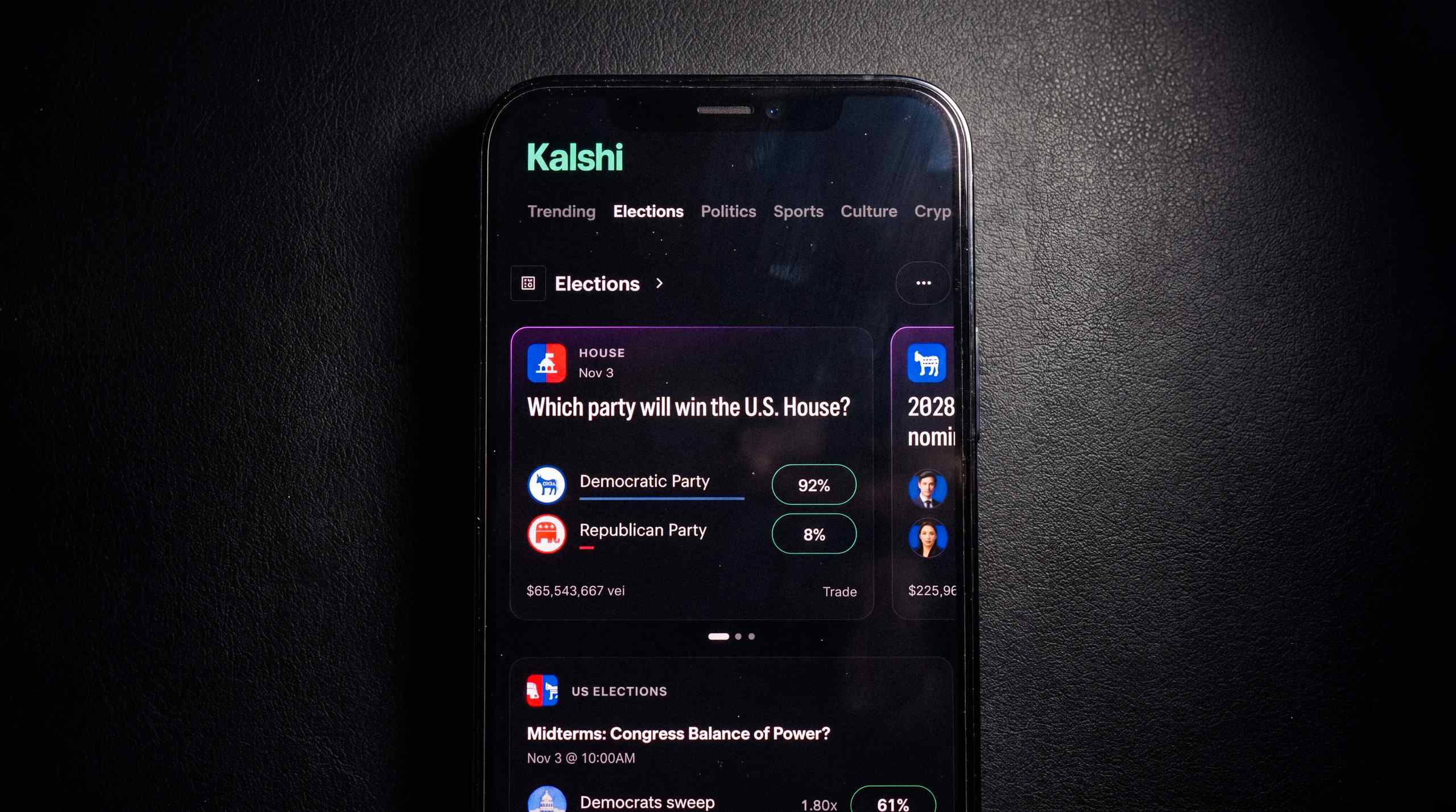
With just over five weeks to go, Kalshi and Polymarket now heavily favor Democrats for the House and give them the edge in the Senate.
By Stuart Hughes
Kalshi’s NFL Volume Is Exploding. Should Sportsbooks Be Worried?
The NFL season is barely underway, but prediction markets have already handled multiple billions in football trading volume. Is that enough to make sportsbooks nervous?

By Charlon Muscat
Best Prediction Market Apps of 2026
Compare the best prediction market apps and platforms for sports, politics and other events, ranked by market selection, fees, liquidity, user experience and availability.

By James Guill
Prediction Markets vs Sports Betting: Key Differences
Prediction markets vs sports books: odds, vig, trading vs fixed bets, legality by state, combos vs parlays. Which is better for sports bettors?

By Arthur Crowson
Sydney Sweeney to LeBron: Prediction Markets Bet on Star Power
Sydney Sweeney just became an equity partner at Novig. She joins a growing list of A-listers cashing massive checks from prediction markets, including LeBron James, Timothée Chalamet and many others.

By Cole Rush