
What Is Closing Line Value?
A Bodog breakdown of closing line value (CLV), the metric sharp bettors use to measure skill and long-term profit potential in sports betting.

Closing line value (CLV) in sports betting measures whether the odds you bet were better than the final odds available right before the game started. Bettors who consistently beat the closing line are, over time, the ones showing real edge rather than luck.
Key Takeaways
- Closing line value compares your bet's odds to the final odds (the "closing line") right before an event starts.
- Positive CLV means you got a better price than the market's last, sharpest number.
- CLV matters because it is is widely considered a stronger predictor of long-term betting success than short-term win rate.
- Sharp bettors track CLV on every wager, not just wins and losses, to judge decision quality.
- Timing, line shopping, and reacting to news faster than the market all improve CLV.
Quick Facts
| Category | Detail |
|---|---|
| Difficulty Level | Intermediate |
| Estimated Time to Learn | 15 to 20 minutes |
| Best Suited For | Bettors moving from casual wagering to disciplined, long-term strategy |
| Related Topic | Moneyline betting and price movement |
Why Does Closing Line Value Matter for Sports Bettors?
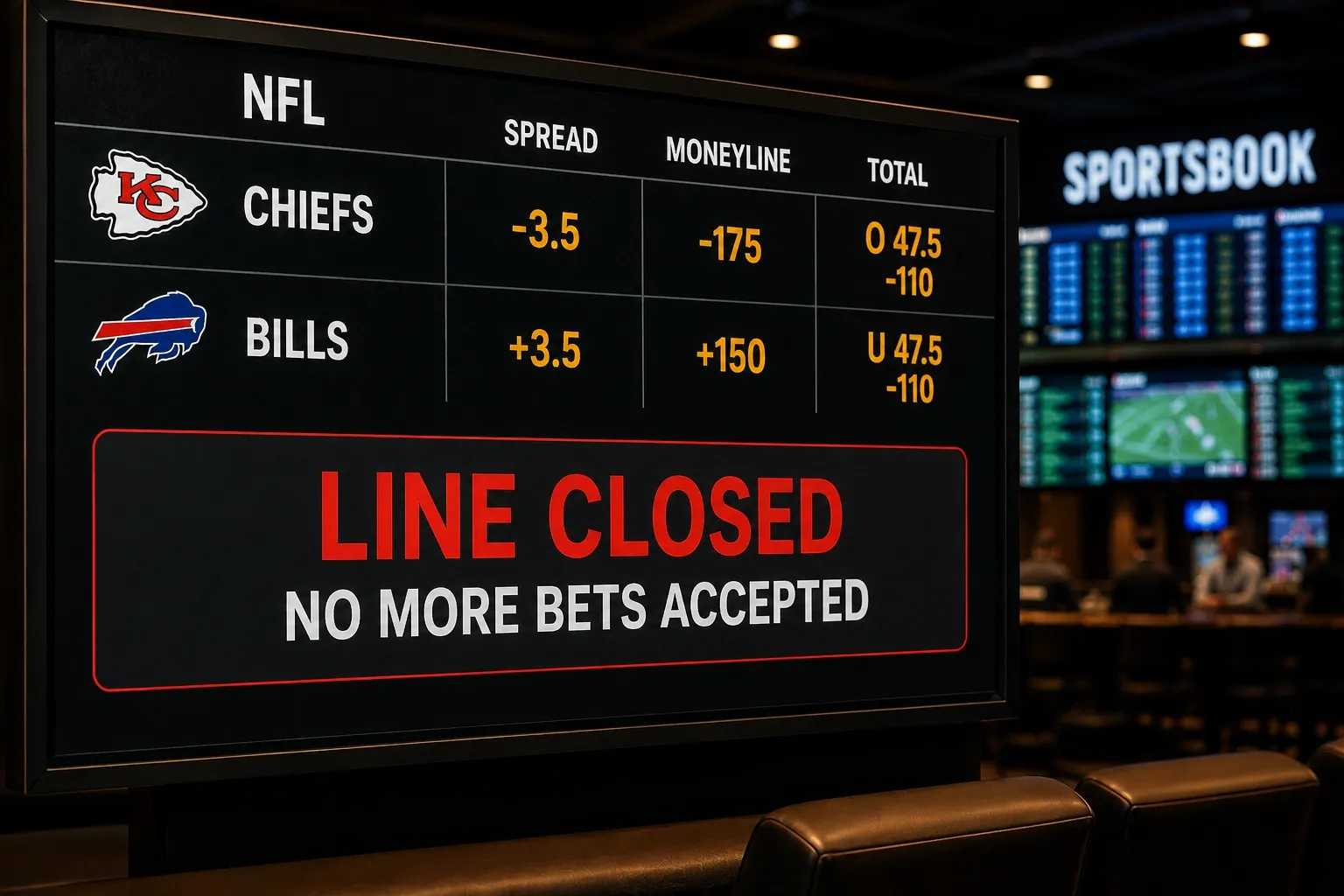
Closing line value matters because it separates skill from short-term luck in sports betting. Short-term outcomes in sports betting can be volatile, with luck sometimes masking a solid betting strategy, but achieving positive CLV over many bets proves that your process has an edge, regardless of individual results. A bettor can lose a game outright and still have made a smart wager, because betting the Chiefs -3 when the line closed at -4 is a smart bet, beating the closing line by a point, even if the Chiefs fail to cover or lose outright.
This distinction protects bettors from two common traps: overconfidence after a hot streak and despair after a cold one. Winning bets doesn't always mean you're a good bettor and losing streaks don't always mean you're a bad one, because closing line value is the single best predictor of long-term sports betting success.
How Do You Calculate Closing Line Value?
You calculate closing line value by comparing the price you bet against the price the market settled on right before kickoff. The most common formula for CLV is CLV% = (Closing Odds / Bet Odds) minus 1, expressed as a percentage to show how much better or worse your odds are compared to the closing line. On point spreads, the math is simpler: it's just the point difference between your number and the closing number.
Say you locked in a total or spread early in the week using a strategy similar to what's outlined in a moneyline bet primer, then checked back before kickoff. If you bet on a team to cover a +5 spread early in the week and the line is +6 by kickoff, you've got 1 point of positive CLV because you got a better number than the closing line. On the moneyline side, the same logic applies to prices instead of points.
What Counts as a Reliable Closing Line for Measuring CLV?
A reliable closing line is the final price at a sportsbook known for tight margins, high limits, and heavy volume, since that price best reflects true probability. Bettors want to use the sharpest, most efficient closing line available, which on average is the closing line from a book known for high betting limits, low margins, and willingness to accept sharp action. Odds formats and market structures vary across regions, and anyone comparing lines internationally may notice differences similar to those covered in discussions about how U.S. and European betting markets are converging.
Not every book's closing number carries equal weight. Not all closing lines are equal, so bettors want to use the sharpest, most efficient closing line available, the one that best reflects true probabilities. A closing price from a book with soft limits and wide margins tells you less than one from a market that absorbs serious volume.
How Do You Read Line Movement When Tracking Closing Line Value?
Reading line movement means recognizing that odds shift from open to close based on new information and betting volume, not random chance. The first odds a sportsbook puts out for a game is the opening line, which is often set days or even weeks before an event. From there, injuries, weather, lineup news, and sharp money all push the number toward its final, closing value.
Bettors who understand why a line moves can position themselves ahead of it. There's a saying in betting circles about betting favorites early and underdogs late, which highlights the importance of timing your bet, and keeping a close eye on line moves and reacting quickly to sharp action or steam moves can make a big difference.
Closing Line Value Examples
Example 1: Beating the Spread Before Kickoff
A bettor takes a favorite at -7 points on Tuesday. If a bettor bets a team at -7 early in the week and the line closes at -10, they've beaten the closing line by 3 points. That's positive CLV of three points, regardless of what the final score ends up being.
Example 2: Beating the Closing Line on a Moneyline Underdog
A bettor grabs an underdog at plus-money odds before news breaks. If a sportsbook initially offers +200 on a team, meaning $100 returns an extra $200 if that team wins, but adjusts the odds to +250 as more information becomes available, then locking in the earlier +200 price means getting a 20% better price than the final market's closing line. That gap is pure, quantifiable CLV.
Example 3: Negative CLV on a Late Bet
A bettor waits until just before kickoff and takes a favorite at -5.5 points after wagering early would have gotten -7. Negative CLV occurs when you place a bet at worse odds than the closing line, such as wagering on a team to cover at -7 early in the week only to watch the line drop to -5.5 by kickoff, meaning the team would then need to win by more than 7 points for the original bet to succeed.
Common Mistakes Bettors Make With Closing Line Value
- Judging bets purely by outcome. A losing bet with positive CLV is often a good process bet, and a winning bet with negative CLV can still reflect a flawed read on the market.
- Using an unreliable closing number. Comparing your bet to a soft book's closing line, rather than a sharp market's, distorts the real CLV picture.
- Ignoring vig when calculating CLV. Two bets at the same point spread but different juice do not carry identical value; the price matters as much as the number.
- Expecting instant results. CLV is a long-run signal. A handful of bets won't reveal whether your process actually beats the market.
- Assuming CLV guarantees profit. Positive CLV improves the odds of long-term profitability, but variance, bankroll management, and bet sizing still affect the bottom line.
Key Closing Line Value Concepts to Understand
Understanding closing line value starts with knowing how oddsmakers set lines and why those numbers change as new information and betting activity enter the market. Bettors should also understand market efficiency, which explains why closing odds are generally considered the market’s most accurate assessment of an outcome. Other important concepts include line shading, where a sportsbook adjusts its odds to account for predictable betting patterns, and expected value, which measures whether a wager is likely to be profitable over time. Together, these ideas explain why consistently beating the closing line can be a stronger indicator of betting skill than the result of any single wager.
How Does Closing Line Value Compare to Win Rate as a Betting Metric?
Closing line value differs from win rate because it measures decision quality rather than short-term results, and most sharp bettors treat it as the more trustworthy number. A bettor who bets 100 games at -110 odds and wins 55 of them might sound good, but if they're consistently getting worse numbers than the closing line, their 55% win rate is likely just short-term luck that will regress over 1,000 bets. Meanwhile, a bettor who wins only 52 of 100 bets at -110 but consistently beats the closing line by an average of a point will likely maintain that win rate over 1,000 bets, since the extra point of value translates to real long-term profit.
What Metrics Measure
| Metric | What It Measures | Reliability Over Small Samples | Reliability Over Large Samples |
|---|---|---|---|
| Win Rate | How often bets hit | Low, easily skewed by variance | Moderate, but still outcome-dependent |
| Closing Line Value | Price quality versus the sharpest market number | Moderate | High, considered the strongest long-term skill signal |
Neither metric works in isolation. ROI and disciplined bankroll strategy still matter, and pairing CLV with a solid grasp of a moneyline bet structure gives bettors a fuller read on whether they're actually beating the market or just getting lucky.
Bodog Insight: What Should Bettors Take Away From Closing Line Value?
Closing line value gives bettors a way to grade their process instead of their luck, and that distinction is what separates hobbyists from serious players. The core idea is simple: track every bet against the closing number, not just the final score.
At Bodog, the take is straightforward. Chasing win totals without checking CLV is like judging a poker player by one hand instead of a full session. Build the habit of logging your bets against the close, and the long-term picture will tell you more about your betting skill than any single Sunday ever could.
Continue Learning
- What Is Implied Probability? — a foundational look at the concept behind every betting line.
- What Are Implied Odds in Poker? — how a related probability concept plays out at the poker table.
- What Is Expected Value in Poker? — see how probability calculations drive long-term profit decisions.
- How Do Prediction Markets Work? — learn how contract prices function as implied probability in a different setting.
Sources & Review
Closing Line Value FAQs
What is a good closing line value percentage?
A positive CLV of any size is a good sign, but consistency matters more than the size of any single number. Bettors who maintain a small positive edge across hundreds of wagers are generally considered sharp, since the effect compounds over volume rather than any one bet.
Can you have positive CLV and still lose a bet?
Yes. CLV measures the quality of the price you got, not whether the outcome favored you. A bet can beat the closing line and still lose because of the natural variance in any single game.
Does closing line value apply to all bet types?
CLV applies most directly to point spreads, totals, and moneylines, since those markets move continuously from open to close. Prop bets and futures can be measured too, though liquidity and market efficiency vary more widely across those bet types.
Why do sportsbooks limit bettors with strong CLV?
Sportsbooks track CLV internally because it identifies bettors who consistently find value before the market corrects. A bettor who repeatedly beats the close is flagged as a threat to the book's margin, regardless of their actual win-loss record.
Is the closing line always accurate?
The closing line is considered the most efficient price available because it reflects the maximum amount of information and betting action, but it is not infallible. Unexpected news right at kickoff, such as a late scratch, can still leave the closing number slightly behind reality.
How often should I track my closing line value?
Tracking every single bet gives the clearest picture, since CLV is a cumulative metric that only becomes meaningful over a large sample. A spreadsheet or tracking tool logging your bet price against the close is enough to start building a reliable trend.
Continue Learning
- What Is a Moneyline Bet? A foundational breakdown of moneyline pricing that pairs well with understanding how closing odds shift over time.
- The Lines Between US and European Betting Are Blurring A look at how odds formats and market structures compare across regions.
- Next Pitch, Next Corner: Why Micro-Betting Is Taking Over A guide to how in-play micro markets are reshaping how bettors chase value in real time.
Sources & Review
- The Action Network: The Importance of Closing Line Value in Sports Betting
- VSiN: Closing Line Value (CLV) in Sports Betting, What It Is & How to Beat It
- OddsJam: What Is Closing Line Value in Sports Betting? How to Track Closing Line Value
- Pinnacle Odds Dropper: What Is Closing Line Value? (Sports Betting)
Arthur Crowson got his start in traditional newspapers before making the jump to digital media, where he's spent the last ten years writing about poker, finance, crypto, gambling, and emerging tech. Over that time, he's developed a knack for spotting the moments when markets, technology, and gambling pull in the same direction. His work has appeared in publications like PokerListings, CryptoVantage, ValueWalk, and PokerScout.
More Articles like this
Do NHL Stars Lose Their Edge After Signing Huge Contracts?
Do NHL stars really take their foot off the gas after a big payday? We analyzed 29 major contracts to find out.

By Charlon Muscat
Five Iconic World Series Moments Since the Brewers' Appearance
The Brewers are back in the World Series after 44 years. From Bill Buckner's error to the Cubs ending their curse, plenty has happened since 1982.
By Bill Gelman
LeBron to Giannis: Ranking 5 NBA Offseason Stunners
LeBron to Philly, Giannis to Miami, and Wemby staying put. Which NBA offseason move will pay off the most?

By Bill Gelman
NFL Fans Spend $900 to Watch Games. WWE Fans Pay Even More
Think watching every NFL game is expensive? WWE fans would argue otherwise.

By James Guill
How Bad Is It? Ranking the NHL's Original Six by Fan Misery
Nearly 60 years without a Stanley Cup is just the beginning. We rank the NHL's Original Six teams by how much misery their fans have endured.

By Bill Gelman
Why Does Everybody Hate Us? 10 Most Hated Sports Teams Ever
Some teams always win; others get caught breaking the rules. Either extreme is a surefire way to become universally hated, as these 10 sports teams can attest to.
By Stuart Hughes