
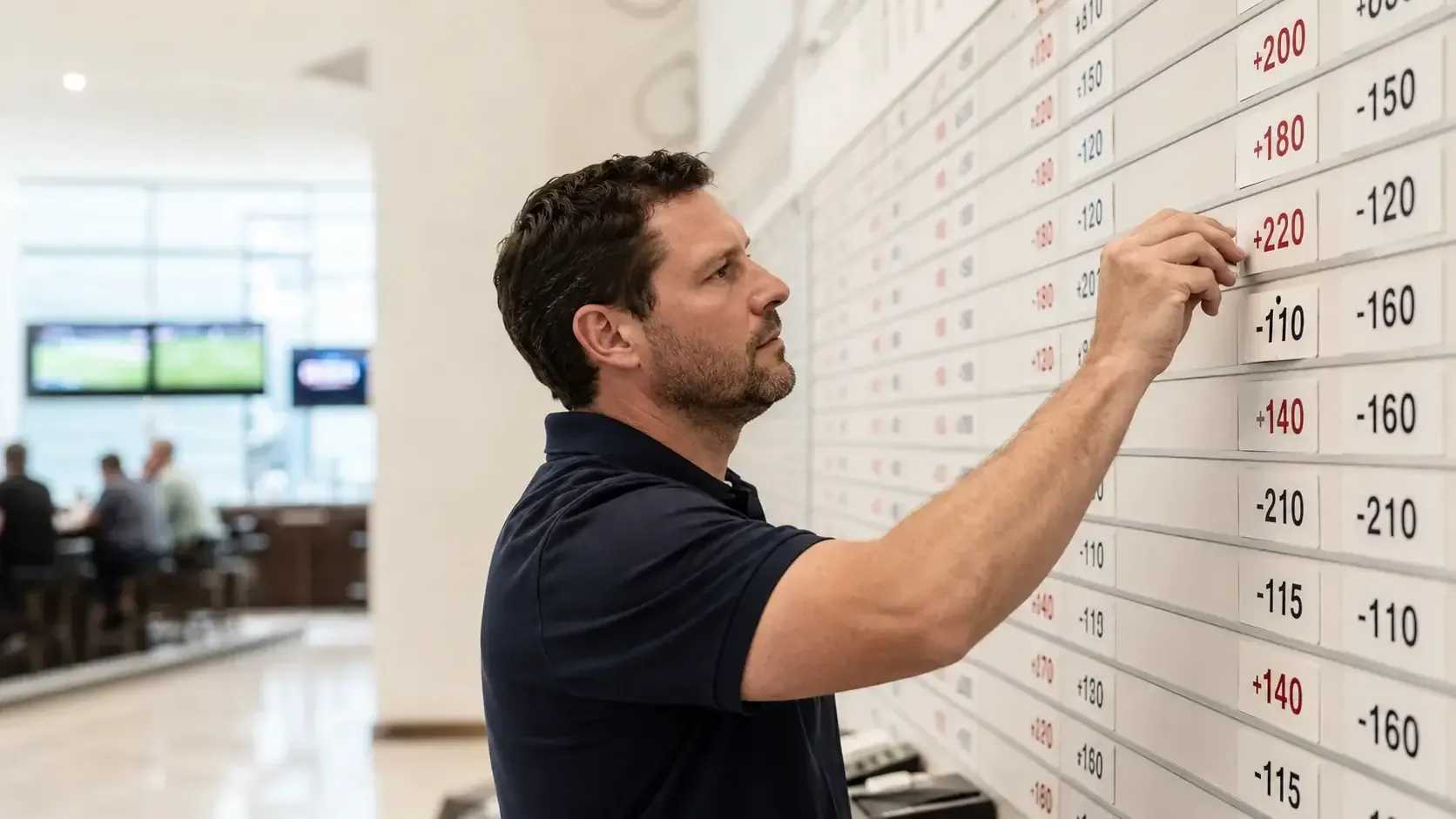
What Is Line Shading?
This article explains line shading, the pricing tactic sportsbooks use to adjust odds on popular bets, and shows bettors how to spot it and use it to their advantage.

Line shading in sports betting is when a sportsbook adjusts a point spread, total, or moneyline away from its true statistical value to make a popular bet more expensive. Sportsbooks do this because they know bettors overwhelmingly favor certain sides, like favorites and overs, and shading protects the house's margin against that predictable behavior.
Key Takeaways
- Line shading means a sportsbook prices a bet slightly worse than its true probability to protect its margin on popular sides.
- Favorites and overs get shaded most often because the betting public leans toward them by a wide margin.
- Shading can show up as extra juice (like -115 instead of -110) or as an extra half-point added to a spread or total.
- Comparing odds across multiple sportsbooks is the most reliable way to spot a shaded line and avoid overpaying.
- Line shading is a pricing strategy, not manipulation of game outcomes, and it differs completely from point shaving.
Quick Facts Box
| Category | Detail |
|---|---|
| Difficulty Level | Beginner to intermediate |
| Estimated Time to Learn | 15 to 20 minutes |
| Best Suited For | Bettors who compare odds across sportsbooks or bet favorites and totals regularly |
| Related Topic | Moneyline pricing and juice on straight bets |
Why Does Line Shading Matter for Sports Bettors?
Line shading matters because it directly affects how much value a bettor gets on a wager, even when the pick itself is correct. A shaded line can turn a break-even bet into a long-term loser simply by shaving a few percentage points off the payout. Bettors who understand line shading know when to shop for a better number instead of accepting the first price they see.
Line Shading vs. Standard Pricing: A Quick Comparison
| Feature | Standard (Centered) Line | Shaded Line |
|---|---|---|
| Pricing Basis | Reflects true statistical probability of the outcome | Skewed to make the popular side more expensive |
| Typical Odds | -110/-110 on a spread | -115 or -120 on the favored side |
| Who It Targets | All bettors equally | Public bettors on favorites and overs |
| Sportsbook Goal | Balance action on both sides | Increase margin without balancing action |
| Bettor Response | Bet either side with confidence | Shop for a better number or take the other side |
What Does It Mean When a Sportsbook Shades a Line?
When a sportsbook shades a line, it means the book has intentionally priced a bet away from its true probability to squeeze more profit out of one-sided action. Instead of setting a spread or total exactly where the numbers say it should sit, the book nudges it in a direction that costs the bettor more to take the popular side. This same logic applies to moneyline bets, where a book might shift the price on a favorite from -200 to -220 even though the true odds haven't changed.
A 2016 industry analysis found that shading a line by even a single percentage point can raise a sportsbook's profit margin significantly over a full season of action. That's because the public consistently gravitates toward favorites and overs, so a small shift compounds across thousands of bets.
How Does Line Shading Show Up on Point Spreads and Totals?
Line shading on point spreads and totals typically appears as an extra half-point or full point tacked onto the number, rather than a change in the juice. A true line might have a favorite at -6 with even -110 odds on both sides, but a shaded version could push that number to -6.5 while keeping the odds the same. Sportsbooks that operate in different markets around the world often price the same game differently, and shifts between American and European formats can make shading harder to spot at a glance.
Why Do Favorites and Overs Get Shaded More Than Underdogs and Unders?
Favorites and overs get shaded more often than underdogs and unders because the betting public consistently prefers them, regardless of the actual matchup. Bettors like backing the team expected to win, and overs simply feel more exciting to watch than a low-scoring under. Sportsbooks recognize this pattern and adjust pricing on those sides to capture extra margin before the public even places a wager.
How Do Sportsbooks Decide Which Lines to Shade?
Sportsbooks decide which lines to shade by tracking betting patterns, matchup popularity, and how much attention a game is getting from the public. High-profile primetime matchups, marquee franchises, and games with heavy local fan interest are prime candidates for shading because they draw lopsided action. A book catering mostly to recreational bettors has more incentive to shade than one built for sharp, high-limit players, since the recreational crowd is less likely to notice or react to a worse number.
Line Shading Examples
Real-world scenarios make the concept easier to spot in practice. Here are two common situations where line shading plays out at the betting window.
- Primetime favorite: A star quarterback's team is favored by 6 points against a divisional rival on Sunday Night Football. The true number might be -6 at even odds, but the book shades it to -6.5 or bumps the price to -120, knowing the public will bet the favorite regardless.
- Popular total: Two high-scoring NBA teams meet, and the public expects fireworks. The true total might be 228.5, but the book shades it up to 230 or raises the over's juice to -115, betting that fans will take the over anyway.
- Alternate markets: A bettor eyeing a spot bet on a specific game situation may notice the pricing looks worse than the underlying probability suggests, a sign the book has shaded that specific market to offset heavy demand.
What Common Mistakes Do Bettors Make With Line Shading?
The most common mistake bettors make with line shading is assuming every sportsbook prices a game the same way. Bettors who stick to a single book never see the shaded number next to a fair one, so they overpay without realizing it. Another frequent error is confusing line shading with match manipulation, when in reality shading is purely a pricing decision that has nothing to do with how the game is played.
- Betting the first number seen instead of comparing prices across multiple sportsbooks.
- Assuming a shaded favorite is always the smarter side simply because it's shaded toward popularity.
- Confusing line shading with point shaving, which involves players deliberately affecting the score.
- Ignoring alternate lines or teasers that can offset a shaded number on the main market.
How Does Line Shading Compare to Hedging a Bet?
Line shading and hedging serve opposite purposes for a bettor, even though both involve managing risk around a wager. Shading is something the sportsbook does to the price before a bet is placed, while hedging a bet is a strategy a bettor uses after placing a wager to lock in profit or limit a loss. Recognizing a shaded line before betting can help a bettor avoid needing to hedge later, since a better initial price reduces the pressure to protect against a bad outcome.
Line Shading vs. Hedging: Key Differences
| Concept | Who Controls It | When It Happens | Purpose |
|---|---|---|---|
| Line Shading | The sportsbook | Before the bet is placed | Protect the book's margin on popular sides |
| Hedging | The bettor | After the bet is placed | Lock in profit or reduce potential loss |
Bodog Insight: Making Line Shading Work for You
Line shading isn't a scandal or a trick designed to cheat bettors. It's a pricing reality built on the predictable habit of backing favorites and overs, and once a bettor recognizes the pattern, it becomes far easier to navigate. Comparing numbers across sportsbooks before placing a wager remains the simplest way to sidestep a shaded price and capture real value.
Bodog treats transparent pricing as a competitive advantage, not an afterthought. Smart bettors don't just pick winners. They pick the best number available for that winner, and that habit compounds into real long-term profit.
Line Shading FAQs
Is line shading legal?
Yes, line shading is a completely legal pricing practice used by licensed sportsbooks worldwide. It involves adjusting odds or point spreads, not altering the outcome of a game, which keeps it well within regulatory bounds.
How can I tell if a line is shaded?
The clearest way to tell if a line is shaded is to compare the same game's odds across several sportsbooks. If one book's number is noticeably worse than the consensus, particularly on a popular favorite or over, that's a strong sign of shading.
Do all sportsbooks shade their lines the same way?
No, sportsbooks that cater to recreational bettors tend to shade lines more aggressively than sharper, high-limit books. Books built for professional bettors generally price closer to the true number because their customers will quickly exploit any gap.
Is line shading the same as point shaving?
No, line shading and point shaving are entirely different concepts. Line shading is a legal pricing adjustment made by sportsbooks, while point shaving is an illegal scheme where players intentionally affect a game's final margin.
Does line shading affect underdogs too?
Line shading can affect underdogs, but it happens far less often than with favorites. Since the betting public rarely favors the underdog, sportsbooks have less incentive to shade that side of the number.
Can shopping for lines really beat shading?
Yes, consistently shopping for the best available line is one of the most effective ways to offset the impact of shading over time. Even small differences of a half-point or a few cents of juice add up significantly across a full season of bets.
Continue Learning
- The Lines Between US and European Betting Are Blurring: a look at how odds formats and pricing habits differ across global betting markets.
- What Is a Same Game Teaser?: a breakdown of how teaser bets adjust lines and how that pricing compares to standard spreads.
Sources & Review
Arthur Crowson got his start in traditional newspapers before making the jump to digital media, where he's spent the last ten years writing about poker, finance, crypto, gambling, and emerging tech. Over that time, he's developed a knack for spotting the moments when markets, technology, and gambling pull in the same direction. His work has appeared in publications like PokerListings, CryptoVantage, ValueWalk, and PokerScout.
More Articles like this
How Bad Is It? Ranking the NHL's Original Six by Fan Misery
Nearly 60 years without a Stanley Cup is just the beginning. We rank the NHL's Original Six teams by how much misery their fans have endured.
By Bill Gelman
Why Does Everybody Hate Us? 10 Most Hated Sports Teams Ever
Some teams always win; others get caught breaking the rules. Either extreme is a surefire way to become universally hated, as these 10 sports teams can attest to.
By Stuart Hughes
5 Outrageous Sports Rules That Need to Die
From a missed signature disqualification to a two-minute penalty for a tucked-in jersey, find out about the top five dumbest rules in sport that leave common sense in the locker room.
By Stuart Hughes
The 10 Most Unforgettable Quotes in Sports History
From Jordan's hard truths to Healy's cheeseburger dig, these legendary greats uttered 10 iconic quotes that turned out to be as memorable as their sporting achievements.
By Stuart Hughes
Eight Years, Eight NBA Champions. Is Parity Here to Stay?
Eight different teams have won the NBA championship in eight years, the longest such streak in league history. Can the Knicks finally break the cycle, or will another contender claim the crown?
By Bill Gelman
Is This the Biggest Acquisition Era in Sports Betting History?
Sportsbooks, prediction markets, and sweepstakes apps are fighting for the same customers. We compared 11 welcome offers to see who's offering the biggest incentives.
By Cole Rush