
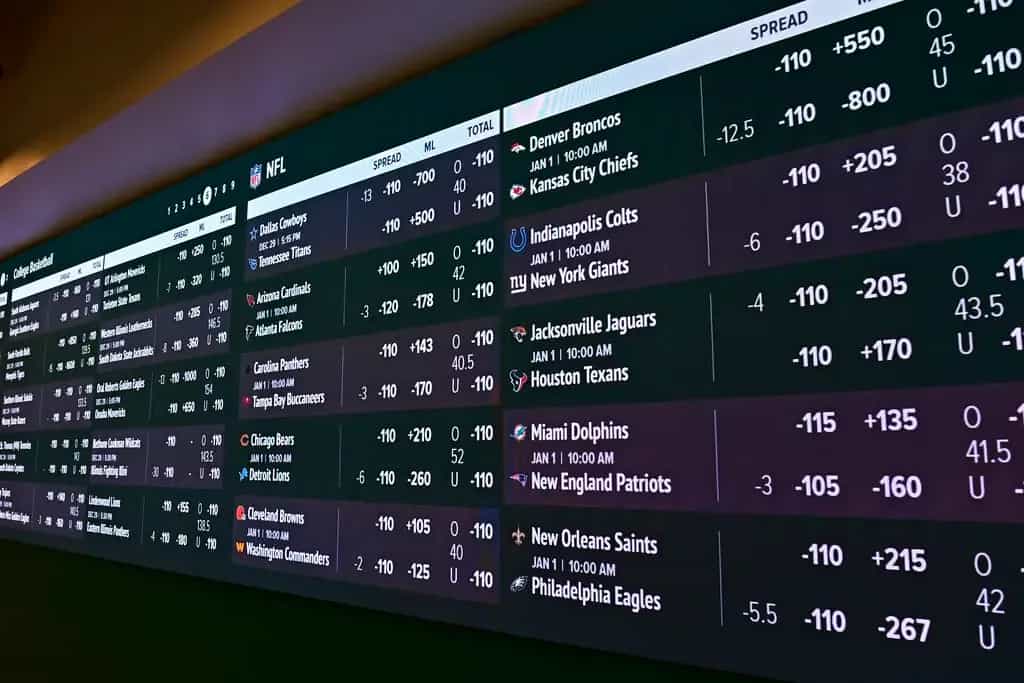
What Is Expected Value in Sports Betting?
A breakdown of expected value in sports betting, how to calculate it, and why it separates disciplined bettors from bettors relying on gut feel.

Expected value in sports betting is the average profit or loss you'd earn if you placed the same bet at the same odds over and over. A bet with positive expected value is mathematically profitable long term, even if it loses on any given night.
Key Takeaways
- Expected value in sports betting measures long-run profit potential, not the outcome of a single wager.
- The formula weighs your win probability against the payout, then subtracts the weighted cost of losing.
- Positive EV (+EV) bets are worth taking repeatedly; negative EV (-EV) bets drain your bankroll over time.
- Sportsbook odds already contain a built-in margin, so beating that margin requires sharper probability estimates than the book's.
- Tracking closing line value is one of the clearest ways to confirm your bets actually carry positive expected value.
Quick Facts Box
| Category | Detail |
|---|---|
| Difficulty Level | Moderate (requires basic probability math) |
| Estimated Time to Learn | 30 to 45 minutes for the formula, weeks of practice to apply it well |
| Best Suited For | Bettors moving past gut-feel picks toward a repeatable, numbers-based strategy |
| Related Topic | Implied probability and odds conversion |
Why Does Expected Value Matter in Sports Betting?
Expected value matters in sports betting because it's the only metric that tells you whether a bet is mathematically worth making, separate from whether you feel confident about it. A bettor can go 8-2 on a run of negative EV bets and still be broke a year later once variance evens out. Understanding EV shifts the entire decision-making process from "who do I think wins" to "does this price actually pay me enough for the risk."
Quick Look: Expected Value Outcomes
| Scenario | Win Probability | Odds | Stake | Expected Value |
|---|---|---|---|---|
| Underdog, market undervalues team | 45% | +150 | $20 | +$2.50 |
| Favorite, priced roughly fair | 60% | -150 | $100 | -$0.67 |
| Coin-flip game at standard vig | 50% | -110 | $110 | -$5.24 |
What Does the Expected Value Formula Look Like in Sports Betting?
The expected value formula in sports betting multiplies your win probability by the potential profit, then subtracts your loss probability multiplied by the amount staked. The formula for EV is commonly given as EV equals probability of winning times potential profit, minus probability of losing times amount staked, which is essentially the average win minus the average loss. Getting an accurate probability estimate usually starts with converting a sportsbook's odds into an implied probability so you have a baseline to compare against your own projection.
Once you have both numbers, the math is arithmetic rather than guesswork. For a $100 bet at plus-150 odds with a 45 percent win probability, the expected value works out to 0.45 times $150 minus 0.55 times $100, which equals plus $12.50. That $12.50 figure represents your average profit per $100 wagered if you made that exact bet repeatedly.
How Does Implied Probability Connect to Expected Value in Sports Betting?
Implied probability connects directly to expected value in sports betting because it's the number you're arguing against every time you make a wager. If you bet an underdog at plus-180 odds, the market's implied probability might sit at 35.7 percent, while your own model says the team actually wins 40 percent of the time. That gap between your number and the market's implied probability is where positive expected value lives.
The wider that gap in your favor, the higher your expected value on that specific bet. A one or two percentage point edge is real but thin. A five-point edge, if your model is sound, represents a much stronger long-term play.
Why Do Different Bet Types Change Expected Value Calculations in Sports Betting?
Different bet types change expected value calculations in sports betting because each format carries its own odds structure, vig, and variance profile. Moneylines, spreads, totals, and props all require you to separately estimate probability and compare it against the price offered, and the mechanics behind each of these betting types shift how much margin the book has baked in. Parlays compound the house edge across multiple legs, which typically makes positive EV far harder to find than on straight single bets.
Prop bets and futures often carry wider margins than mainline markets, meaning the bar for positive EV is higher on those wagers. A bettor chasing a same-game parlay for entertainment is playing a different game, mathematically, than one grinding single-game spreads for profit.
Why Does Positive Expected Value Matter More Than Win Rate in Sports Betting?
Positive expected value matters more than win rate in sports betting because win percentage alone says nothing about whether the payout justified the risk. Someone who understands and uses EV, even with limited sports knowledge, will often profit more than someone with deep sports knowledge who ignores EV, because expected value strips the decision down to the numbers. A bettor can win 55% of their bets and still lose money if the odds they accepted didn't compensate for the actual risk involved.
Examples of Expected Value in Sports Betting
Two worked scenarios show how expected value plays out differently depending on the matchup and the market.
Example 1: NFL Underdog With a Model Edge
An NFL underdog sits at plus-150 on the moneyline, implying a market probability near 40%. Your own research puts their true win chance at 45%, so a $20 bet nets an expected value of roughly plus $2.50, a modest but real edge worth taking repeatedly over a season.
Example 2: Early-Season MLB Volatility
Baseball odds tend to move more sharply in the season's first weeks as small samples and weather swing perceived probabilities, and understanding the added volatility in early-season MLB betting helps explain why EV calculations need wider error bars during that stretch. A line that looks like clear value in April can reflect nothing more than noise, so bettors should treat early-season probability estimates as less reliable than midseason numbers.
What Are the Most Common Mistakes People Make With Expected Value in Sports Betting?
The most common mistake people make with expected value in sports betting is judging a bet by its result instead of its process. A losing bet made with a real probability edge was still a good decision, and a winning bet made on a bad price was still a mistake, even though it paid off.
- Confusing confidence with probability: feeling sure about a pick isn't the same as having an accurate win percentage.
- Ignoring the vig: sportsbook margin means even a true coin-flip bet at standard odds carries negative EV.
- Treating parlays like single bets: compounding odds across legs multiplies the house edge with each addition.
- Chasing losses: increasing stakes after a loss doesn't change the expected value of the next bet.
How Does Expected Value in Sports Betting Compare to Related Betting Concepts?
Expected value in sports betting compares closely to closing line value and to implied probability, though each measures a slightly different thing. Closing line value measures whether you consistently get better odds than the market's final price, and getting better odds than the close is a strong sign you're making positive expected value bets. Implied probability is simply the market's estimate baked into the odds, while EV is the profit calculation that results from comparing that estimate against your own.
Comparing Concepts
| Concept | What It Measures | How It's Used |
|---|---|---|
| Expected Value | Average profit or loss per bet over time | Decides whether a specific wager is worth placing |
| Implied Probability | The win chance baked into a given price | Provides the baseline to compare against your own model |
| Closing Line Value | Your odds versus the market's final price | Confirms whether your EV edge held up against the sharpest number |
Sports betting markets also share DNA with prediction markets, where contracts are priced on probability rather than fixed odds, and comparing how prediction markets stack up against traditional sports betting shows both formats reward the same underlying skill: pricing outcomes more accurately than the crowd.
Bodog Insight: Expected Value in Sports Betting
Expected value in sports betting is the difference between gambling and investing with a calculator. The formula itself is simple arithmetic, but the discipline to only bet when your number beats the book's number is where most bettors fall short. At Bodog, we treat EV as the baseline test for every wager, not a nice-to-have concept reserved for spreadsheet enthusiasts. Run the math before the bet, not after the final score.
Expected Value FAQs
What does positive expected value mean in sports betting?
Positive expected value means a bet is mathematically profitable if placed repeatedly at the same odds, even though any single instance can still lose.
Can a bet have positive expected value and still lose?
Yes. A single bet losing doesn't disprove positive EV, since expected value describes the average outcome across many repeated bets, not one result.
How do I calculate expected value for a moneyline bet?
Multiply your estimated win probability by the potential profit, then subtract your loss probability multiplied by the stake, giving you the average profit or loss per bet.
Why do sportsbooks always have an edge over bettors?
Sportsbooks build a margin, commonly called the vig, into their odds, which means even a true 50/50 game priced at standard juice carries negative expected value for the bettor.
Is closing line value the same thing as expected value?
No. Closing line value compares your odds to the market's final price, while expected value calculates the actual profit math behind a bet, though positive CLV is a strong signal of positive EV.
Does a high win rate guarantee positive expected value?
No. Win rate alone ignores the price paid for each bet, so a bettor can win most of their wagers and still show negative expected value if the odds were poor.
Continue Learning
- What Is Expected Value in Poker? — see how the same core concept applies at the poker table.
- Why People Love Betting on Sports They Barely Understand — a look at how emotion overrides sound probability thinking.
- Why Sports Stars Keep Making the Same Money Mistakes — a breakdown of decision-making errors that mirror poor EV discipline.
- The Psychological Trap of Rivalry Betting — how bias clouds judgment on games that matter emotionally.
Sources & Review
Arthur Crowson got his start in traditional newspapers before making the jump to digital media, where he's spent the last ten years writing about poker, finance, crypto, gambling, and emerging tech. Over that time, he's developed a knack for spotting the moments when markets, technology, and gambling pull in the same direction. His work has appeared in publications like PokerListings, CryptoVantage, ValueWalk, and PokerScout.
More Articles like this
Do NHL Stars Lose Their Edge After Signing Huge Contracts?
Do NHL stars really take their foot off the gas after a big payday? We analyzed 29 major contracts to find out.

By Charlon Muscat
Five Iconic World Series Moments Since the Brewers' Appearance
The Brewers are back in the World Series after 44 years. From Bill Buckner's error to the Cubs ending their curse, plenty has happened since 1982.

By Bill Gelman
LeBron to Giannis: Ranking 5 NBA Offseason Stunners
LeBron to Philly, Giannis to Miami, and Wemby staying put. Which NBA offseason move will pay off the most?
By Bill Gelman
NFL Fans Spend $900 to Watch Games. WWE Fans Pay Even More
Think watching every NFL game is expensive? WWE fans would argue otherwise.

By James Guill
How Bad Is It? Ranking the NHL's Original Six by Fan Misery
Nearly 60 years without a Stanley Cup is just the beginning. We rank the NHL's Original Six teams by how much misery their fans have endured.

By Bill Gelman
Why Does Everybody Hate Us? 10 Most Hated Sports Teams Ever
Some teams always win; others get caught breaking the rules. Either extreme is a surefire way to become universally hated, as these 10 sports teams can attest to.
By Stuart Hughes