
What Are Decimal Odds?
A plain-language breakdown of decimal odds, how to calculate payouts, and how this format compares to American and fractional odds for sports bettors.

Decimal odds are a sports betting probability format that shows your total payout, including your original stake, for every one dollar wagered. Multiply your stake by the decimal number and you get your full return before the bet even settles, a core piece of understanding betting odds at any sportsbook.
Key Takeaways About Decimal Odds:
- Decimal odds show total return per dollar wagered, stake included, in one clean number.
- The formula is simple: stake multiplied by decimal odds equals payout.
- Numbers below 2.00 mark favorites. Numbers above 2.00 mark underdogs.
- Decimal odds convert to implied probability with one calculation: 100 divided by the odds.
- They dominate betting markets in Europe, Canada, and Australia, and work well for parlay math.
Quick Facts
| Category | Detail |
|---|---|
| Difficulty Level | Beginner-Friendly |
| Estimated Time to Learn | 10 minutes |
| Best Suited For | New bettors and anyone comparing odds across international sportsbooks |
| Related Topic | American odds |
Why Does Understanding Decimal Odds Matter for Bettors?
Understanding decimal odds matters because it lets bettors calculate payouts instantly without memorizing separate formulas for favorites and underdogs. One multiplication does the job every time, whether the number is 1.50 or 5.00. That speed adds up across a season of wagers, especially when comparing lines between multiple sportsbooks before placing a bet.
What Do Decimal Odds Look Like Across Common Payouts?
Decimal odds look like straightforward numbers, usually shown to two decimal places, that represent a multiplier on your stake. The table below shows how common decimal prices translate into payouts and implied probability on a $100 bet.
Decimal Odds and the American Equivalents
| Decimal Odds | American Equivalent | Payout on $100 | Implied Probability |
|---|---|---|---|
| 1.50 | -200 | $150 | 66.7% |
| 1.91 | -110 | $191 | 52.4% |
| 2.00 | +100 | $200 | 50.0% |
| 2.50 | +150 | $250 | 40.0% |
| 4.00 | +300 | $400 | 25.0% |
How Do Decimal Odds Work in Sports Betting?
Decimal odds work by giving you a single number that represents your entire payout for every dollar risked, stake included. A price of 2.50 means a $10 bet returns $25 total if it wins, not $25 in profit. This is one reason bettors who learn how betting odds work across formats find decimal pricing the fastest to calculate on the fly.
How Do You Read Decimal Odds at a Sportsbook?
Reading decimal odds means scanning for numbers typically between 1.01 and double digits, with the lowest figure marking the favorite. A matchup showing 1.65 against 2.20 tells you the 1.65 side is expected to win more often. Bettors who practice how to read betting odds in this format quickly learn to spot mismatches versus toss-ups just by scanning the spread between two numbers.
How Do You Calculate Payouts With Decimal Odds?
Calculating payouts with decimal odds requires one multiplication: stake times odds equals total return. A $50 bet at 3.20 decimal odds returns $160, which breaks down to $110 profit plus the original $50 stake back. This single formula replaces the separate positive and negative calculations required by American odds.
How Do Decimal Odds Reveal Implied Probability?
Decimal odds reveal implied probability through one consistent calculation: 100 divided by the decimal number. Odds of 4.00 imply a 25% chance of winning, while odds of 1.25 imply an 80% chance. This probability estimate reflects the bookmaker's built-in margin, so it will always run slightly higher than the true chance of the outcome.
Where Are Decimal Odds Most Commonly Used?
Decimal odds are most commonly used across continental Europe, the United Kingdom's betting exchanges, Canada, and Australia. American sportsbooks default to moneyline pricing, but most platforms, including international betting exchanges, let bettors switch display formats with a single click. Bettors who follow soccer, tennis, or international racing will encounter decimal pricing constantly.
What Are Real Examples of Decimal Odds in Action?
Real examples of decimal odds show exactly how the multiplication formula plays out across different bet sizes and prices. These scenarios cover a favorite, an underdog, and a shopping situation that highlights why the exact number matters.
Example One: Betting on a Favorite
A bettor wagers $75 on a team priced at 1.40 decimal odds. Multiplying $75 by 1.40 gives a total payout of $105, meaning $30 profit on top of the returned stake.
Example Two: Betting on an Underdog
A bettor wagers $40 on a team priced at 3.75 decimal odds. Multiplying $40 by 3.75 gives a total payout of $150, meaning $110 profit if the underdog wins.
Example Three: Comparing Prices Across Books
A bettor sees the same team priced at 2.05 at one sportsbook and 2.15 at another. Shopping for the higher number turns a $100 bet from a $105 profit into a $115 profit, which is why bettors focused on finding the best available odds treat small decimal differences as real money.
What Are the Most Common Mistakes Bettors Make With Decimal Odds?
The most common mistake bettors make with decimal odds is confusing the total payout number with pure profit. A price of 2.00 does not mean you double your profit. It means your $100 bet returns $200 total, of which only $100 is actual winnings.
- Forgetting the stake is baked into the number, leading to overestimated profit expectations.
- Assuming decimal odds below 1.10 carry no real risk, when a loss still wipes out the full stake.
- Ignoring implied probability, which reveals the bookmaker's margin built into every price.
- Mixing up decimal and fractional formats when switching between sportsbooks or regions.
How Do Decimal Odds Compare to American and Fractional Odds?
Decimal odds compare to American and fractional odds mainly in how each format displays the same underlying probability. Decimal odds show total return per dollar, American odds use plus and minus signs around $100 units, and fractional odds show profit as a ratio to the stake. Bettors weighing American odds against decimal pricing often find the decimal version easier for quick mental math, especially on parlays where multiplying decimal numbers together works cleanly.
American vs. Decimal. vs. Fractional
| Format | Example | What It Shows | Common Region |
|---|---|---|---|
| Decimal | 2.50 | Total payout per $1 staked | Europe, Canada, Australia |
| American | +150 | Profit per $100 staked | United States |
| Fractional | 3/2 | Profit ratio to stake | United Kingdom, Ireland |
What Is the Bottom Line on Decimal Odds?
The bottom line on decimal odds is that they turn payout math into a single multiplication, which is why they dominate betting markets outside the United States. One number tells you the favorite, the underdog, the payout, and the implied probability all at once. Bodog bettors who get comfortable switching between formats gain an edge when comparing lines, because a half-point difference in decimal pricing can mean real dollars over a long betting session. Treat the decimal number as a tool for speed, not a shortcut around doing the math on value.
Decimal Odds FAQs
What do decimal odds of 1.00 mean?
Decimal odds of 1.00 mean there is no potential profit. You get your exact stake back with zero winnings, which sportsbooks almost never offer on an active market.
Are decimal odds better than American odds?
Decimal odds are not objectively better than American odds. They represent identical probabilities, but decimal pricing uses one consistent formula for every calculation instead of separate rules for favorites and underdogs.
How do you convert decimal odds to American odds?
For decimal odds of 2.00 or higher, subtract one and multiply by 100 for a positive American number. For decimal odds under 2.00, divide negative 100 by the decimal minus one.
Can decimal odds be negative?
Decimal odds cannot be negative. Every decimal price sits at 1.00 or above, since it represents your full payout multiplier rather than a profit ratio.
Why do European sportsbooks use decimal odds instead of American odds?
European sportsbooks use decimal odds because the format simplifies parlay calculations and gives bettors a direct read on total payout without extra conversion steps.
Do decimal odds include the original stake in the payout?
Decimal odds always include the original stake in the total payout figure. Subtract your stake from the result to find your actual profit on a winning bet.
What decimal odds number represents a 50-50 chance?
A decimal price of 2.00 represents a 50-50 chance, since 100 divided by 2.00 equals exactly 50% implied probability.
Where Can You Continue Learning About Decimal Odds?
- Fractional odds explained: a breakdown of how the UK's traditional ratio-based odds format works and how it compares to decimal pricing.
- Odds conversion calculator guide: a resource for switching quickly between decimal, American, and fractional formats.
- How to find the best odds: a guide to shopping lines across sportsbooks to squeeze extra value from every bet.
What Sources Support This Decimal Odds Guide?
The Bodog editorial team is comprised of experts in the iGaming, Sportsbetting, Lifestyle, Travel Wellness and Casino space.
More Articles like this
Why Does Everybody Hate Us? 10 Most Hated Sports Teams Ever
Some teams always win; others get caught breaking the rules. Either extreme is a surefire way to become universally hated, as these 10 sports teams can attest to.
By Stuart Hughes
5 Outrageous Sports Rules That Need to Die
From a missed signature disqualification to a two-minute penalty for a tucked-in jersey, find out about the top five dumbest rules in sport that leave common sense in the locker room.

By Stuart Hughes
The 10 Most Unforgettable Quotes in Sports History
From Jordan's hard truths to Healy's cheeseburger dig, these legendary greats uttered 10 iconic quotes that turned out to be as memorable as their sporting achievements.

By Stuart Hughes
Eight Years, Eight NBA Champions. Is Parity Here to Stay?
Eight different teams have won the NBA championship in eight years, the longest such streak in league history. Can the Knicks finally break the cycle, or will another contender claim the crown?
By Bill Gelman
Is This the Biggest Acquisition Era in Sports Betting History?
Sportsbooks, prediction markets, and sweepstakes apps are fighting for the same customers. We compared 11 welcome offers to see who's offering the biggest incentives.

By Cole Rush
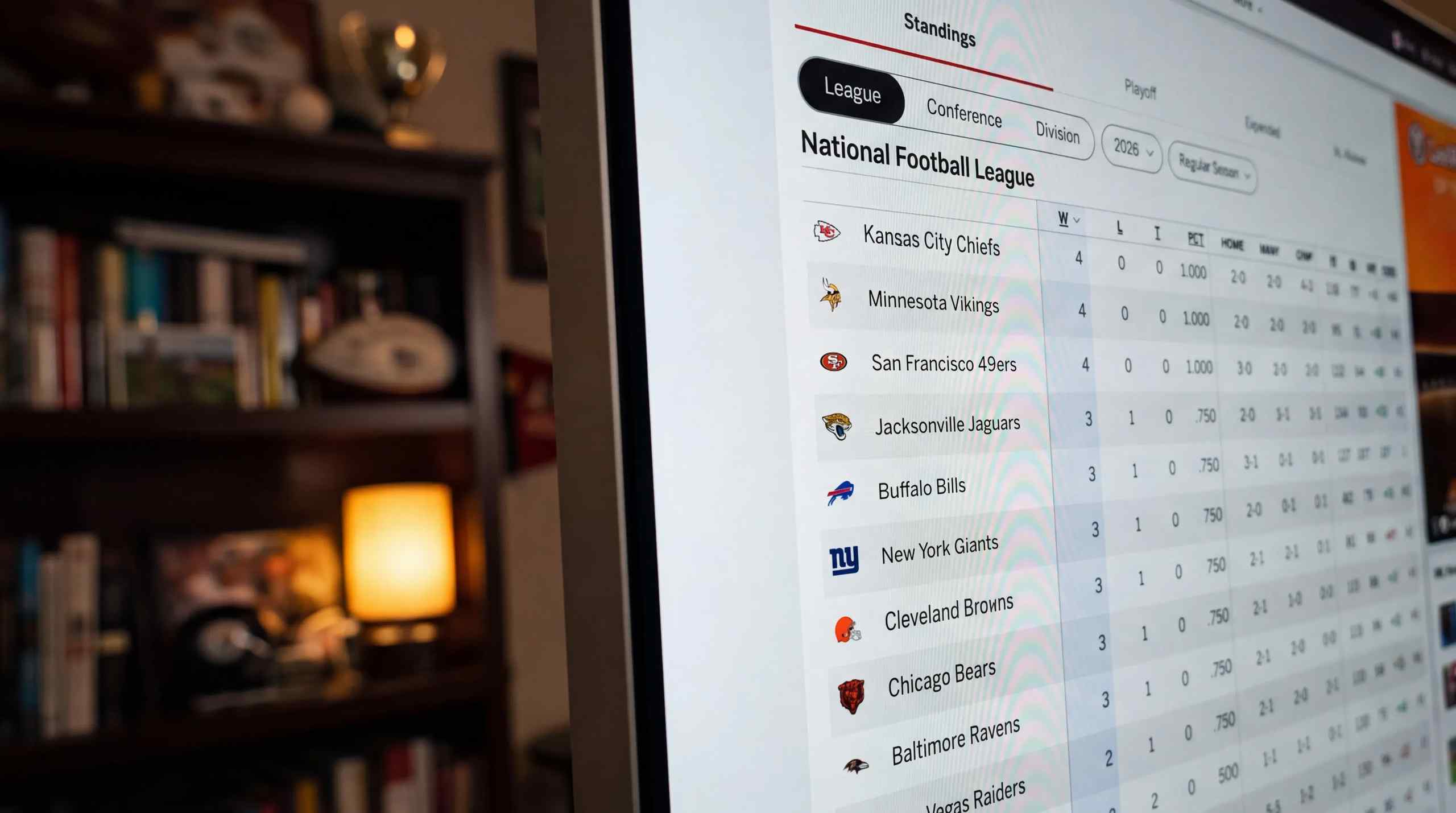
Does a 4-0 NFL Start Mean You're Playoff Bound?
A 4-0 start can put your team on the fast track to the playoffs, but history shows that even Super Bowl champions don't always start strong.
By Marcus Mosher