

Nevada Sports Betting: Is Sports Gambling Legal in Nevada in 2026?
Nevada sports betting has been legal since 1949 — but mobile registration rules, DFS restrictions, and active enforcement against prediction markets make it more nuanced than most bettors expect.

Nevada sports gambling is fully legal in 2026, both at retail sportsbooks and through licensed mobile betting apps. The Silver State has operated a regulated sports wagering market since 1949, making it the longest-running legal sports betting jurisdiction in the United States.
Nevada Sports Gambling: Legal Status Overview for 2026
Nevada has the most mature legal sports betting market in the United States, but "fully legal" does not mean "anything goes." Here is where the state stands in 2026:
- Retail sports betting: Legal and widely available at licensed sportsbooks in casinos and gaming establishments across Nevada.
- Online sports betting: Legal through mobile sportsbook apps operated by licensed Nevada books. Wagers must be placed while physically located in Nevada, and wagering accounts must be opened under Nevada's registration rules.
- Mobile wagering: Legal, but account registration is not a fully remote process. Patrons must present government-issued ID in person to establish an account, either at the book or at another approved location.
- Daily Fantasy Sports (DFS): Paid DFS is not a casual legal gray area in Nevada. In 2015, the NGCB concluded that pay-to-play DFS constitutes gambling under Nevada law and requires licensure. As a result, major national DFS operators have generally not offered paid contests in Nevada.
- Sweepstakes platforms: Not licensed by Nevada gaming regulators. Any site offering gambling-style products without Nevada licensure carries serious regulatory risk in this state.
- Prediction markets: Legally contested in Nevada. The NGCB has stated that sports event contracts are wagers under Nevada law and has taken enforcement action against Kalshi and Polymarket. The NGCB's posture toward Robinhood's sports event contracts has also been active, and Robinhood suspended such contracts pending broader legal battles.
- Online casino gambling: Nevada does not offer online casino gaming. It permits regulated interactive gaming, but the state's live online market is effectively limited to online poker rather than full iGaming.
- Minimum age for sports betting: 21 years old.
Regulatory bodies: The Nevada Gaming Control Board and Nevada Gaming Commission oversee licensed sports wagering and broader gaming activity.
BETTING-BY-REGION
BETTING-BY-REGION
Nevada
Mobile Sportsbooks
Prediction Markets
Online Casinos
Sweepstakes Casinos
Daily Fantasy Sports
How Nevada Sports Betting Became Legal: Legislative History and Regulatory Framework
Nevada did not "join" the post-2018 sports betting wave. It predates it by decades. Sports betting has been legal in Nevada since 1949, making the Silver State the first true U.S. jurisdiction for regulated sports wagering.
When Congress enacted the Professional and Amateur Sports Protection Act (PASPA) in 1992, the federal law that effectively banned sports betting in most states, Nevada was expressly grandfathered in as one of the few jurisdictions allowed to continue its existing sports gambling activity. Nevada imposes no state income tax, which puts it in a different position than bettors in states that rank among which states have the worst taxes on online sports betting, a distinction worth noting for anyone wagering across state lines.
The Supreme Court's landmark decision in Murphy v. NCAA in 2018 struck down PASPA for everyone else, but Nevada entered that new era as the incumbent, not the newcomer. Nevada's regulated market stands in sharp contrast to the situation in California, where retail and mobile sports wagering has faced repeated legislative and ballot-measure setbacks with no clear resolution in sight.
Nevada Mobile Sportsbook Apps
| Brand | Key Feature | App Store Rating |
|---|---|---|
| William Hill Nevada | One of the biggest statewide books, with broad market depth and 100+ registration locations | 4.7/5 |
| Caesars Sportsbook | Strong rewards ecosystem and polished national sportsbook experience | 4.7/5 |
| BetMGM Sports - Nevada | Major national brand with a full menu of pro and college betting markets | 4.8 |
| Boyd Sports | Good option for locals using Boyd properties like The Orleans, Suncoast, and Sam’s Town | 4.6/5 |
| Circa Sports Nevada | Best known for higher limits and a bettor-first reputation | 3.5/5 |
| STN Sports and Race | Station Casinos’ in-state app with wide coverage across Las Vegas locals properties | 2.1/5 |
| Wynn Sports Nevada | Clean, simpler interface tied to Wynn Las Vegas | 4.7/5 |
| The SuperBook | Deep menu and strong brand recognition with longtime Vegas bettors | 2.8/5 |
| SouthPoint Sports | Reliable, straightforward app with strong reviews for usability | 4.5/5 |
| Peppermill Sports | Northern Nevada-focused option with direct sportsbook support | 4.2/5 |
| Atlantis Sports Nevada | Reno-based option with low minimums and local-market appeal | 3.6/5 |
| Rampart Sports | Summerlin-friendly locals book with a solid user rating | 4.5/5 |
| Baldini’s Sports | Small local book with mobile funding and in-game betting | 4.4/5 |
| Boomer’s Sportsbook | Newer independent Nevada book with mobile deposits and withdrawals | 4.7/5 |
| ResortsWorld Las Vegas–Digital | Strip-based app with 24/7 wagering and live in-game markets | 4.4/5 |
| CG Sportsbook | Smaller Nevada book with statewide mobile wagering | 2.5/5 |
The app ratings listed above reflect user scores, but independent reviews of Nevada-licensed sportsbooks often surface more granular detail on withdrawal speeds, limit structures, and customer service quality.
Why aren’t FanDuel and DraftKings available in Nevada?
Because neither company runs a regulated Nevada sportsbook. Nevada’s market works differently from most states: sportsbooks generally need a licensed in-state casino presence, and mobile betting usually still requires in-person account registration. FanDuel and DraftKings do not currently have live Nevada sportsbook apps under that model.
There is also a regulatory conflict. In late 2025, the Nevada Gaming Control Board said DraftKings withdrew its pending Nevada sportsbook-related applications and stated that both FanDuel and DraftKings intended to engage in unlawful sports event-contract activity in Nevada, which the Board said was incompatible with participating in the state’s gaming industry.
The bottom line: if you’re in Nevada, you can still bet online through licensed local sportsbook apps, but FanDuel and DraftKings are not among them. Nevada’s casino-based licensing system and the recent dispute over prediction-style contracts are the main reasons why.
Nevada Online Gambling Summary by Product
| Product | Status | Notes |
|---|---|---|
| Online Sports Betting | ✅ Legal | Legal and regulated, but Nevada generally requires in-person registration for mobile sportsbook accounts. |
| Online Poker | ✅ Legal | Legal and regulated. Nevada’s Gaming Commission lists licensed interactive gaming operators including WSOP and Real Gaming. |
| Daily Fantasy Sports | ❌ Restricted | Nevada treats paid DFS as gambling that requires a gaming license, and major unlicensed DFS operators pulled out years ago. |
| Online Casinos | ❌ Illegal | Full online casino play is not authorized. Nevada’s interactive gaming framework is limited, in practice, to licensed online poker rather than slots and table games. |
| Prediction Markets | ❌ Restricted | Nevada regulators are actively blocking sports and other event-contract platforms; the NGCB recently obtained a TRO against Kalshi and says these contracts are wagering under Nevada law. |
| Sweepstakes Casinos | ⚠️ Blocked | Not state-regulated, and Nevada’s enforcement posture is increasingly hostile toward unlicensed online gambling. Availability is uncertain and risky. |
Nevada Online Gambling Alternatives: Poker, DFS, Sweepstakes, and What's Actually Legal
The online gambling conversation in Nevada is more complicated than the state's reputation suggests. Sports betting is legal. Full online casino gaming is not. Online poker exists within a regulated framework, but the broader digital casino market does not mirror New Jersey, Michigan, or Pennsylvania.
Online Poker in Nevada: The One Legal iGaming Exception
Nevada permits regulated interactive gaming, and in practice that means online poker rather than a full menu of online casino games. Nevada remains one of the few states with a legal online poker framework, a structure built on the same licensing and oversight principles that govern retail casino gaming. However, Nevada has not expanded that structure into full statewide iGaming. So if a bettor is asking whether Nevada allows legal online blackjack, roulette, or slot apps from state-licensed operators, the answer is still no. The state's online gambling footprint is deliberately narrow, reflecting a regulatory philosophy that prioritizes control over market breadth.)
Nevada's online poker market operates under a shared liquidity agreement with New Jersey, Michigan, and Pennsylvania, allowing players from all three states to compete at the same tables. This interstate compact expands the player pool for Nevada's online poker operators and reflects the state's willingness to innovate within its existing regulatory framework, even while resisting the broader iGaming expansion seen in other states.
Daily Fantasy Sports (DFS) in Nevada: A Licensing Requirement, Not a Gray Area
In 2015, the NGCB issued formal notices stating that pay-to-play daily fantasy sports constitutes gambling under Nevada law and requires licensing. That legal position sharply distinguishes Nevada from states where DraftKings and FanDuel continue accepting paid fantasy entries under looser or undefined rules. Major national DFS operators have generally not offered paid contests in Nevada without first obtaining Nevada gaming approval.
The DFS licensing requirement also has broader implications for the state's approach to skill-versus-chance determinations. Nevada's regulators have consistently taken the position that if a product involves wagering real money on uncertain outcomes, regardless of how much skill is involved, it falls within the state's gaming licensing framework. That is a more expansive definition of gambling than most states apply, and it is one reason Nevada's regulatory environment is considered among the strictest in the country.
Sweepstakes Platforms in Nevada: High Risk, No License
Sweepstakes casinos and sweepstakes sports products are not part of Nevada's licensed gaming structure. Because Nevada treats unlicensed gambling activity more aggressively than most states, these sites carry unusually high legal risk in the Silver State. Nevada's 2025 enforcement changes and broader anti-unlicensed-gaming posture make this one of the least forgiving states for operators trying to hide behind creative legal labels. Bettors who use sweepstakes platforms while physically present in Nevada should understand that those products operate entirely outside the state's consumer protection framework: there is no NGCB recourse if something goes wrong.
Prediction Markets in Nevada: Legal Status, Enforcement Actions, and What Bettors Need to Know
Prediction markets, platforms that allow users to buy and sell contracts based on the outcome of real-world events, including sports results, have emerged as one of the most contested legal battlegrounds in U.S. gambling regulation. In Nevada, the NGCB has taken an unambiguous position: sports event contracts are wagers under Nevada law, and any platform offering them without a Nevada gaming license is operating illegally in the state.
The distinction between prediction markets and traditional sports betting is largely structural rather than substantive. A prediction market contract that pays out based on whether the Las Vegas Raiders win a game is, from Nevada's regulatory perspective, functionally identical to a sports wager placed at a licensed Nevada sportsbook. The NGCB has made clear that labeling a product as a "financial contract" or "event contract" does not exempt it from Nevada's gaming licensing requirements if the underlying product resembles sports betting.
Nevada regulators have been explicit and aggressive in enforcement. The NGCB issued a cease-and-desist order to Kalshi, in March 2025, directing it to stop offering sports and election event contracts to Nevada residents. Kalshi fought back in court, and for several months operated under its own injunction, but a federal judge sided with the NGCB in November 2025 and dissolved that protection. Nevada courts have since ordered Kalshi to implement geofencing against Nevada users, and as of mid-2026 the NGCB is pursuing a contempt finding over alleged continued access, a request the Nevada Supreme Court has so far declined to block.
Polymarket has faced a similar trajectory. The NGCB filed a civil enforcement action against Polymarket in January 2026, and a Nevada court granted a preliminary injunction in May 2026 barring Polymarket from offering event contracts to Nevada residents, despite Polymarket's relaunch in December 2025 as a CFTC-regulated exchange through its QCX LLC subsidiary. Nevada's position is that state gaming law governs sports-outcome contracts regardless of federal derivatives registration.
Robinhood, facing the same legal theory, agreed to suspend its sports event contracts in Nevada effective December 1, 2025, after a federal judge denied its request to block the NGCB's position, pending the outcome of the broader litigation.
The broader legal tension here is significant. Prediction market platforms are regulated at the federal level by the Commodity Futures Trading Commission (CFTC), which asserts jurisdiction over event contracts. Nevada's NGCB disagrees as applied to sports-outcome contracts and has pursued state-level enforcement, backed by court rulings, even as the federal jurisdictional question remains unresolved. The outcome will shape not just Nevada's market, but the national prediction-market industry.
For Nevada bettors, the practical takeaway is unchanged: prediction market platforms offering sports-outcome contracts are not legally operating in Nevada, and using them while physically present in the state carries legal risk, with none of the consumer protections that come with Nevada's licensed sports betting system.
Nevada Betting Rules, Age Requirements, and Responsible Gambling Protections
The minimum age to place a legal sports bet in Nevada is 21. That age standard applies to sportsbook wagering and aligns with the state's broader casino gaming framework.
Nevada's sportsbook rules are stricter than they appear from the outside. Mobile betting is legal, but wagers must be placed from within Nevada. Sportsbook accounts must be established under the state's in-person identity-verification requirements. Operators must follow internal control systems, approved communications technology rules, and detailed recording and account-wagering standards.
Nevada also maintains a robust responsible gambling framework. The NGCB directs patrons to problem gambling assistance resources including the Nevada Council on Problem Gambling, the National Council on Problem Gambling, Gamblers Anonymous, and the national 1-800-GAMBLER helpline. Licensed Nevada sportsbooks are required to display responsible gambling information and provide self-exclusion options to patrons who request them. Nevada's self-exclusion program, administered through the NGCB, allows individuals to voluntarily ban themselves from all licensed gaming establishments in the state, including sportsbooks.
Nevada has continued updating its regulatory and policy discussions around problem gambling as online and mobile products evolve. Bettors who have concerns about their gambling behavior are encouraged to use the resources available through the NGCB's problem gambling page.
Nevada Online Gambling FAQs
Is sports gambling legal in Nevada?
Yes. Sports gambling is fully legal in Nevada at licensed retail sportsbooks and through licensed mobile sportsbook apps connected to Nevada books. Nevada has operated a regulated sports wagering market since 1949 and remains one of the most tightly controlled betting jurisdictions in the United States.
Do I have to register in person for a Nevada sportsbook app?
In most cases, yes. Nevada regulations require patrons to present government-issued photo identification in person to a sportsbook employee or another approved affiliated location before the wagering account can be activated. Once registered, the mobile app can be used for all subsequent wagers placed within Nevada.
What is the minimum age to bet on sports in Nevada?
The minimum age for legal sports betting in Nevada is 21. This applies to both retail sportsbook wagering and mobile app betting, and aligns with Nevada's broader casino gaming age requirement.
Are sweepstakes sportsbooks legal in Nevada?
Sweepstakes sportsbooks and sweepstakes casino platforms are not licensed by Nevada gaming regulators. Nevada has one of the country's toughest stances toward unlicensed gambling activity, and these platforms carry significant legal risk for both operators and users within the state.
Are prediction markets like Kalshi or Polymarket legal in Nevada?
Their legal status in Nevada is not just contested, it's been tested in court, and Nevada has been winning. The NGCB issued a cease-and-desist order to Kalshi in March 2025; after Kalshi sued, a federal judge sided with Nevada in November 2025 and the state has since pursued contempt proceedings over alleged continued access. The NGCB filed a civil enforcement action against Polymarket in January 2026, and a Nevada court granted a preliminary injunction against Polymarket in May 2026, barring it from offering sports event contracts to Nevada residents. The NGCB maintains that sports event contracts are wagers under Nevada law and require a Nevada gaming license, regardless of federal derivatives registration.
Does Nevada allow online casino gambling?
Not in the full sense. Nevada permits regulated interactive gaming, but its live online market is effectively limited to online poker rather than a full suite of iGaming products. Nevada does not currently offer state-licensed online blackjack, roulette, or slot apps in the way that states like New Jersey, Michigan, or Pennsylvania do.
How is Nevada sports betting taxed?
Nevada sportsbooks pay a monthly percentage fee on gross gaming revenue under the state's nonrestricted gaming tax structure: 3.5% on the first $50,000, 4.5% on the next $84,000, and 6.75% on revenue above $134,000. Individual bettors benefit from the fact that Nevada has no state income tax, meaning sports betting winnings are not subject to state-level income taxation, though federal tax obligations still apply.
What responsible gambling resources are available in Nevada?
Nevada offers several responsible gambling resources for bettors who need support. The NGCB directs patrons to the Nevada Council on Problem Gambling, the National Council on Problem Gambling, Gamblers Anonymous, and the national 1-800-GAMBLER helpline. Nevada also operates a statewide self-exclusion program that allows individuals to voluntarily ban themselves from all licensed gaming establishments, including sportsbooks. Licensed operators are required to display responsible gambling information and provide self-exclusion options to patrons upon request.
Bodog’s Sports Betting Guides by State
At Bodog, we feature up-to-date coverage of sports betting in each state. Explore the following list and find our authoritative guide to sports betting in your home state.
Alabama
Alaska
Arizona
Arkansas
California
Colorado
Connecticut
Delaware
Florida
Georgia
Hawaii
Idaho
Illinois
Indiana
Iowa
Kansas
Kentucky
Louisiana
Maine
Maryland
Massachusetts
Michigan
Minnesota
Mississippi
Missouri
Montana
Nebraska
New Hampshire
New Jersey
New Mexico
New York
North Carolina
North Dakota
Ohio
Oklahoma
Oregon
Pennsylvania
Rhode Island
South Carolina
South Dakota
Tennessee
Texas
Utah
Vermont
Virginia
Washington
West Virginia
Wisconsin
Wyoming
James Guill is an experienced iGaming journalist with a diverse background spanning IT, poker, and online gambling media. With over 20 years in the industry, he’s covered a wide range of gaming topics and has been featured in outlets like USA Today and G4 TV.
More Articles like this
Why Does Everybody Hate Us? 10 Most Hated Sports Teams Ever
Some teams always win; others get caught breaking the rules. Either extreme is a surefire way to become universally hated, as these 10 sports teams can attest to.
By Stuart Hughes
5 Outrageous Sports Rules That Need to Die
From a missed signature disqualification to a two-minute penalty for a tucked-in jersey, find out about the top five dumbest rules in sport that leave common sense in the locker room.
By Stuart Hughes
The 10 Most Unforgettable Quotes in Sports History
From Jordan's hard truths to Healy's cheeseburger dig, these legendary greats uttered 10 iconic quotes that turned out to be as memorable as their sporting achievements.

By Stuart Hughes
Eight Years, Eight NBA Champions. Is Parity Here to Stay?
Eight different teams have won the NBA championship in eight years, the longest such streak in league history. Can the Knicks finally break the cycle, or will another contender claim the crown?
By Bill Gelman
Is This the Biggest Acquisition Era in Sports Betting History?
Sportsbooks, prediction markets, and sweepstakes apps are fighting for the same customers. We compared 11 welcome offers to see who's offering the biggest incentives.

By Cole Rush
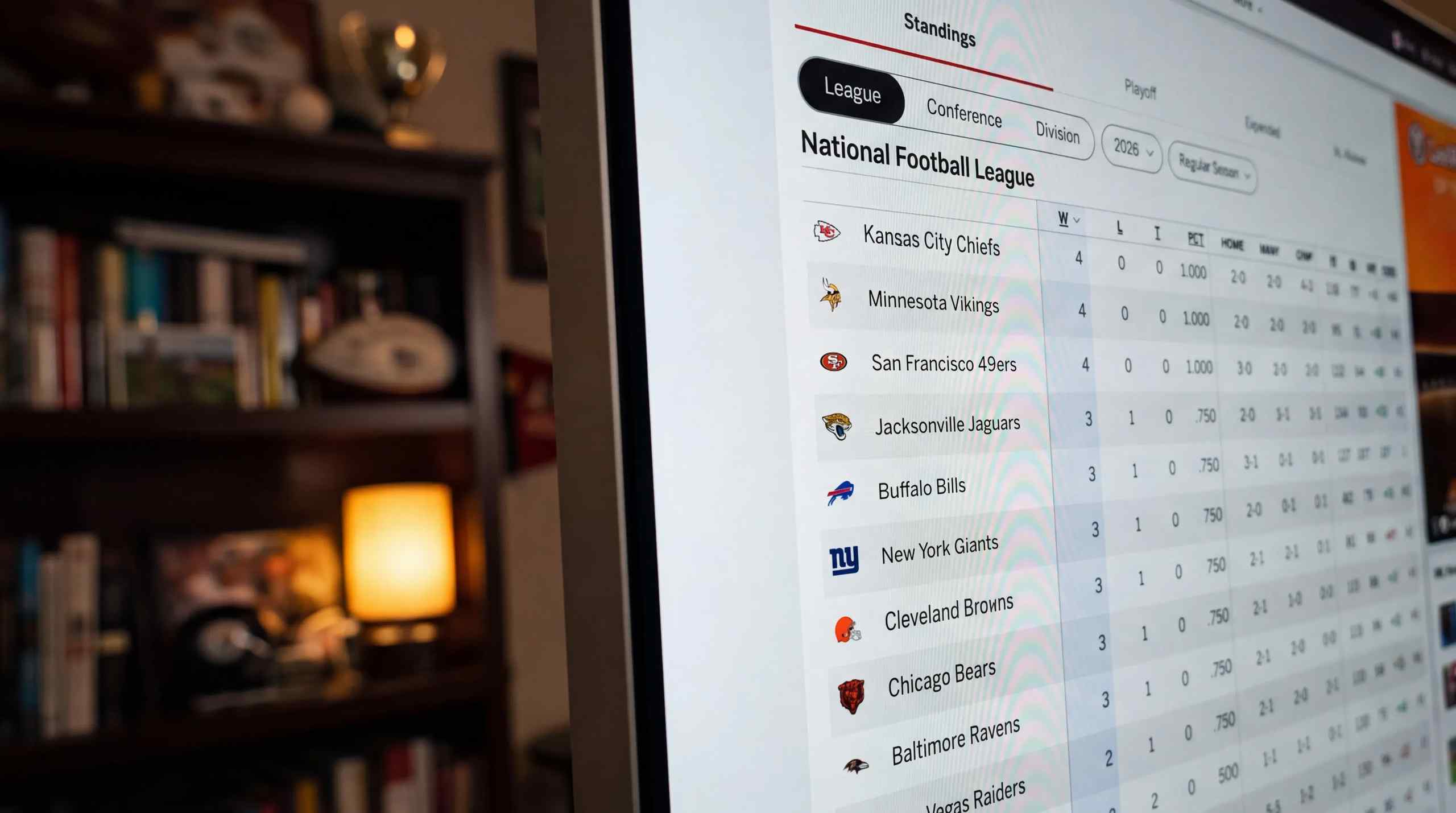
Does a 4-0 NFL Start Mean You're Playoff Bound?
A 4-0 start can put your team on the fast track to the playoffs, but history shows that even Super Bowl champions don't always start strong.
By Marcus Mosher