
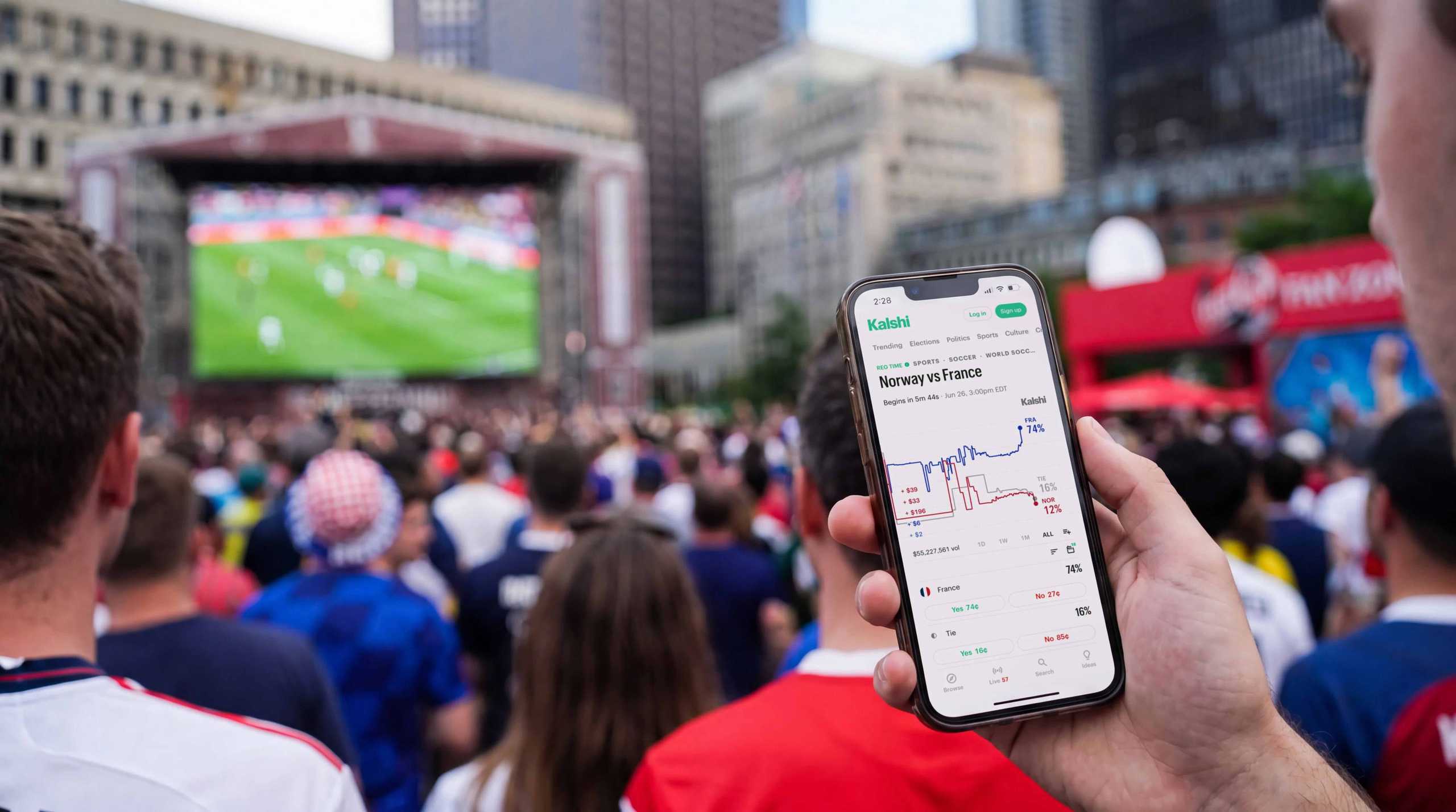
Why DraftKings and FanDuel Can't Ignore Prediction Markets
Despite their vehement opposition at the start, sportsbooks like DraftKings and FanDuel are now openly jumping on the prediction market bandwagon. Yet, they’re spending millions lobbying to also have platforms like Kalshi and Polymarket banned.

They’re not exactly new, but their escalating popularity demonstrates that prediction markets have successfully upended the sports betting marketplace - for now. Whereas traditional sportsbooks had an enviable monopoly on the industry before, prediction markets such as Kalshi and Polymarket - emboldened by CFTC regulatory approval - have lit a fire under the likes of DraftKings and FanDuel.
With the FIFA World Cup in full swing, Bodog dives in to find out why some sportsbooks are so desperate to join in, while others sit out, and why they’re all forking out millions of dollars to try to have the prediction market concept outlawed entirely.
Why Sportsbooks Want a Piece of the Prediction Market Pie
Predictions markets have undoubtedly flourished, first as a novelty financial platform to wager on real-world events to becoming the hottest innovation in sports betting since the same-game parlay (SGP).
Building on its trading format, market leaders Kalshi and Polymarket have shown that billions can be made wagering on sports outside of the traditional sportsbook model, which hasn’t gone down well with operators.
Sportsbook Stance vs Q1 2026 Revenue Growth
| Sportsbook Operator | Prediction Market Stance | Q1 Revenue Growth (YoY) |
|---|---|---|
| Flutter / FanDuel | Expanding with FanDuel Predicts partnerships with CME Group & Crypto.com | +17.0% |
| DraftKings | Aggressively expanding with DraftKings Predictions, registering $3.1bn trading volume in May | +16.8% |
| Robinhood | Aggressive expansion into event contracts with the Robinhood Prediction Markets platform | +15.0% |
| PENN Entertainment | Avoiding, remaining focused on the sportsbook domain | +6.4% |
| BetMGM | Defensive, believe it's a temporary distortion | +6.0% |
| Caesars Entertainment | Holding firm, argues it does not want to jeopardize its existing gaming licenses | +2.7% |
Of course, gambling operator Q1 revenue growth inevitably incorporates a number of external factors, however, the upward trend of those embracing the prediction market format is already noticeable.
The appeal of prediction markets for punters is glaringly obvious, not least because it minimizes the sportsbook vig (the profit margin built into traditional odds), but it does so by creating sharper odds for seasoned bettors with the added appeal of being crypto-friendly.
Yet, the standout differentiator is perhaps that it grants prediction markets access to two of the biggest domestic sports betting markets where sports wagering is banned – Texas and California. Clearly, a CFTC facilitated loophole that sportsbooks such as DraftKings and FanDuel are keen to exploit.
Nonetheless, while DraftKings and FanDuel have jumped in with both feet, launching DraftKings Predictions and FanDuel Predicts, respectively, others, including BetMGM and Caesars Entertainment, are holding out, believing that prediction markets will eventually be regulated out of existence.
The World Cup Could Be the Ultimate Showdown
Without a shadow of a doubt, the FIFA World Cup is an absolute beast when it comes to sports betting volumes. As the most bet-on sports event on the calendar, with prediction markets in play for the first World Cup ever, analysts have already predicted that total wager and trading volumes could exceed $50bn, dwarfing every previous tournament wagering record.
With Kalshi and Polymarket now in the fold, not only can residents of California and Texas start trading on World Cup results, but the entire sportsbook landscape has deviated to become more aligned with prediction market offerings.
Even FIFA itself is getting involved, having recently announced a partnership with ADI Predictstreet, a Gibraltar-based prediction market operator aiming to bring event-contract style engagement to football fans worldwide.
In response, sportsbooks have been forced to roll out new wagering features never seen before in the US.
These include FanDuel's introduction of live in-play gamified penalty shootout markets, where bettors can predict where penalty takers will place their penalties, not just whether they will score or not. Likewise, DraftKings has expanded into micro-betting, such as predicting the outcome of the next possession or whether the next shot will result in a goal.
At the same time, prediction market World Cup trades have become increasingly sophisticated. In fact, unlike before, platforms now allow traders to combine multiple contracts to mimic the concept of a sportsbook parlay.
Sportsbooks Are Playing Both Sides Of The Fence
Despite sportsbooks initially presenting a united front, DraftKings is now leading the charge as one of the most aggressive players opting to diverge rather than get caught out. After a rather protracted entry, the company finally launched DraftKings Predictions in December 2025, recently revealing the platform had surpassed $3.1bn in trading volume in May, up 34% on the month before.
Flutter, too, parent company of FanDuel, adopted a similar strategy, going live with FanDuel Predicts with CME Group in December. However, after a slower-than-expected start with CME Group, FanDuel has now partnered up with Crypto.com to expand its prediction market product suite to customers.
The logic is simple. If prediction markets are indeed going to cannibalize the sports betting market, at least for now, sportsbooks are being forced to establish their own foothold rather than become victims of its success.
So much so that increasingly, savvy gambling operator executives are going on the record stating that prediction markets should be a supplementary income stream, rather than a competitive one… but not everyone agrees.

If Prediction Markets Are So Great, Why Are Sportsbooks Still Spending Millions Defending Betting?
With all that said, here’s where things get really interesting.
That’s because, despite the sports event trading volumes seen over the course of the NFL season, and now the FIFA World Cup, behind the enthusiastic façade, sportsbooks – including DraftKings and FanDuel – are simultaneously spending millions of dollars to try eradicating the trading model altogether.
Behind the scenes, sportsbooks have collectively continued to pour tens of millions of dollars into prominent political lobbying campaigns and state-level policy organizations. The goal is simple: reinforce existing sports betting legislation in a bid to shut down the incursion of prediction markets.
This alone tells you everything you need to know about sportsbook operators’ true sentiment toward this market-shifting industry disruptor. After all, who wouldn’t want to retain a monopoly of one of the fastest-growing industries on the planet?
Bottom Line
You’d be hard-pressed to find a punter who doesn’t view the emergence of prediction markets favorably – unless, perhaps, you’re also sitting on a sizable sports betting investment portfolio, of course.
Just the prospect of reduced sportsbook vigs, wider sports betting market variabilities, not to mention a move toward a trader-led betting mindset, should be music to the ears of punters who appreciate more consistent value conditions.
Nevertheless, established sportsbooks are now faced with a formidable gamble of their own – do they partake in a bid to ascertain a place at the prediction market table, or sit out in the hope that the house of cards may eventually fall. Either way, the stakes are extremely high for everyone involved.
Stuart Hughes is a London-based freelance journalist covering sports, travel, lifestyle, and technology. He’s worked with brands like Lenovo, Best Western, and Frontier Airlines, bringing a global perspective shaped by years of travel.
More Articles like this
Kalshi Wants Margin Trading. What Could Go Wrong?
Kalshi’s proposed margin system would let eligible traders put up less than the full value of some positions, freeing capital for other trades while also introducing a new layer of leverage and risk.

By Charlon Muscat
Kalshi, Polymarket Starting to Price the Midterms as Blowout
With just over five weeks to go, Kalshi and Polymarket now heavily favor Democrats for the House and give them the edge in the Senate.
By Stuart Hughes
Kalshi’s NFL Volume Is Exploding. Should Sportsbooks Be Worried?
The NFL season is barely underway, but prediction markets have already handled multiple billions in football trading volume. Is that enough to make sportsbooks nervous?

By Charlon Muscat
Best Prediction Market Apps of 2026
Compare the best prediction market apps and platforms for sports, politics and other events, ranked by market selection, fees, liquidity, user experience and availability.

By James Guill
Prediction Markets vs Sports Betting: Key Differences
Prediction markets vs sports books: odds, vig, trading vs fixed bets, legality by state, combos vs parlays. Which is better for sports bettors?

By Arthur Crowson
Sydney Sweeney to LeBron: Prediction Markets Bet on Star Power
Sydney Sweeney just became an equity partner at Novig. She joins a growing list of A-listers cashing massive checks from prediction markets, including LeBron James, Timothée Chalamet and many others.

By Cole Rush