
Online Slots vs. Vegas: Which Has Higher Return to Player (RTP)?
Online slots often advertise higher RTPs than Vegas machines, but the reality is more nuanced. Here’s how the numbers compare and what they actually mean for players.

Las Vegas has long sold the idea of big wins under bright lights, yet now online casinos are right there trying to muscle in on the attention. The industry’s out in the open, with clearer game data and much greater awareness of metrics, especially RTP. Add in the long-held view that Vegas is tight, shaped by years of anecdotal play, and a natural question starts doing the rounds: are digital slots paying more than those on the Strip?
This article breaks down slot RTP across online and land-based casinos and what that translates to when you’re playing.
What is RTP (Return-to-Player)?
RTP, or Return to Player, is the percentage of all player bets a slot or casino game pays back over time.
Let’s say a game has an RTP of 96%. Its math is set so that across a huge number of spins, the total payouts average about $96 for every $100 wagered. The remaining $4 represents the built-in house edge.
The key point is that “very large sample.” We are talking millions of spins before results even start to drift toward that theoretical number. In the short term, there is zero guarantee, meaning you are very unlikely to get $96 back after spending $100. And that’s actually a good thing, because if it worked that way, every session would already be locked in as a loss before you even start. Any single spin can pay nothing or hit big. Variance is what plays a much bigger role here, but that’s another conversation when we get into slot volatility.
Research from Dr. Leonardo Cohen at the University of Nottingham shows that up to half of gamblers think a game with 90% RTP means they have a 90% chance of winning. That’s a major misconception. RTP is simply a theoretical measure of how much a game pays back over millions of spins in relation to total bets placed.

Average RTP: online vs Vegas slots
The generally accepted average RTP for online slots is 96%. Anything above that stands out as more player-friendly, while lower figures raise eyebrows for the opposite reason.
There are exceptions, though, most notably with progressive jackpots. Take Mega Moolah as an example. The base game comes in at about 88.12% RTP, because part of every bet is routed into the growing prize pool instead of regular wins. Another roughly 5.3% is tied to those big top-tier payouts, like the £11,498,211 hit in the UK last year.
Switching over to land-based slots, the numbers trend downward overall, often landing in the low nineties. A Nevada Gaming Control Board report, reviewed by UNLV, breaks down average hold percentages by area using data from 2004 through 2026. Casinos in Reno post the lowest number at 5.22%, while Las Vegas carries the highest, around 7.57%. That brings the average RTP to 93.5%.
➡️ What is hold percentage? Hold percentage is the share of all money wagered on a game that stays with the casino over time after paying out winnings. The slight difference from house edge is that the latter is the theoretical figure built into the underlying math model.
Naturally, any individual game can land higher or lower. One of the most popular slot machines, Lightning Link, has been seen anywhere from the high-80s to mid-90s, depending on the exact title and how the casino has it set up.
At the same time, casinos cannot set these numbers however they like. The Massachusetts Gaming Commission, for example, requires a minimum RTP of 80% on slots. The most recent revenue report, though, had figures much closer to 90%.
Here’s a quick table that lays all these numbers out, side by side:
Online vs. Vegas Strip vs. Off-Strip
| Slot Type | Typical RTP Range | Key Notes |
|---|---|---|
| Online Slots | 94% - 98% | Competitive market |
| Vegas Strip | 85% - 90% | Higher overhead |
| Downtown / Off-Strip | 88% - 92% | Better value than Strip |
Why online slots have higher RTP
The main reason online slots often post better RTP figures is the much lower cost base compared with land-based venues. That means casinos can allow higher returns while still maintaining viable margins. There are, of course, other factors that play a part, such as:
- Large player volume: Online casinos account for about 58% of total global participation with over 280 million active users. Therefore, revenue comes from volume rather than squeezing each wager.
- No floor space limits: Operations face minimal to no physical capacity constraints, so there is less pressure to optimize each individual game for maximum edge
- Lower operating costs: No physical machines, floor space, on-site maintenance or installation, and far less investment in real estate and equipment.
- Higher competition: As of 2024, there were 4,563 online gambling businesses, many of them behind multiple casino brands. In Nevada, by comparison, you are only looking at a few hundred operators, including smaller machine outfits.
Lower tax and regulatory burdens in many markets: Many offshore jurisdictions, such as Malta and Curaçao, have lower tax and regulatory burdens than U.S. land-based casinos. In Pennsylvania, slot machines are taxed at about 54% on gross gaming revenue, one of the highest rates in the country.
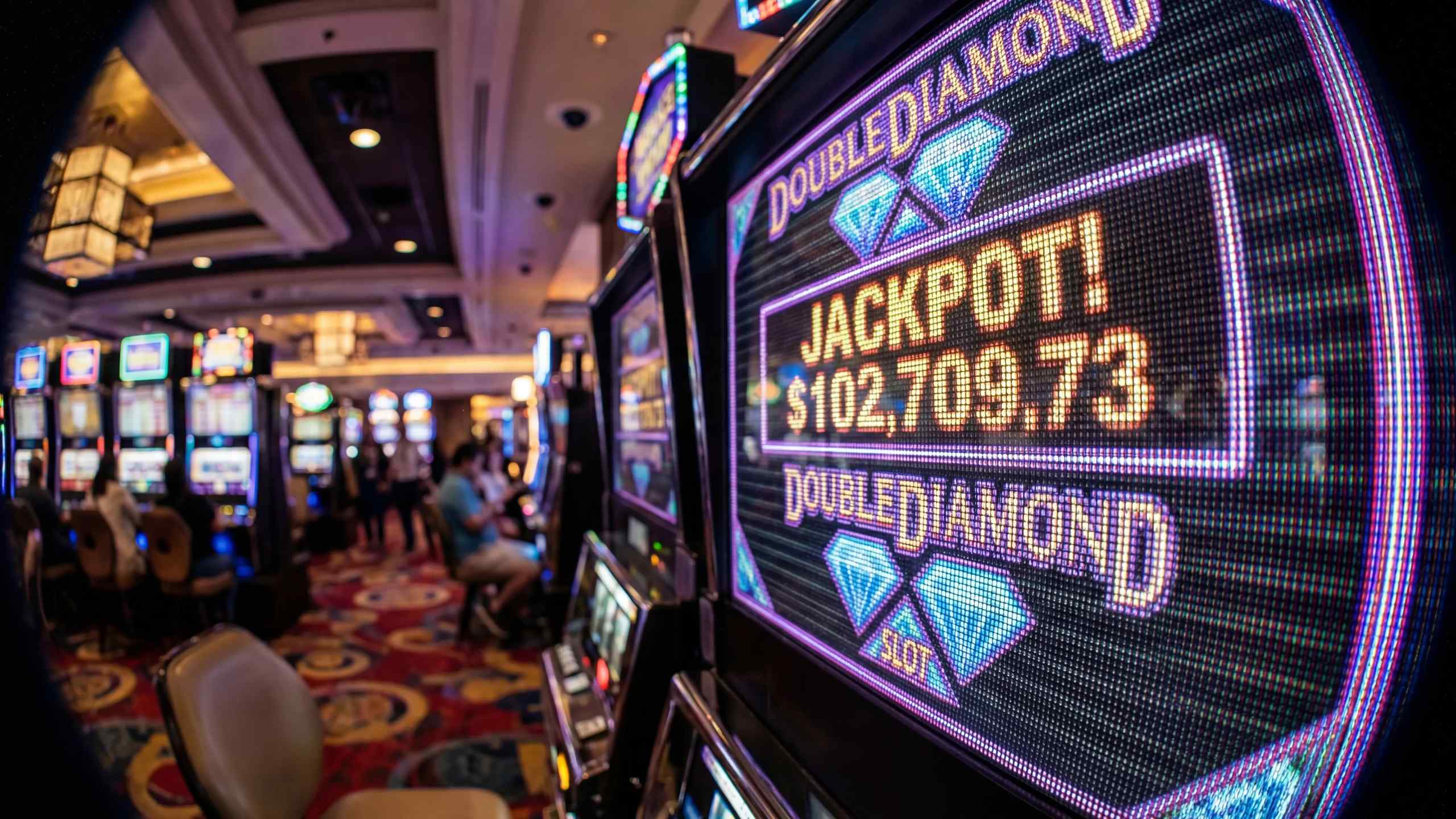
Why Vegas slots have lower RTP
Flip those same points around, and you start to see why Vegas slots tend to land lower on RTP on average. You’ve also got a few other reasons, like:
- Tourist-driven play: Many players are one-time visitors. This shifts attention away from long-term retention and lowers pressure to offer higher RTP settings.
- Denomination anchoring: Low-denom machines dominate floors, and these are typically configured with lower returns than higher-limit games.
- Higher volatility and feature-heavy design: Jackpots grab attention on casino floors, and operators love them. All of these are funded by slightly lower base returns.
- You're paying for the experience: Part of each wager supports the full casino offering, including drinks, staff, atmosphere, live entertainment, and premium real estate.
What RTP means for players (simple math example)
The best way to look at RTP is as a long-term cost indicator — the price you pay for the experience, the spins, the features, and the chance of landing a big win.
Mathematically, this means a slot with 96% RTP has an expected cost of about $4 per $100 wagered. But most of the time, you will not see that play out in practice. After putting through $100, you might end up close to zero, ahead, or anywhere in between. It’s only over many sessions and a very large number of spins that results start to move toward that theoretical number.
That is why I do not get too hung up on the RTP of a single game. If I want a short session on a new slot with a 100,000x max win and some fresh feature, I will play it, even if the RTP is 95% or 94%. What matters more is the overall approach, trying to give more weight to games closer to that 96% mark, so, over time, it costs less to play. Let me give you a simple example:
- Slot 1 → RTP 95.73% → $118 wagered → expected cost $5.04
- Slot 2 → RTP 94.69% → $209 wagered → expected cost $11.10
- Slot 3 → RTP 96.63% → $130 wagered → expected cost $4.38
- Slot 4 → RTP 97.51% → $134 wagered → expected cost $3.34
- Slot 5 → RTP 97.44% → $69 wagered → expected cost $1.77
- Slot 6 → RTP 96.66% → $155 wagered → expected cost $5.18
- Slot 7 → RTP 96.32% → $185 wagered → expected cost $6.81
Total wagered: $1,000
Total expected cost: $37.62
Average RTP across all seven slots: 96.24%
Are online slots always better?
No, there’s no rule anywhere saying online slots always have to offer better RTP than those in Vegas. Plenty of them do, sure, as long as that’s what the casino has opted for.
The reason I say that is because software providers often release the same slot with multiple RTP settings. NetEnt’s Starburst, for example, gives casinos a choice between six options — 96.09%, 95.05%, 94.05%, 93.05%, 92.05%, and 90.05%. In one place, you might be on the 96.09% version, while somewhere else it could be set to 90.05%, which is actually lower than what you would get from a typical land-based machine.
➡️ Did you know? You can check the exact RTP version by opening the game info or settings menu after it loads and looking for the return to player figure in the help or paytable section. If it’s not listed, reach out to the casino customer support team and ask which RTP configuration that specific game is set to.
Then there’s also the bonus angle. If you’re given a set of free spins or a match bonus on your deposit, that shifts your overall return. In Vegas, those don’t really exist, though you’re getting a more glamorous experience, with loads of entertainment and perks inside the venue.
Wrapping up: online vs Vegas slots RTP
Online slots, on average, have better RTPs than land-based machines. The lower operating costs and large player volume are two of the biggest drivers, reinforced by intense competition. Those higher percentages point to more favorable long-term odds, meaning it should cost you less over multiple sessions to keep playing and stay in the game. But none of that guarantees wins, or even losses for that matter.
At the end of the day, it largely depends on what you want out of the experience. If you care about raw numbers and textbook value, online slots tend to come out ahead. The Vegas experience is different. You have dealers, servers, other players, free drinks at the tables, live shows nearby, that whole atmosphere, which, for someone who enjoys the social side, is worth paying for.
Charlon Muscat is an established iGaming expert who entered the space in 2019 and went on to build a name across both casino and sportsbook content.
More Articles like this
Are eBay's "Spin the Wheel" Listings Just Gambling?
A corner of eBay Live auctions off wheel spins instead of actual items. Bid starts at $1, the price climbs, and the winner finds out what they bought only after the wheel stops. Here's why that's not really shopping.

By Cole Rush
Casino Carpets Are Ugly. But Not for the Reason You Think
Casino carpets have long been accused of keeping gamblers disoriented and glued to the games. The truth is considerably more practical, though just as strange.

By Cole Rush
The Strange Gambling Laws Behind Cruise Ship Casinos
Cruise ship casinos only open once a ship clears territorial waters, and the odds, oversight, and rules that follow are nothing like a Vegas floor. Here's what actually changes at sea.

By Cole Rush
Six Reasons Bettors Are Starting to Ditch Credit Cards
States are increasingly questioning whether borrowed money has any place in gambling. From instant interest to damaged credit, the risks can extend far beyond the bet itself.

By Charlon Muscat
How Subscriptions Use Gambling Psychology to Hook You
Streaming services, apps, and subscription boxes may look nothing like a casino, but many tap into the same psychological forces that make gambling so hard to walk away from.

By Cole Rush
The Best Gambling Songs Ever Written, Ranked
From Kenny Rogers to Sting, these seven songs go beyond casino clichés to capture the risk, psychology and obsession behind gambling.

By Cole Rush