
Ear-Splitting: The 5 Loudest Stadiums in Sports
From Arrowhead’s Guinness World Record to Celtic Park’s European-night roar, these five venues have turned crowd noise into a measurable home-field advantage.

Some stadiums are famous for atmosphere or size, but a smaller group is known for measurable sound.
They are loud enough to turn a quarterback’s cadence into a guessing game, force a soccer opponent into rushed decisions or make a crowd roar feel less like background noise than a physical event.
Different readings use different equipment, microphone placements and measurement standards. Some capture brief peaks, while others are part of formal Guinness World Records attempts.
But these are five of the loudest documented stadium environments, with crowds that have made noise a genuine part of home-field advantage.
The Loudest Stadiums by the Numbers
| Rank | Stadium | Team/Sport | Capacity | Reported Peak dB | Event/Year |
|---|---|---|---|---|---|
| 1 | Arrowhead Stadium | Kansas City Chiefs, NFL | 76,416 | 142.2 dBA | vs. Patriots, 2014 |
| 2 | Lumen Field | Seattle Seahawks, NFL | 68,740 | 137.6 dB | vs. Saints, 2013 |
| 3 | Neyland Stadium | Tennessee football, NCAA | 101,915 | 137.0 dB | vs. Georgia, 2023 |
| 4 | Husky Stadium | Washington football, NCAA | 70,083 | 133.6 dB | vs. Nebraska, 1992 |
| 5 | Celtic Park | Celtic FC, soccer | 60,411 | 129.0 dB | vs. RB Leipzig, 2024 |
These readings were taken under different conditions and should be understood as documented peak crowd-noise environments, not a laboratory-grade universal ranking.

5. Celtic Park
Celtic Park is not the world’s biggest soccer ground, but it has a uniquely concentrated kind of noise. The 60,000-plus crowd sits close to the field, and European nights in Glasgow can turn the venue into one long wall of sound.
Celtic fans recorded a reported 129-decibel roar during a 2024 Champions League match against RB Leipzig, peaking at halftime after a 2–1 Celtic lead. While not a Guinness-sanctioned attempt, it still credibly illustrates the stadium’s reputation.
The competitive effect is harder to measure than an NFL false start, but soccer noise can disrupt verbal instruction, complicate set pieces and alter an opponent’s composure. Celtic Park’s loudest moments also tend to arrive when games are already emotionally charged.

4. Husky Stadium
University of Washington’s Husky Stadium has one of the most surprising numbers on this list.
It holds a historic 133.6-decibel reading from a 1992 game against Nebraska, recorded by an ESPN sound-level meter and long treated as the benchmark for college football crowd noise.
The most remarkable part is its capacity. Husky Stadium seats roughly 70,000, around 30,000 fewer people than some of college football’s gigantic venues. Its sound comes from its shape and location: The stadium’s steep seating bowl and partial enclosure hold energy close to the field, while the water-adjacent setting adds a tight, echoing feel.
Nebraska players described communication trouble that day, and the number endured for more than three decades as college football’s loudness record before Tennessee surpassed it in 2023.

3. Neyland Stadium
Neyland Stadium is the most recent college football entry at the top of the decibel leaderboard.
A 137-decibel reading was reported during Tennessee’s 2023 game against Georgia, exceeding the widely cited 133.6 dB figure associated with Husky Stadium. Georgia ultimately won 38–10, a useful reminder that extreme noise does not guarantee an upset.
Tennessee’s 100,000-plus capacity gives it raw volume few venues can match. Its enclosed bowl, steep seating and the intensity of SEC night-game culture do the rest. The school has continued investing in the building’s sound system, adding speakers and subwoofers before the 2026 season, although crowd-noise records should be distinguished from amplified stadium sound.

2. Lumen Field
There might be something in the water in Washington.
Seattle’s “12s” briefly held the Guinness World Record for the loudest crowd roar at a sports stadium after reaching 137.6 dBA during a 2013 Monday Night Football win over New Orleans. The record came during a third-down defensive stand in the second quarter.
Lumen Field’s advantage is architectural. Its roof covers are designed to reflect noise toward the field, and its relatively compact seating arrangement traps the sound in a way massive open bowls often cannot. Seattle’s fans do not have the raw headcount of the biggest college stadiums, but they create a sound environment visiting offenses have long identified as uniquely difficult.
The stadium’s noise was so intense during the 2013 season that seismologists recorded crowd-induced tremors in the Seattle area, estimated between magnitude 1 and 2. That does not mean the crowd created an earthquake in the normal sense. It does mean thousands of people jumping and yelling at once created measurable ground movement.
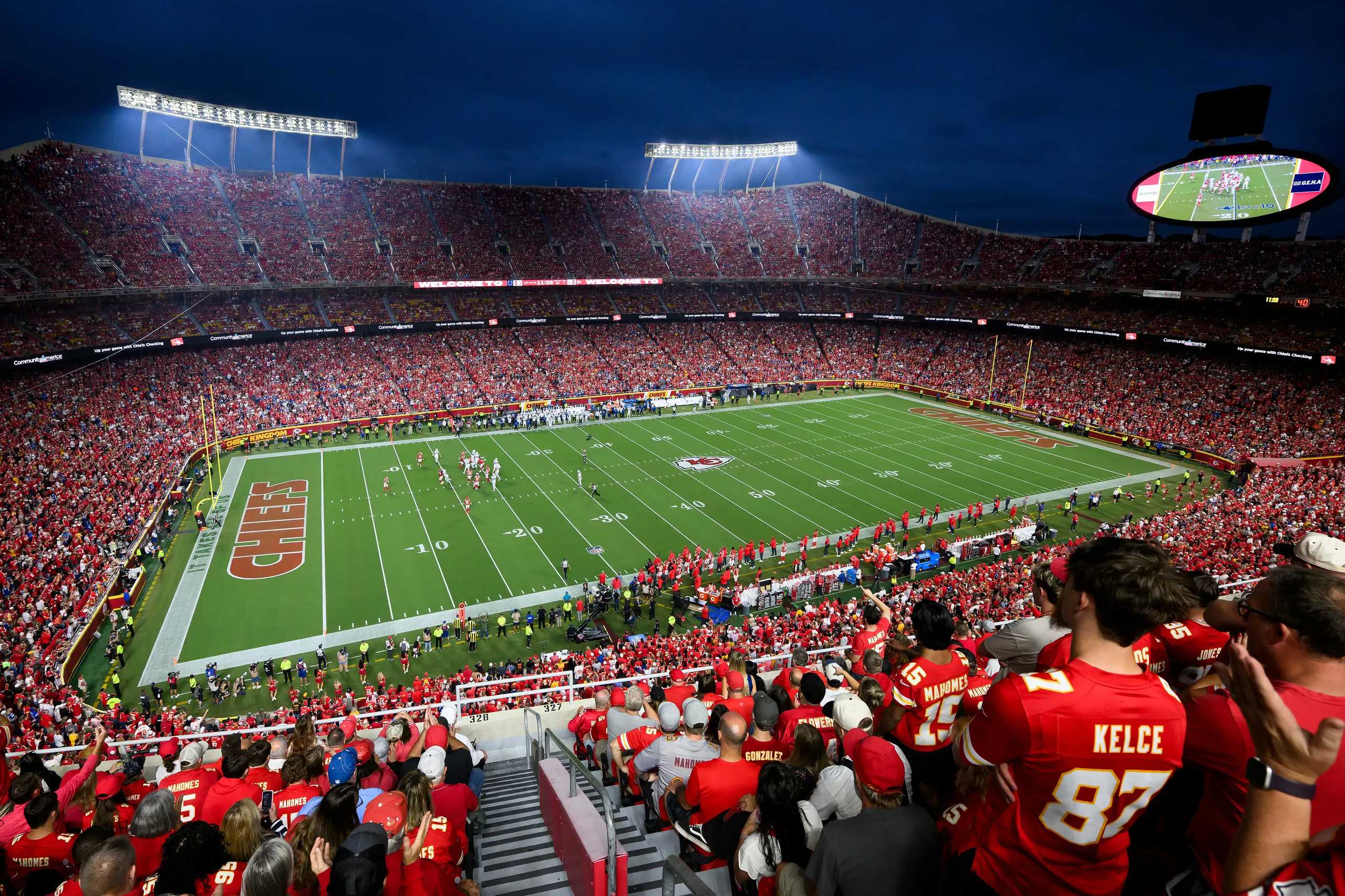
1. Arrowhead Stadium
Arrowhead remains the gold standard.
Kansas City Chiefs fans reached 142.2 dBA on Sept. 29, 2014, during a 41–14 win over the Patriots, the official Guinness World Record for the loudest crowd roar at an outdoor sports stadium. The peak came with eight seconds remaining in the first quarter.
The number eclipsed Seattle’s 137.6 dB mark and remains remarkable even with the usual decibel caveat. A difference of a few decibels is not marginal on a logarithmic scale and represents a meaningful rise in sound intensity. Arrowhead’s deeply enclosed bowl, steep upper deck and famously relentless crowd give Kansas City a home-field advantage that is more than branding.
Visiting teams prepare for Arrowhead with silent counts, hand signals and artificial crowd noise. Chiefs games routinely produce false starts and hurried pre-snap communication.
The record may have been set during a formal attempt, but its broader reputation comes from what happens every Sunday.
What 130+ decibels means
Decibel comparisons are imperfect because distance, duration, and the kind of sound all matter. Still, they help explain why these readings are more than novelty statistics.
A normal conversation is roughly 60 dB. A motorcycle or chainsaw can approach 100–110 dB. A rock concert may reach roughly 110–120 dB. A jet engine at takeoff is often cited around 140 dB, depending on distance.
That puts Arrowhead’s 142.2 dBA peak in a range associated with immediate hearing-risk exposure, not simply “a loud night at the game.”
It was a brief roar, not sustained sound at that level for an entire contest. But players do not need three hours of 140-decibel noise for it to matter. They need one third down, one delayed call or one false start at the wrong time.
Pat Evans is a Grand Rapids-based journalist and editor covering the intersection of business, sports, lifestyle, and gambling regulation. With a background in business journalism and legislative reporting (LSR, iGamingBusiness), he brings an analytical, human-focused approach to stories about modern trends. His work has appeared in regional and national publications, and he is also the author of two books on beer history.
More Articles like this
More Games, Bigger Cap: 5 NHL Changes You Need to Know
Thanks to a new CBA, hockey fans can get excited about an extended regular season, a nearly $10M salary cap jump, and the arrival of highly touted rookie Gavin McKenna.

By Bill Gelman
Five Incredibly Weird 'Sports' That Are Suddenly Taking Off
Suction-cup darts, marble racing, and grappling inside a car sound made up. They aren't, and some now have ESPN airtime and serious prize money.

By Cole Rush
Have the Buffalo Bills Become Canada’s NFL Team?
Buffalo has 8,000 Canadian season-ticket holders and just welcomed fans with “O Canada.” But does Seattle still have a claim to Canada’s NFL loyalties?
By Stuart Hughes
Six Cinderella Stories That Shocked the Sports World
Zheng Qinwen’s improbable US Open run showed why we love an underdog. These six Cinderella stories pushed the impossible even further.

By Charlon Muscat
Pickleball vs. Padel: Which Wins the Next Decade?
Pickleball dominates America on accessibility. Padel has the bigger global footprint and pro potential. Which racket sport is better built for the next decade?

By Charlon Muscat
Are the Carolina Hurricanes the New Blueprint for NHL Teams?
Carolina didn't win with a superstar-heavy roster or an expensive goalie. It won with depth, discipline, and a relentless commitment to its system.

By Lucie Turner


