

Kalshi’s NFL Volume Is Exploding. Should Sportsbooks Be Worried?
The NFL season is barely underway, but prediction markets have already handled multiple billions in football trading volume. Is that enough to make sportsbooks nervous?

Prediction markets spent years on the fringes of the betting business, better known for election trading than anything you’d see on a sportsbook board. Then, seemingly overnight, came $983 million in Kalshi NFL volume, nearly half of it on combo contracts, the prediction-market version of a parlay. That hits two sensitive spots at once. Football is one of the industry’s biggest customer-acquisition engines, and parlays are among its richest products. If exchanges can capture both while reaching places sportbooks cannot, who gets the upper hand in the next wave of growth?
Over $5.83 billion traded on prediction markets during NFL opening weekend
Aldrin Research data, as reported by Barron’s, put prediction-market trading volume at over $5.83 billion during the first Saturday and Sunday of the 2026 NFL season. Kalshi recorded $4.89 billion, equal to 84% of the weekend total, while sports and combination markets captured a 91% share across the tracked platforms.
A separate Jefferies estimate counted $3.17 billion in Saturday trading and another $3.12 billion on Sunday across Polymarket, DraftKings’ DKeX, and six other major platforms. Kalshi hit a $2.433 billion daily high on the second day of the NFL’s opening weekend, including more than $590 million in trading tied to individual Week 1 contracts. The biggest draw on the board was Cowboys-Giants ($112.8 million), roughly $104 million ahead of Jets-Titans, the lightest cited matchup.
For scale only, $5.83 billion is numerically equivalent to almost one-fifth of the AGA’s projected $29.5 billion in legal NFL sportsbook handle this season. The two measures are not directly comparable because prediction contracts can trade repeatedly before settlement. Still, it's a staggering amount of money.
The advantages prediction markets hold over sportsbooks
Reading through the reports, I can’t say those figures caught me completely off guard. Prediction markets enjoy several advantages over traditional sportsbooks, like, for example:
- Wider reach: Prediction exchanges can reach customers under a federal framework, including in some states that do not authorize mobile sports betting.
- Lower visible cost: Kalshi says its blended fee, measured as trading fees against volume, is roughly 1%, compared with a 10.2% national online sportsbook hold in 2025.
- Core product overlap: Moneylines, spreads, totals, props, futures, and multi-event combos all show up on prediction exchanges now, so anyone who already knows how sportsbooks work will find the menu familiar.
- Tradable positions: Exchange users can sell their contracts before settlement, similar to the cashout feature at online sportsbooks, except the exit price comes from the market rather than the house.
- Broader account utility: The same exchange can cover sports, politics, economics, weather, and entertainment, including event categories that state gambling laws generally keep off traditional betting menus. You might even come across unusual NFL contracts sportsbooks rarely offer.
NFL combos move into sportsbooks’ most lucrative territory
Parlays are some of the highest-hold products on a sportsbook menu. Them, certainly, and markets like next pitch and next corner too, at least based on the conversations I’ve had with traders around micro betting. During opening week, DeFiRate found that nearly half of Kalshi’s tracked NFL activity came from NFL-only combos, worth $445.88 million.
A Washington Post analysis calculated a 20.8% expected hold on a five-leg parlay built from -110 spreads, versus 4.5% for the standalone bet. The reason is that the house edge compounds. Reporters Emily Giambalvo, Kati Perry and Aaron Steckelberg go on to note that, in most states publishing the relevant data, multi-leg wagers account for between half and two-thirds of sportsbook revenue.
Prediction markets could reach future sportsbook customers first
Football being at the center of this whole thing cuts straight into sportsbook growth. The NFL has long been the industry’s biggest customer-acquisition machine, with new-account registrations jumping more than 310% on the first Sunday of the 2026 season. You see the same thing in Kalshi’s numbers. The $590 million tied to individual Week 1 contracts made NFL opening week the platform’s second-largest event pool, behind only its 2026 World Cup winner market.
But the bigger issue may well be what this does to future customer growth. Someone in Texas or California who learns to price and trade sports-event contracts on an exchange today may already have their betting habit established by the time legal mobile sportsbooks arrive.

How sportsbook operators are responding to prediction markets
What convinces me sportsbooks see the threat is what they’re doing about it.
DraftKings, for one, has already folded Predictions into its nationwide Super App. On its Q2 call, analyst Jordan Bender asked how cross-selling Horse, Jackpocket and DFS users into prediction markets was developing in new states.
Jason Robins, Chief Executive Officer and Co-Founder, framed that existing customer base as a major edge, adding that “[cross-selling is] something we'll continue to press. And then also having a really strong cross-sell engine so that not only can we get those customers on to Predictions and things like that when we launch, but we can continue to create that flywheel where we're engaging customers on all of our products throughout the year, which, again, is really a great thing for monetization as well.”
FanDuel’s parent, Flutter, rather than competing with prediction markets only through its sportsbook, is now also supplying liquidity. The company first disclosed the trial in its Q1 earnings report without naming the exchange. Barron’s later reported that the venue was Kalshi, and by Q2 Flutter was forecasting about $50 million in 2026 market-making revenue.
The clearest example, at least from a financial standpoint, of prediction-market competition affecting sportsbook economics is BetMGM. In July, the company downgraded its 2026 outlook for the second time, saying revenue would likely finish near the low end of its $2.9 billion to $3.1 billion revenue range, while adjusted core profit was expected to land closer to $300 million than the $350 million upper bound. BetMGM also said it no longer expects to hit the $500 million profit target by 2027, blaming tougher competition and regulatory complexity tied to prediction-market expansion.
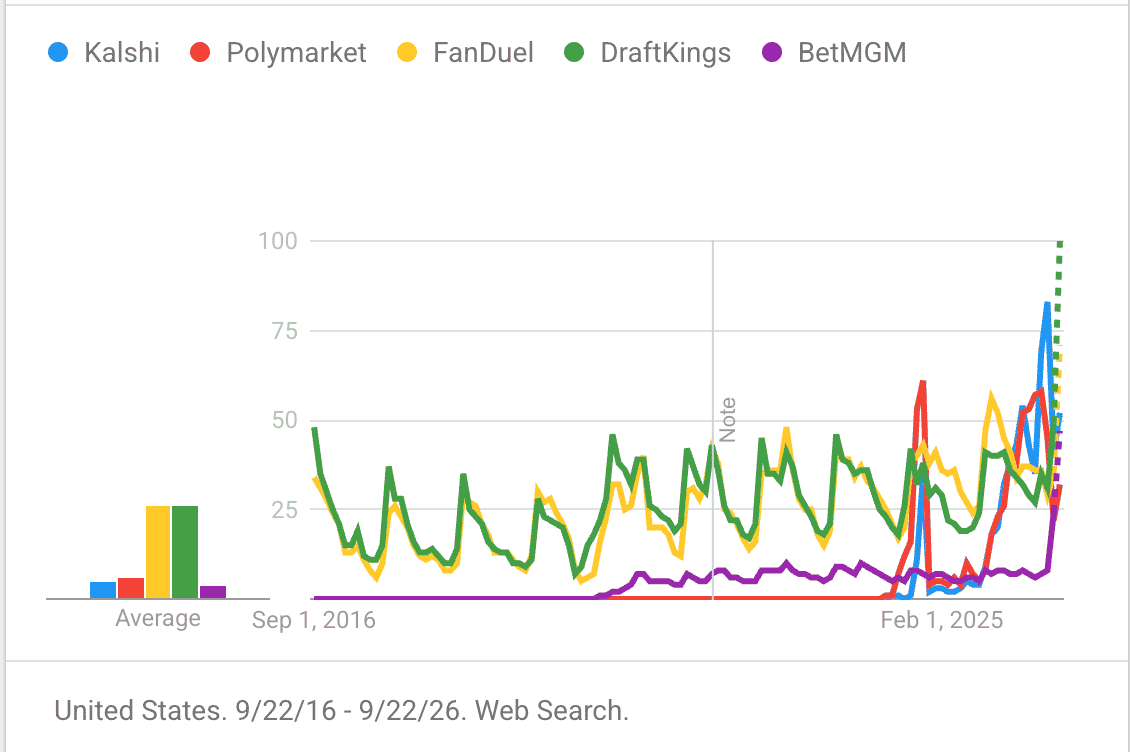
How US search interest changed over ten years
Google Trends tracks what people are looking up and when. Across the terms and time period analyzed, a score of 100 marks the point of highest search interest; 50 represents half that level, and so on.
For years, FanDuel and DraftKings owned the conversation, predictably spiking with football season. Polymarket broke through around the 2024 election. Then sports contracts hit in early 2025, and both Polymarket and Kalshi started getting attention beyond the big event cycle. By September 2026, their yearly averages had moved ahead of the sportsbook brands.
The threat to sportsbooks has a lot riding on what courts decide
One of prediction market platforms’ biggest advantages, their federal reach, is also the most unsettled right now. Courts are increasingly having to decide where sports prediction contracts can legally be offered.
On August 28, the Ninth Circuit ruled that Kalshi could not rely on federal commodities law to shield its sports contracts from Nevada gaming rules. Less than three weeks later, the same court found two California tribal governments likely to prevail under federal Indian gaming law. That appeal also drew support from 27 states and Washington, D.C.
Kalshi argues that federal commodities law blocks states from applying their gambling rules to its sports contracts. Regulators and tribes disagree, and the fight is now before the Supreme Court on a petition for review. A federal-preemption win would largely preserve the nationwide distribution model. The alternative could force exchanges into a state-by-state maze of licenses, taxes, and geofencing, clipping their reach before this NFL surge can harden into a lasting threat to traditional sportsbooks.
Charlon Muscat is an established iGaming expert who entered the space in 2019 and went on to build a name across both casino and sportsbook content.
More Articles like this
Kalshi Wants Margin Trading. What Could Go Wrong?
Kalshi’s proposed margin system would let eligible traders put up less than the full value of some positions, freeing capital for other trades while also introducing a new layer of leverage and risk.

By Charlon Muscat
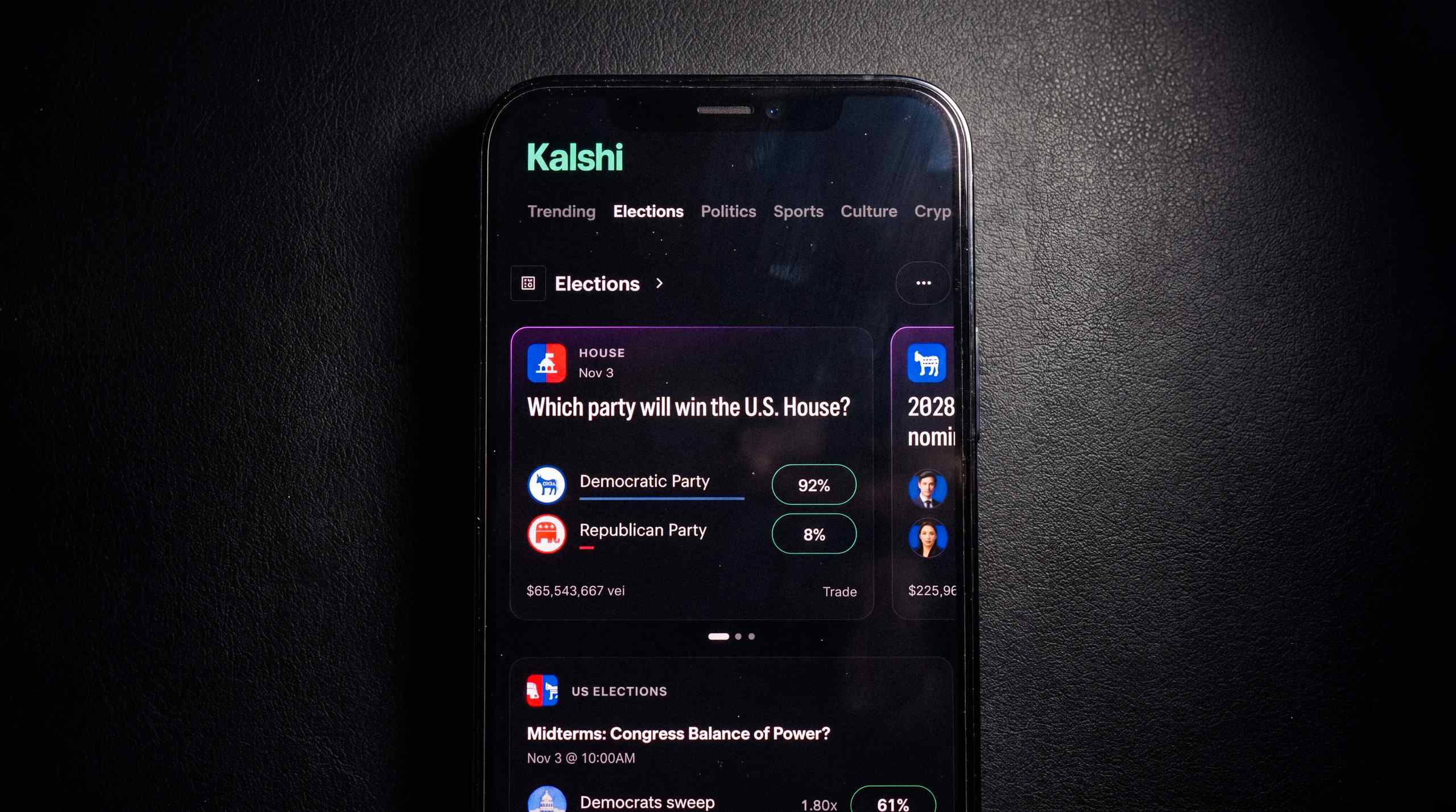
Kalshi, Polymarket Starting to Price the Midterms as Blowout
With just over five weeks to go, Kalshi and Polymarket now heavily favor Democrats for the House and give them the edge in the Senate.
By Stuart Hughes
Best Prediction Market Apps of 2026
Compare the best prediction market apps and platforms for sports, politics and other events, ranked by market selection, fees, liquidity, user experience and availability.

By James Guill
Prediction Markets vs Sports Betting: Key Differences
Prediction markets vs sports books: odds, vig, trading vs fixed bets, legality by state, combos vs parlays. Which is better for sports bettors?

By Arthur Crowson
Sydney Sweeney to LeBron: Prediction Markets Bet on Star Power
Sydney Sweeney just became an equity partner at Novig. She joins a growing list of A-listers cashing massive checks from prediction markets, including LeBron James, Timothée Chalamet and many others.

By Cole Rush
Are Prediction Markets Legal?
Prediction market laws depend on the platform, contract and jurisdiction. Learn how CFTC oversight, state disputes and Canadian regulations affect where event contracts can be traded.

By James Guill