

America’s Best and Worst Airport Hubs in 2026, Ranked
Some airport hubs just work. Others turn even a short stop into a headache. At the worst, complaint rates reached 6.83 per 100,000 passengers, nearly double the US average.

Airport hubs are the main layover crossroads that airlines funnel people through before sending them off in all directions. In the U.S., there is no formally defined, nationwide list. But combining airline-designated connection points with the Federal Aviation Administration traffic tiers puts the total somewhere around 70 to 90 airports.
As someone who has passed through a fair few of these, I can say from experience that no two ever feel the same. Airport hubs sit at the center of nearly every major trip, and the broader world of travel is full of similarly uneven experiences where the gap between expectation and reality can be just as wide. There are some where I almost catch myself hoping for a slight delay, just to stretch out the lounge time a bit longer, or finally slow down enough to take in those art and nature exhibits you never quite have time to properly look through. In others, I can’t get out of there fast enough.
This article breaks down exactly that. I used publicly available data alongside input from several on the Bodog team to put together the three best and worst U.S. airport hubs to pass through in 2026.
What makes a “good” airport hub?
How good an airport hub feels really comes down to what you value in the experience. Independent industry bodies like Skytrax base their work on large-scale passenger surveys targeting specific areas, then roll those results up into a yearly list that ranks airports overall.
What you will see below leans on our own travel experiences, backed by hundreds of user reviews we went through, and also industry data. Let me go through some of the key factors we considered:
- Connection flow and timing: How easy it is to make a transfer without rushing or cutting things too fine between gates.
- Terminal layout: Whether getting from one point to another is simple or ends up being long walks, buses, or confusing detours.
- Queue time at key touchpoints: Time spent standing in line at check-in, security, and passport control.
- On-time reliability: How often flights stick to schedule rather than slipping into delays that mess up connections.
- Disruption handling: What it feels like when things go wrong, from rebooking to how clearly staff share information.
- Crowding: Whether terminals feel manageable or packed, especially during peak hours.
- Food, seating, and lounge access: How easy it is to find a decent place to sit and eat, plus lounge availability, crowd levels, food quality, and extras like showers or smoking areas.
- Signage and wayfinding: How quickly you can figure out where to go without second-guessing every turn.
- Security and border control: The best US airports uphold safety to the highest standards while keeping the queue moving through checks efficiently.
- Baggage handling and transport links: Whether bags reliably make tight connections or show up late, alongside how straightforward it is to get from the airport to the city and back.
The data-gathering process behind rankings like these is increasingly shaped by AI, which is now being used by airports and airlines alike to model passenger flow, predict congestion points, and flag delays before they cascade.
The 3 best US airport hubs
1. Minneapolis–Saint Paul International Airport — MSP
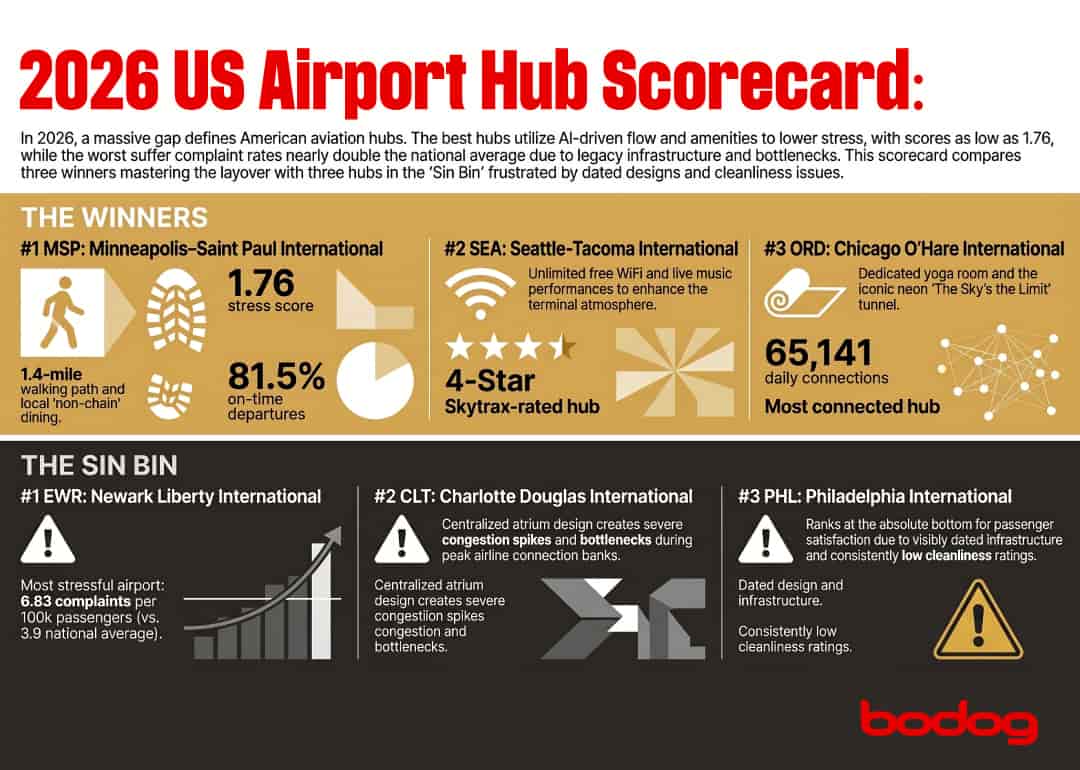
The J.D. Power North America Airport Satisfaction Study had Minneapolis–Saint Paul International Airport coming out on top for passenger satisfaction in both 2024 and 2025, ahead of other major hubs like those in Detroit, Phoenix, and Dallas. This year, it also recorded a 1.76 out of 10 stress score, with on-time departures sitting at 81.5%.
- Strengths: There’s loads of space, proper local eateries instead of the usual fast-food chains, quiet spots to switch off, and a hotel on site that accepts day stays.
- Things to do: You grab something from Black Sheep or Shoyu, walk the 1.4-mile path to kill time, maybe sit somewhere quiet, and if the layover drags, the Mall of America is one stop away.
User reviews:
- “I passed through MSP on a layover and was pleasantly surprised by how comfortable and well-designed it is. The airport is very walkable, with plenty of moving walkways, lots of seating, and ample charging stations, which made the layover easy and relaxed.” — Chekaya G., Yelp
- “Nice large airport offering plenty of dining, both sit-down and local options. Wide corridors, so even walking from Concourse F to C was a breeze.” — Richard S., Yelp

2. Seattle-Tacoma International — SEA
Seattle–Tacoma International Airport has gone through a wave of upgrades that pushed it into 4-star territory with Skytrax. The revamped N Concourse and new International Arrivals Facility are the main upgrades, with quieter spots and smoother security helping round things out.
- Strengths: Power outlets under seats across A, B, D, and S gates + more being added. The free “SEATAC-FREE-WIFI” has no time limits, and top lounges like Centurion and Club SEA are available, both with showers.
- Things to do: Walk the marked half-mile Art Walk in the Central Terminal or catch live music performances near the main hub. You can also take the shuttle train out to N Gates for a quieter change of scene.
User reviews:
- I loved that there was free WiFi here. The TSA Staff are very smoothly flowing here. It is easy to navigate through this airport. — Varshitindrayarakala, FlightRadar24
- Took a late-night flight from EWR to SEA. The ground staff was friendly. Smile faces everywhere when we landed around midnight. — Wei H., Yelp

3. Chicago O’Hare International Airport — ORD
I have passed through Chicago O'Hare International Airport a few times, and it never really felt like I was moving through the most connected airport in the U.S. The OAG Megahubs Index 2025 ranking puts it at 65,141 viable onward itineraries in a single day, spanning 297 travel destinations. Industry recognition has never really let up, with repeated “Best Airport in North America” titles and regular awards across dining, design, and passenger experience from groups like Airports Council International and Global Traveler.
- Strengths: What stands out most is the immense route depth. You get loads of easy airline connections and solid backup during disruption. The weather-resilient runway design then helps keep the latter to a minimum.
- Things to do: Grab a deep-dish slice at Reggio’s, walk the neon “The Sky’s the Limit” tunnel between Concourses B and C, stretch in the Terminal 3 Rotunda yoga room, then kill time with free WiFi or a paid lounge if you need quiet.
User reviews:
- ORD is a big airport and was decked out nicely for Christmas. They have plenty of restaurants, shops, and a few lounges. We had to transit to T5, and it was easy to transfer on the shuttle bus. — Blackbeauty75., TripAdvisor
- Easy airport for the CTA train that's directly connected to the airport from Terminal 5. Ride share apps are available at Terminal 3. And there's lots of food in all terminals and Garretts Popcorn and Nuts on Clark stands. Many areas of the airport at ORD are renovated or getting a facelift. — Karina K., Yelp

The 3 worst airport hubs in the US
Next are the three airports that ranked lowest in our research, along with the main reasons why:
- Newark Liberty International Airport (EWR): ~6.83 complaints per 100,000 passengers, well above the ~3.9 average. It also ranked as the most stressful airport.
- Charlotte Douglas International Airport (CLT): The layout centers on a main atrium with concourses radiating outward, so during connection banks, large volumes of passengers route back through shared corridors and intersections, which leads to repeated congestion spikes.
- Philadelphia International Airport (PHL): Despite generally reliable flight timings, the airport ranks at the bottom for overall passenger satisfaction. Recent J.D. Power findings show consistently low scores tied to dated terminals and cleanliness.
Comparing US Airport Hubs
The following table lines up the six airport hubs featured above and shows what each one does well and where it struggles.
Comparing US Airport Hubs
| Airport | Overall Standing | Key Strength | Core Weakness |
|---|---|---|---|
| Minneapolis–Saint Paul International Airport | #1 satisfaction (J.D. Power 2024–2025) | Spacious layout + strong local dining | Limited late-night food options. Most outlets close overnight |
| Seattle-Tacoma International Airport | High-rated (Skytrax 4-star) | Modern upgrades + strong lounge offering | Security wait times can exceed 60 minutes at peak |
| Chicago O'Hare International Airport | Top connectivity hub (OAG) | Massive route depth + resilient runway system | Gate-to-gate transfers can exceed 20 - 30 minutes + terminal separation |
| Newark Liberty International Airport | Lowest-tier satisfaction | Strong international and domestic network | ~6.83 complaints per 100k passengers + severe congestion across terminals |
| Charlotte Douglas International Airport | Bottom-ranked (J.D. Power) | Efficient airline hub for connections | Central atrium design causes repeated congestion spikes during bank waves |
| Philadelphia International Airport | Lowest satisfaction scores | Reliable flight timings | Consistently low cleanliness ratings + visibly dated infrastructure |
Trends and outliers we picked up on:
While going through all the data and reviews, a few patterns started to show up, along with some airports that behaved very differently than you would expect. Shifting passenger expectations and post-pandemic infrastructure investment are among the travel trends that have quietly reshuffled airport satisfaction rankings over the past two years. Just to name a few:
- Smaller mega hubs keep topping satisfaction: Minneapolis–Saint Paul International Airport and Detroit Metropolitan Wayne County Airport regularly outrank larger hubs.
- The busiest airport is not the best rated: Hartsfield–Jackson Atlanta International Airport moves the most passengers globally, yet does not rank at the top for passenger experience.
- Legacy hubs cluster at the bottom: Newark Liberty International Airport and Philadelphia International Airport scored consistently low satisfaction ratings across multiple years.
- Recent upgrades do not shift rankings quickly: New York LaGuardia Airport improved its facilities but still trails top-tier hubs in overall scores.
- Layout design appears repeatedly in rankings: Centralized designs like Charlotte Douglas International Airport correlate with lower satisfaction due to recurring congestion patterns.
A Final Look at the best and worst airport hubs in the US
Airports across the US have come a long way, and with ongoing upgrades and expansion, the pecking order has a habit of reshuffling itself. At the same time, how it all feels depends heavily on what you are actually there to do. A quick connection, a long layover, switching terminals, clearing security again, or having lounge access can change things completely.
Based on our own time passing through and what regularly comes up in user reviews, Minneapolis, Seattle, and Chicago are leading the pack in 2026, while Newark, Charlotte, and Philly drag on at the bottom. We’ll be keeping a close watch on how things develop and circle back here the moment anything worth mentioning appears.
Charlon Muscat is an established iGaming expert who entered the space in 2019 and went on to build a name across both casino and sportsbook content.
More Articles like this
Emerging Travel Destinations to Watch in 2026
Travelers are skipping crowded hotspots in favor of emerging destinations that offer better value, fewer crowds, and standout experiences. Here are the regions gaining momentum in 2026.

By Pat Evans
Why Every Sports Fan Needs to Add Tokyo to Their Sports Travel Bucket-List
Forget London and New York - Tokyo’s year-round lineup of elite sporting events easily makes the Japanese capital one of the best-kept secrets for sports tourism on the planet.

By Stuart Hughes
Is Vegas Dead? A Look at the Next Global Gambling Capitals
Budget-friendly Vegas is dead, but while the Strip goes premium, new destinations are popping up around the globe. Do any stand a chance of ousting Sin City as the biggest gambling destination in the world?
By Lucie Turner
Ultimate Sports Trip: Catching a Cubs Game at Wrigley Field
Historic ballpark, rooftop views, neighborhood bars, and one of baseball's best atmospheres. Here's how to experience Wrigley Field like a Chicago local.

By Cole Rush
Why Silverstone Is Formula 1's Ultimate Bucket List Race
More than 75 years after hosting Formula 1's first ever race, here's why Silverstone has earned a reputation as the most popular Grand Prix in the F1 calendar, attracting all the top celebrities and over half a million fans every year.

By Stuart Hughes
The New Luxury Flex Is Experiences, Not Stuff
Luxury status now favors experiences—fine dining, travel, wellness resorts—over material possessions like cars and watches.

By Cole Rush


