
Do NHL Stars Lose Their Edge After Signing Huge Contracts?
Do NHL stars really take their foot off the gas after a big payday? We analyzed 29 major contracts to find out.

A player signs for $9 million a year, then suddenly his scoring drops. The fan verdict tends to be some version of “he got paid and took his foot off the gas.” Easy place to point the finger, let’s face it, especially when a team has tied up years of cap space in one forward. To see how much of that reaction holds up against the numbers, I compared 29 major NHL contracts with the seasons immediately before and after they began.
Two studies split on the big-contract effect
A recent scoring-production study published by FanPoolHQ examined 1,248 NHL skater deals from 2006 through 2024 before the contract year, during it, and after signing. The difference came out to only +0.022 points per contest, roughly 1.8 across an 82-game season. Younger players who picked up more ice time made the biggest gains, while skaters already logging 20+ minutes saw no improvement. For forwards specifically, it was +0.008 PPG, or about two-thirds of a point over a full schedule.
Two years earlier, in June 2024, Sound of Hockey published a similar analysis tracking 38 major free agents whose deals consumed at least 8% of the following season’s salary cap. Among 26 forwards, points per game fell 12% in years one and two, then 24% by the following season. Only three of them managed to improve their rate after signing.
Narrowing the field to $9+ million forwards
The conflicting results, along with two very different ways of defining who made the sample, pushed me toward my own analysis of NHL scoring after major contracts. I used the following criteria to build the cohort:
- The player must be classified as a forward.
- Each new contract had to begin sometime from 2016-17 through 2024-25, inclusive.
- Every deal needed an average annual value of at least $9 million.
The final cut produced 29 qualifying contracts covering 28 players. Auston Matthews appears twice because two separate deals took effect within the window.
Player | First Season | Contract AAV | Pre-Contract P/G | First Year P/G | Change |
|---|---|---|---|---|---|
Anze Kopitar | 2016-17 | $10.00M | 0.91 | 0.68 | -25.1% |
Connor McDavid | 2018-19 | $12.50M | 1.32 | 1.49 | +12.9% |
Auston Matthews | 2019-20 | $11.63M | 1.07 | 1.14 | +6.5% |
Mitch Marner | 2019-20 | $10.89M | 1.15 | 1.14 | -0.9% |
Artemi Panarin | 2019-20 | $11.64M | 1.10 | 1.38 | +25.0% |
Tyler Seguin | 2019-20 | $9.85M | 0.98 | 0.72 | -25.7% |
Nikita Kucherov | 2019-20 | $9.50M | 1.56 | 1.25 | -19.9% |
Jeff Skinner | 2019-20 | $9.00M | 0.77 | 0.39 | -49.3% |
Mikko Rantanen | 2019-20 | $9.25M | 1.18 | 0.98 | -17.0% |
Alex Ovechkin | 2021-22 | $9.50M | 0.93 | 1.17 | +25.2% |
Kirill Kaprizov | 2021-22 | $9.00M | 0.93 | 1.33 | +43.8% |
Johnny Gaudreau | 2022-23 | $9.75M | 1.40 | 0.93 | -34.0% |
Brayden Point | 2022-23 | $9.50M | 0.88 | 1.16 | +31.8% |
Nathan MacKinnon | 2023-24 | $12.60M | 1.56 | 1.71 | +9.2% |
Jonathan Huberdeau | 2023-24 | $10.50M | 0.70 | 0.64 | -7.8% |
Auston Matthews | 2024-25 | $13.25M | 1.32 | 1.16 | -11.9% |
William Nylander | 2024-25 | $11.50M | 1.20 | 1.02 | -14.3% |
Jake Guentzel | 2024-25 | $9.00M | 1.15 | 1.00 | -13.0% |
Elias Pettersson | 2024-25 | $11.60M | 1.09 | 0.70 | -35.2% |
Average | All years | $10.32M | 1.10 | 1.06 | -3.3% |
Selected 19 contracts from the full 29-contract analysis. The overall averages and findings are calculated using all 29 contracts, not just those displayed. AAV is average annual value in U.S. dollars; P/G is points per game. Changes use unrounded rates from the prior season against each contract’s first year. The average-row percentage reflects equally weighted scoring means. Contract and performance data are from NHL, PuckPedia and StatMuse.
Scoring fell 3.3% after the big deal
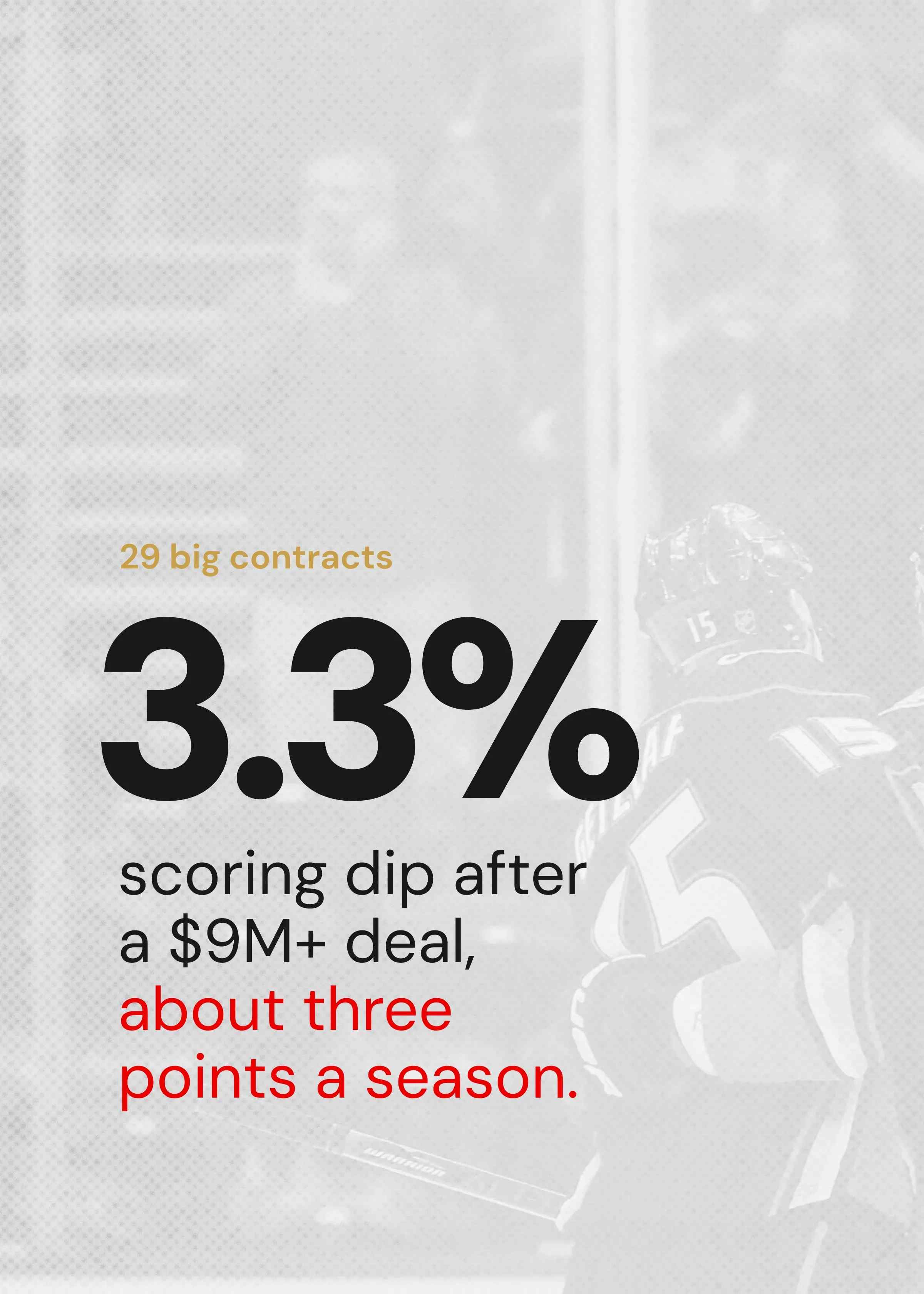
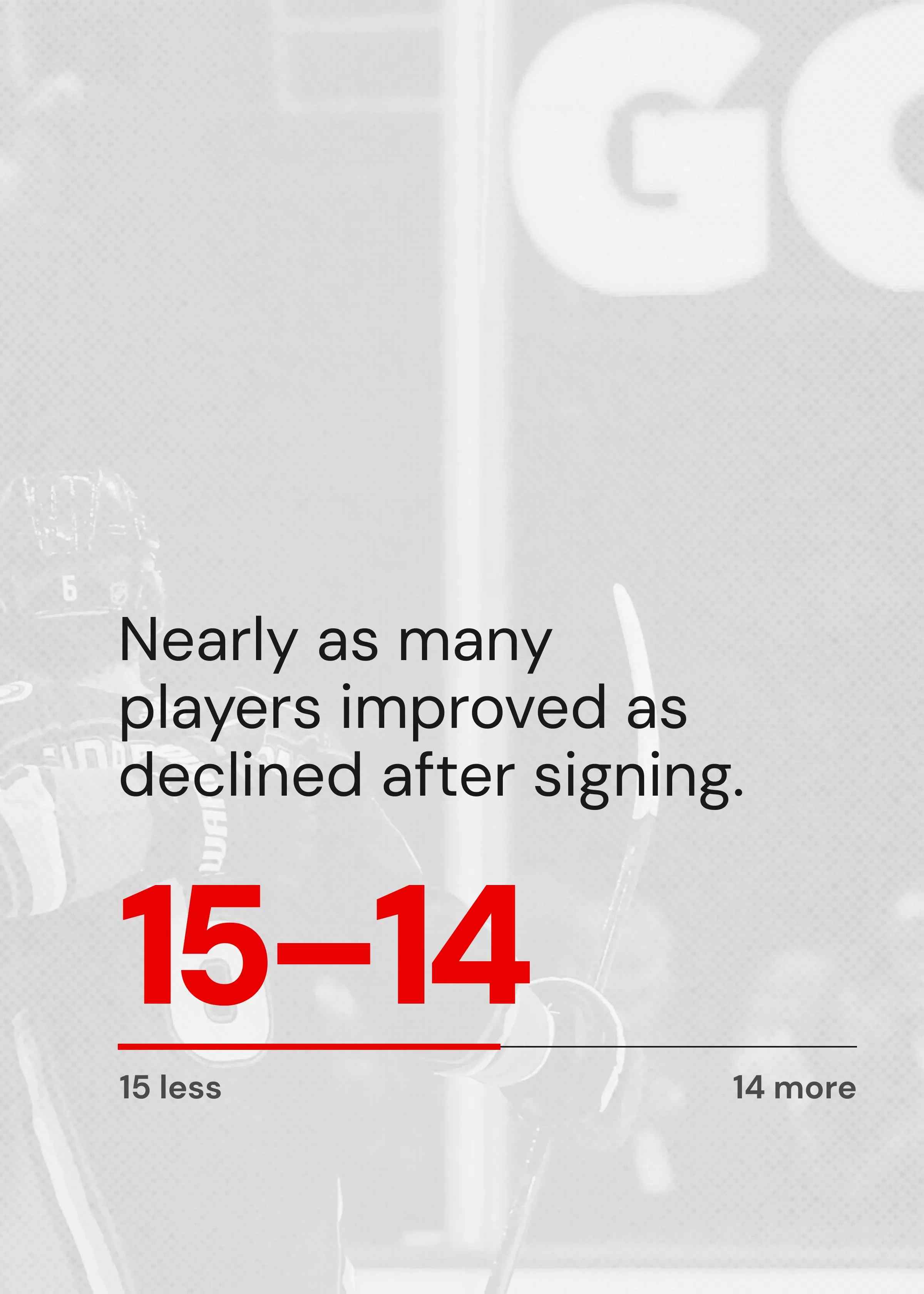
On the narrow question of scoring, the NHL’s biggest contract earners tilted expectations lower in the over/under betting market after putting pen to paper compared with the season prior. Production slipped from 1.099 to 1.063 P/G, a 3.3% drop worth around three fewer points over 82 appearances. Almost even, 15 deals finished lower and 14 higher. The median individual change was down 0.9%.
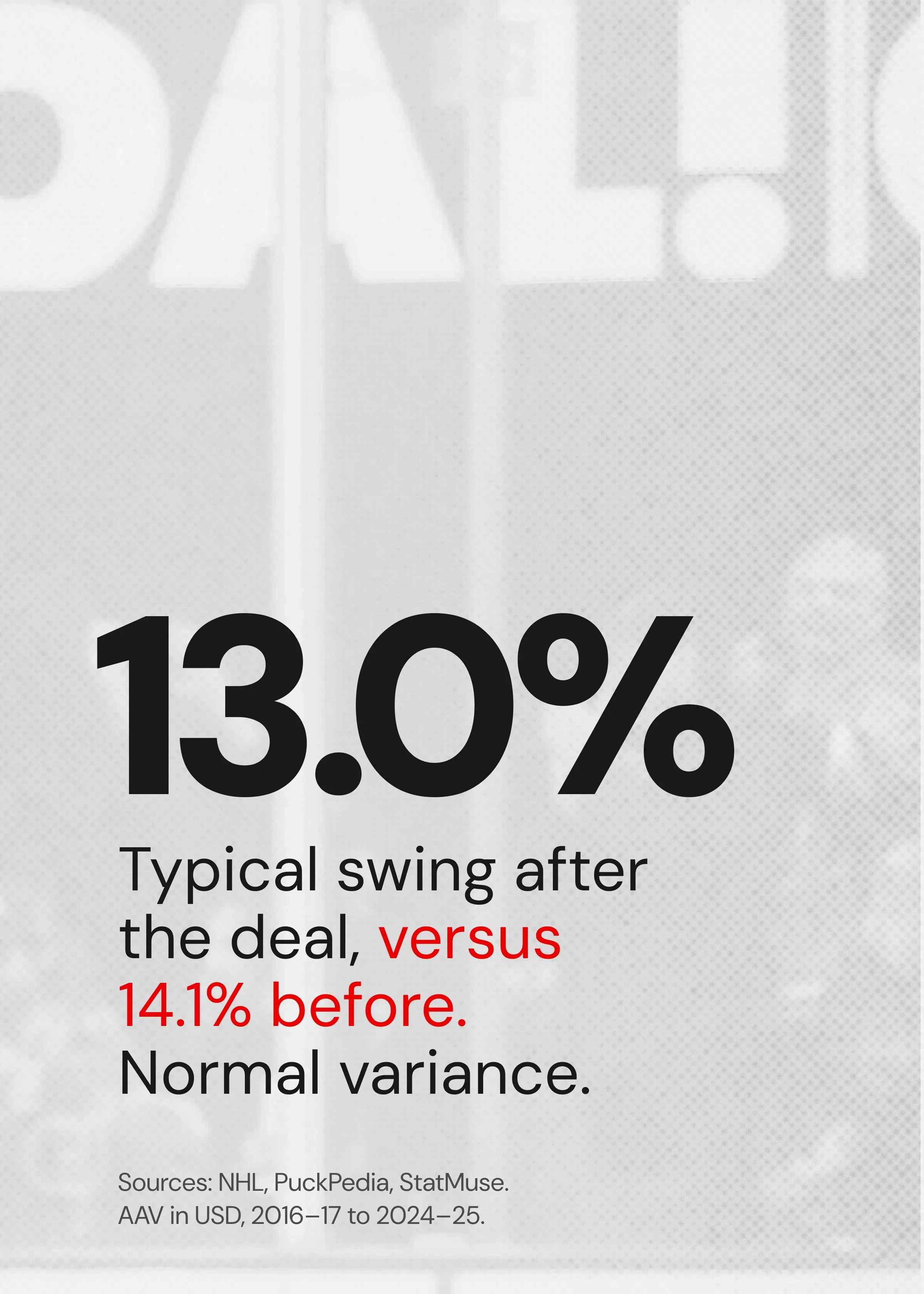
The rest of the offensive numbers went the same way. Goals per game dropped 6.5% and Points/60 slid 4.9% right behind it. For 28 deals with an earlier NHL season available, the typical swing in either direction was 14.1% before the new contract and 13.0% afterward, suggesting pretty similar year-to-year volatility on both sides of the deal.
Among the steepest drop-offs, Jeff Skinner’s scoring rate nearly halved, and Johnny Gaudreau lost about a third of his production after the move to Columbus.
Early extensions deliver both wins and regrets
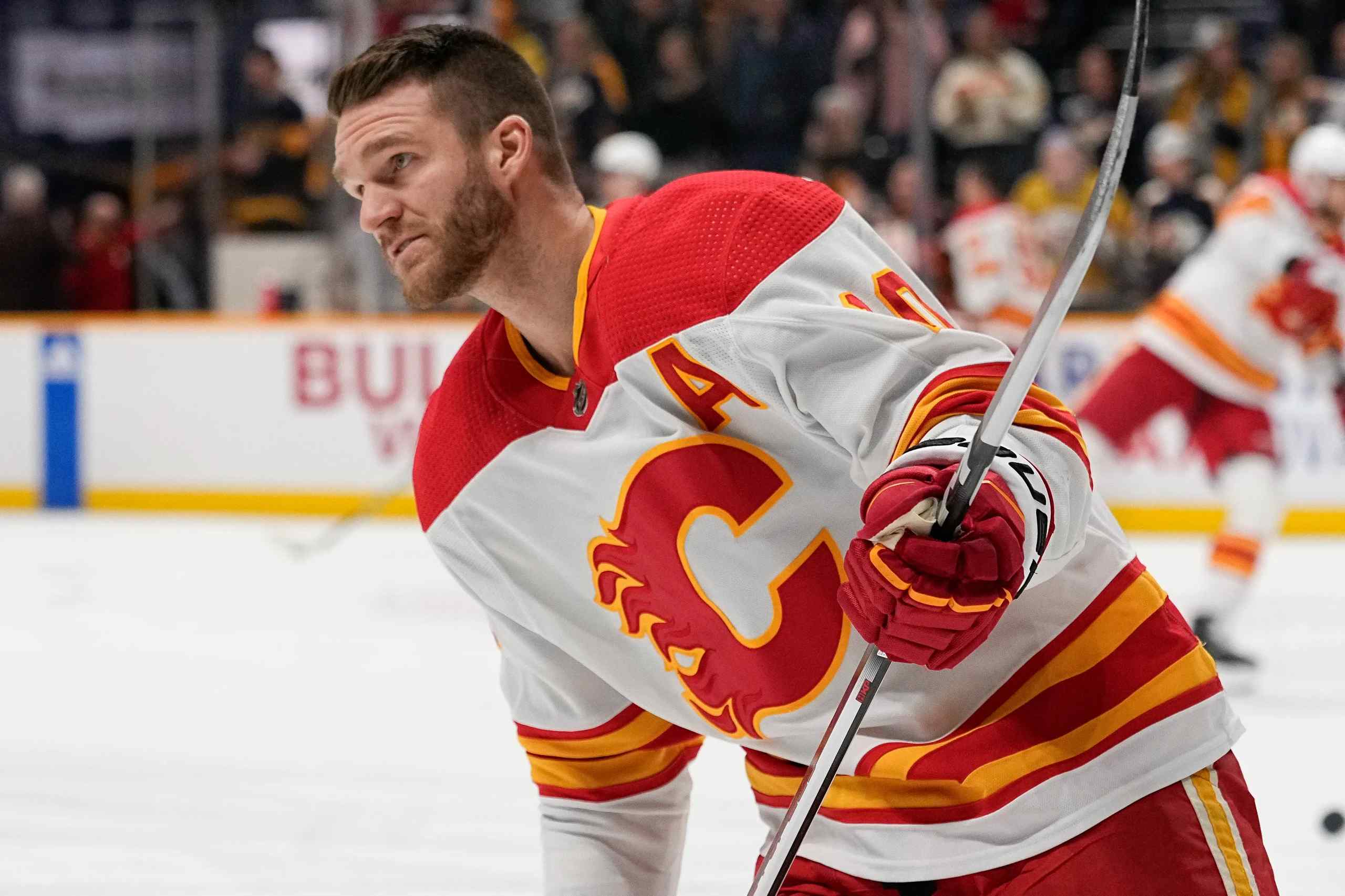
Jonathan Huberdeau offers perhaps the sample’s starkest example of an investment failing to match the price tag, or at least the return Calgary envisioned. His eight-year $10.5M-AAV extension began during 2023-24, one campaign after moving north, following scoring regression from 115 points for Florida to 55 amid a debut year wearing Flames colors. The new deal produced 52 points initially, climbed to 62 the next season, then fell to 25 through 50 games in 2025-26 while dealing with chronic hip trouble. Meanwhile, his club missed the playoffs throughout all four years.
But not every early commitment went bad. Connor McDavid also signed his original eight-year, $100 million extension a season before it took effect in 2018-19. His scoring rate increased 12.9% during the first year of that deal.
The biggest drop-offs weren’t among the oldest
On my side of the world, soccer has its own version of the aging-star debate whenever a big contract enters the picture. Of course, teams can be paying for very different things with those deals. Scott Carson’s value at Manchester City was largely his influence around the goalkeeper department, while Al Nassr’s Cristiano Ronaldo is still scoring at 41 with 1,000 career goals in sight.
The NHL contract numbers I tracked looked somewhat similar on that front, with no real age pattern showing up across these 28 players. If anything, the biggest declines cluster right in the middle of the age range.
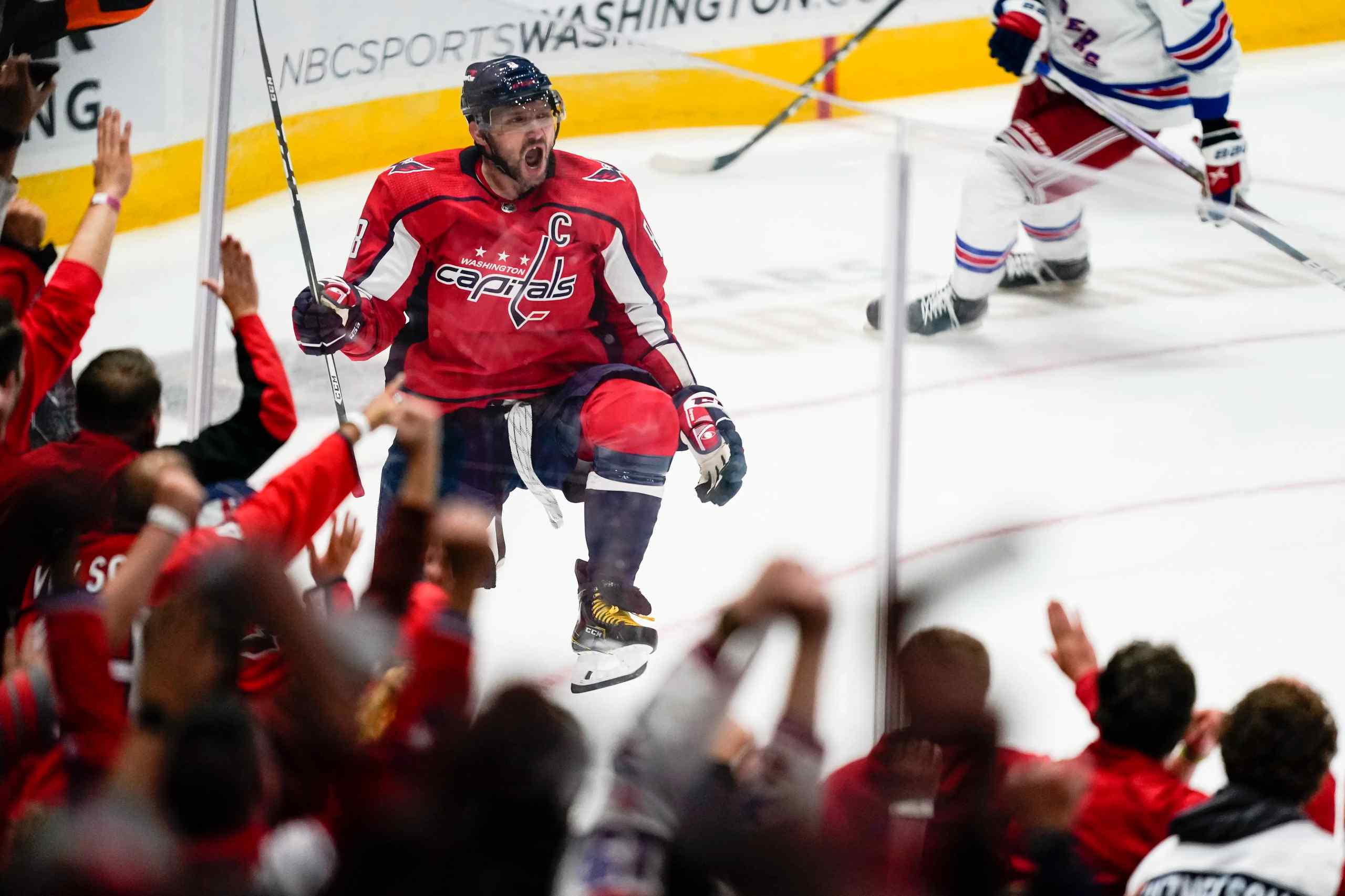
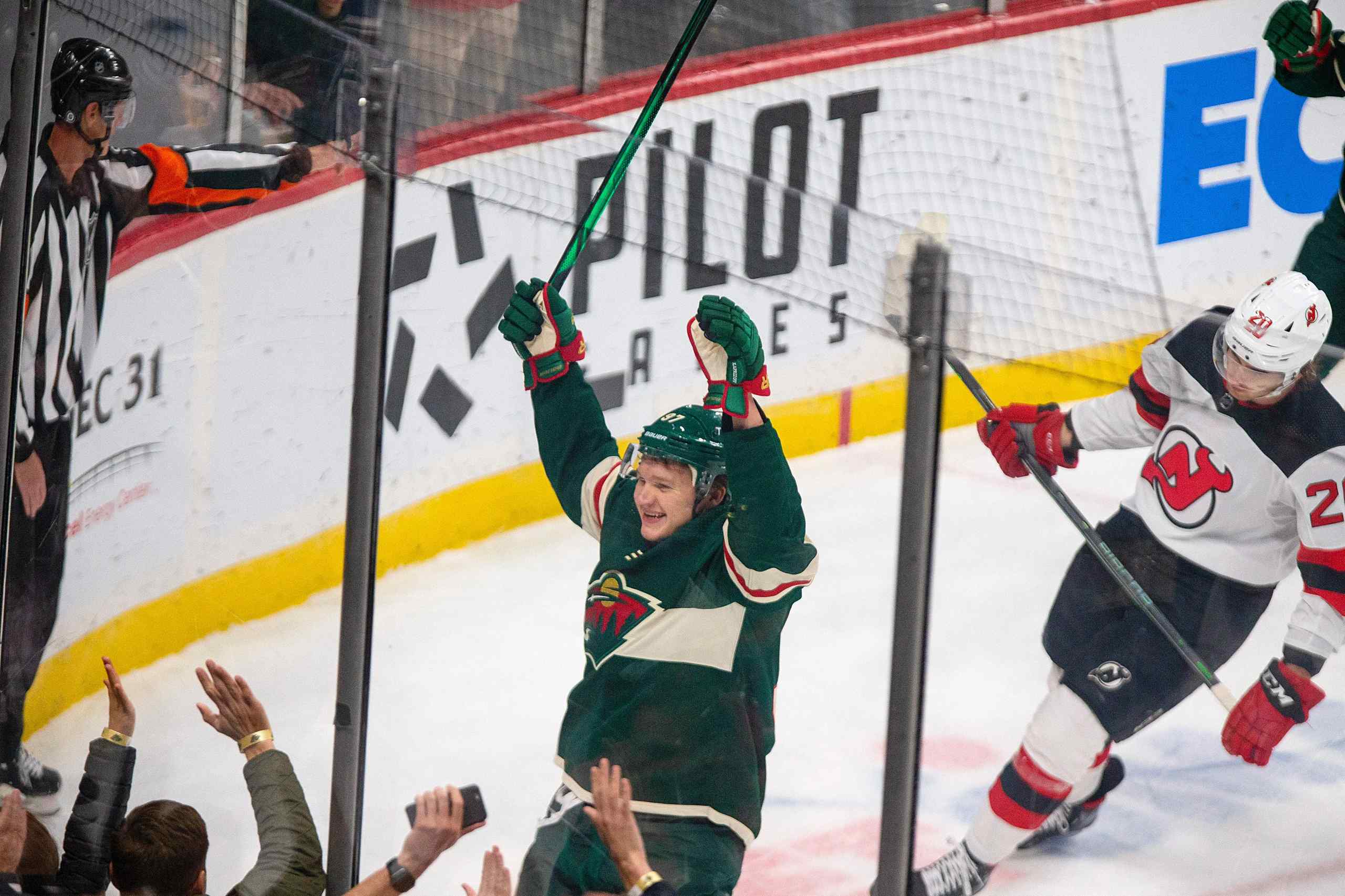
12 of 19 contracts for players between 25 and 29 were followed by lower points per game, including all five cases north of 20%. Among the seven under 25, five deals brought improvements. At 24, Kirill Kaprizov gave Minnesota the biggest immediate return on a major deal, gaining 43.8%. Wild GM Bill Guerin had already set the expectation, saying Kaprizov would “play the same whether he makes his entry-level salary or $9 million a year”.
Then, on the other hand, Alex Ovechkin, who was already 36 at the start of 2021-22, improved by 25.2%, and same for the second oldest, Backstrom (8.9%).
The payday effect fails the test
My answer to the coasting theory is no: NHLers do not systematically play worse after signing big contracts. Taken together, the 29 deals produced only a small scoring dip, with nearly as many players trending up as falling back. The year-to-year swings were almost identical on either side of the new money, and age offered no reliable dividing line either. Some deals soured over time, while others paid off immediately.
The point here, perhaps, is that a major contract, often for good reason, raises expectations and puts every cold stretch under heavy scrutiny, yet these numbers give little cause to treat the deal itself as the trigger for a scoring turn. Ice time, role, linemates, power-play usage, coaching changes, health, and the kind of year-to-year variation that happens regardless might be bigger contributing factors.
Charlon Muscat is an established iGaming expert who entered the space in 2019 and went on to build a name across both casino and sportsbook content.
More Articles like this
Five Iconic World Series Moments Since the Brewers' Appearance
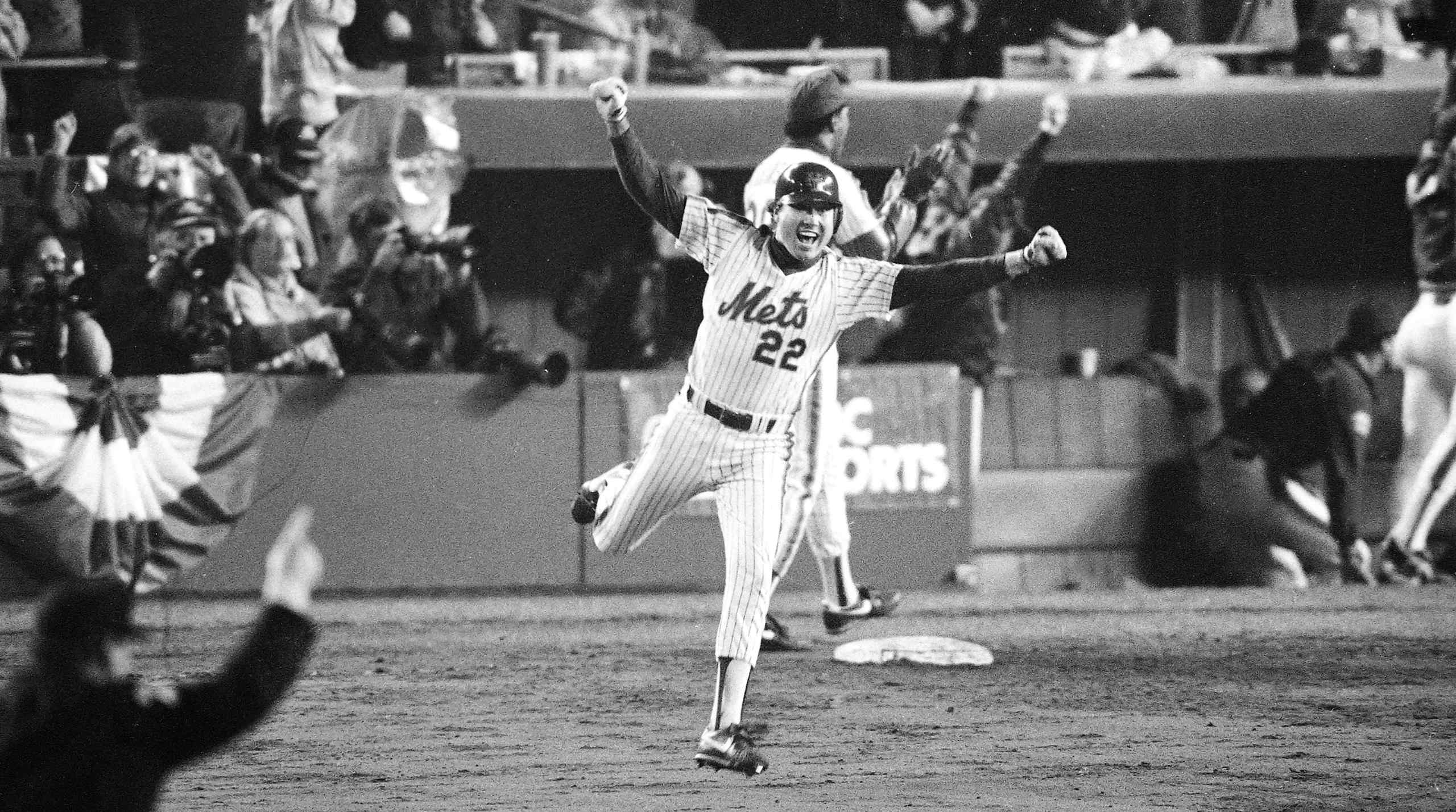
The Brewers are back in the World Series after 44 years. From Bill Buckner's error to the Cubs ending their curse, plenty has happened since 1982.
By Bill Gelman
LeBron to Giannis: Ranking 5 NBA Offseason Stunners
LeBron to Philly, Giannis to Miami, and Wemby staying put. Which NBA offseason move will pay off the most?
By Bill Gelman
NFL Fans Spend $900 to Watch Games. WWE Fans Pay Even More
Think watching every NFL game is expensive? WWE fans would argue otherwise.

By James Guill
How Bad Is It? Ranking the NHL's Original Six by Fan Misery
Nearly 60 years without a Stanley Cup is just the beginning. We rank the NHL's Original Six teams by how much misery their fans have endured.
By Bill Gelman
Why Does Everybody Hate Us? 10 Most Hated Sports Teams Ever
Some teams always win; others get caught breaking the rules. Either extreme is a surefire way to become universally hated, as these 10 sports teams can attest to.
By Stuart Hughes
5 Outrageous Sports Rules That Need to Die
From a missed signature disqualification to a two-minute penalty for a tucked-in jersey, find out about the top five dumbest rules in sport that leave common sense in the locker room.

By Stuart Hughes