
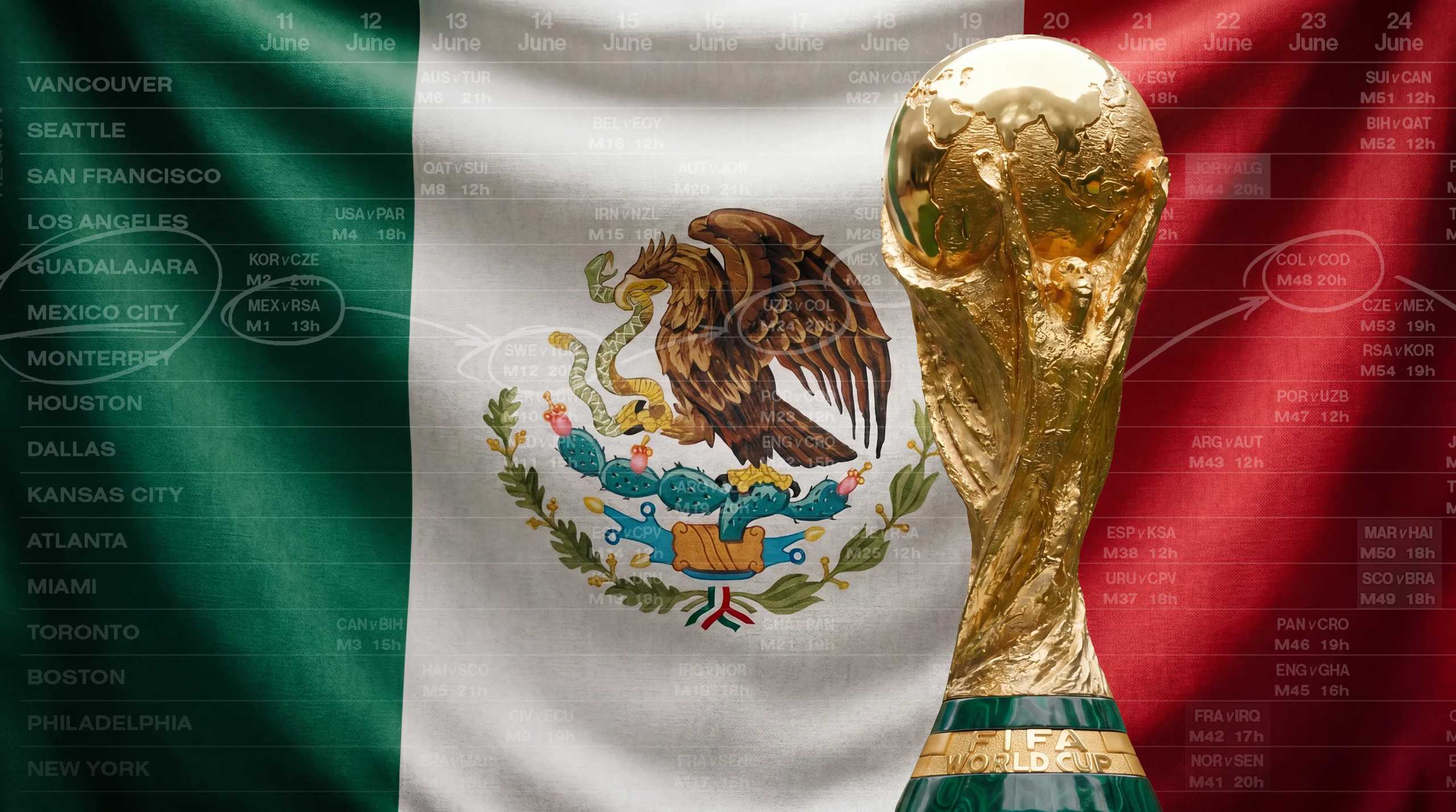
2026 FIFA World Cup Guide: Mexico Edition
Mexico is where the 2026 World Cup opens. This guide breaks down the scheduled games, different ticket routes, and how to cut flight and stay costs across Mexico City, Guadalajara, and Monterrey.

All soccer fans dream about watching the sport’s biggest stage, but traveling to Mexico for the World Cup takes it somewhere else entirely. This is where legends stamped their name on it, Pelé, Maradona, Jairzinho, Beckenbauer, the lot.
Locals are among the most passionate crowds, and the culture hits harder and louder than anything you will find across the US or Canada. June 11, 2026, marks the third time Mexico opens a World Cup when the hosts face South Africa.
For those of you planning to be there, this guide breaks down what it takes to pull it off, from tips on buying tickets to finding flight deals, sorting accommodation, and getting around the country.
Every 2026 World Cup game taking place in Mexico
Mexico’s share of the 2026 FIFA World Cup centers on Group A, featuring Mexico, South Africa, South Korea, and the Czech Republic. Beyond that, a few cross-group fixtures appear before heading into two Round of 32 ties and a Round of 16 in Mexico City.
The table below shows all FIFA World Cup matches happening in Mexico this year:
FIFA World Cup 2026 Matches Taking Place in Mexico
Full Schedule of World Cup Matches in Mexico
| Teams | Date | Stadium | City |
|---|---|---|---|
| Mexico vs South Africa | June 11, 2026 | Estadio Azteca | Mexico City |
| South Korea vs Czechia | June 11, 2026 | Estadio Akron | Guadalajara |
| Sweden vs Tunisia | June 14, 2026 | Estadio BBVA | Monterrey |
| Uzbekistan vs Colombia | June 17, 2026 | Estadio Azteca | Mexico City |
| Mexico vs South Korea | June 18, 2026 | Estadio Akron | Guadalajara |
| Tunisia vs Japan | June 20, 2026 | Estadio BBVA | Monterrey |
| Colombia vs DR Congo | June 23, 2026 | Estadio Akron | Guadalajara |
| Czechia vs Mexico | June 24, 2026 | Estadio Azteca | Mexico City |
| South Africa vs South Korea | June 24, 2026 | Estadio BBVA | Monterrey |
| Uruguay vs Spain | June 26, 2026 | Estadio Akron | Guadalajara |
| 1st Group F vs 2nd Group C (Round of 32) | June 29, 2026 | Estadio BBVA | Monterrey |
| 1st Group A vs Best 3rd (C/E/F/H/I) | June 30, 2026 | Estadio Azteca | Mexico City |
| Winner Match 79 vs Winner Match 80 (Round of 16) | July 5, 2026 | Estadio Azteca | Mexico City |
Mexico City, Guadalajara, Monterrey: The three Mexico World Cup hosts
Mexico has done this before, two times already, first in 1970, then in 1986. This year, three cities spread across the country are part of a joint setup with the US and Canada. Mexico City is set to make history as the first to host three World Cup openers. The other two bring their own feel and matchday edge that fans can look forward to. Here is a closer look at each.
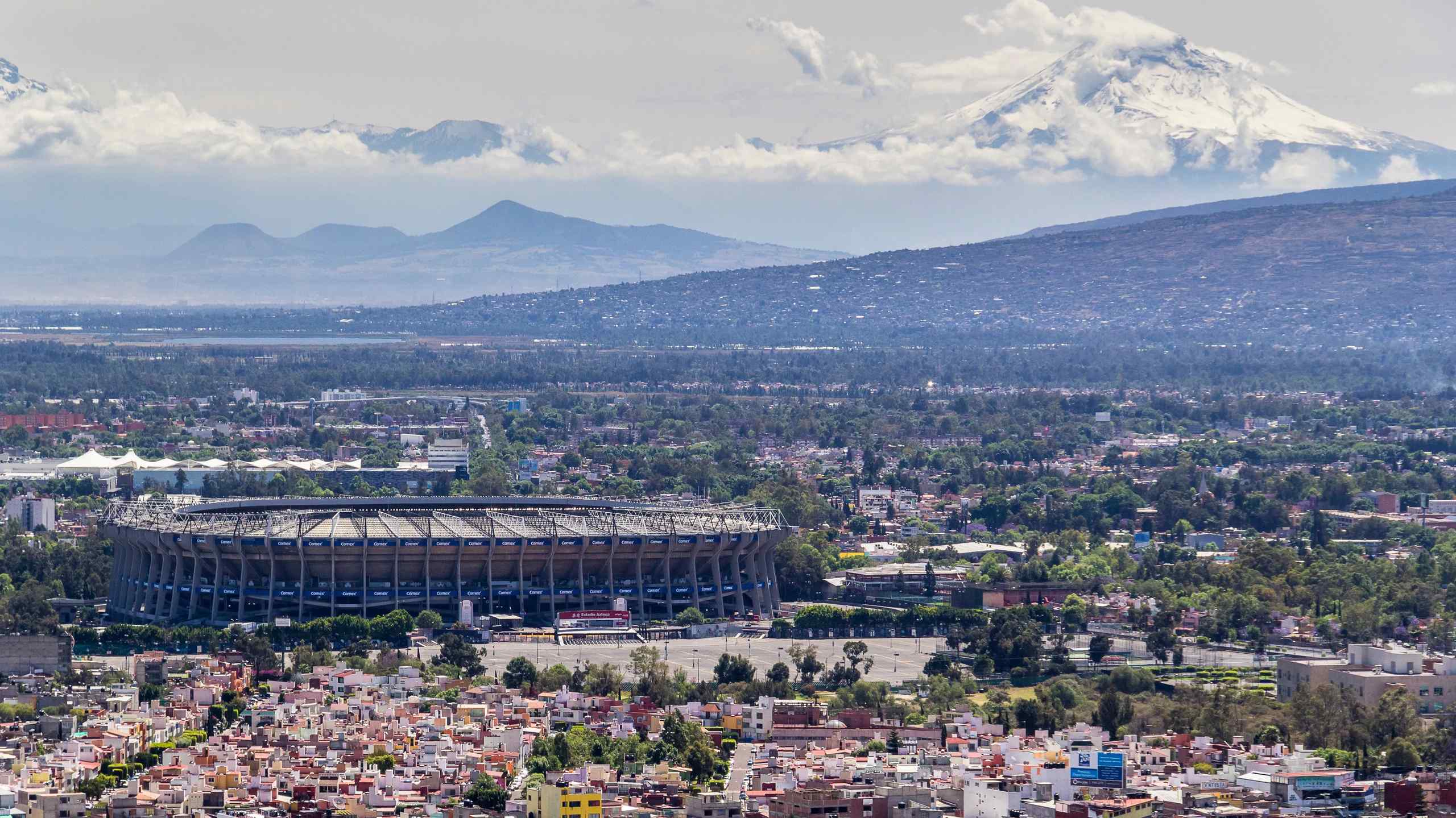
Estadio Azteca – Mexico City, CDMX
For 2026, FIFA picked Estadio Azteca in the capital to host the June 11 opener between Mexico and South Africa, which makes sense, really. This is the only venue in the world that has staged two separate World Cup finals. The stands have seen it all — Diego Maradona pulling off the “Goal of the Century,” and years earlier Pelé lifting the trophy with what many still see as Brazil’s greatest side. A few days later, two more group games follow, plus a Round of 32 and Round of 16 knockout fixture in late June and early July.
FUN FACT: The 87,523-seat Estadio Azteca is higher than any of the 16 World Cup venues, at just over 2,200 metres above sea level. The thinner air reduces oxygen availability, which affects endurance, and even if the effect is subtle, it also changes how the ball travels. It could pay to consider these factors when soccer betting.
Estadio Akron – Guadalajara, Jalisco
Second up on Mexico’s World Cup stadium list is Estadio Akron, home of C.D. Guadalajara. This place has a few things that set it apart. Home fans are heavily behind the national team, having grown up around a club built on fielding only Mexican players. It’s a setup similar to Athletic Bilbao over in Spain. We expect the crowd to find another gear when Mexico takes on South Korea in a likely Group A swing game.
Then there is the build itself. Estadio Akron is constructed into a slope, so entry happens at street level and spectators move downward into the seating bowl. This, along with the steep stands running right up to the pitch, gives it a tighter and more enclosed feel than most multi-use stadiums. Also, the fact that it maintains a permanent natural grass surface means there was minimal pitch work needed to meet FIFA standards, unlike most World Cup venues in the US and Canada.
FUN FACT: The roof of Estadio Akron follows a volcanic form found in the Jalisco landscape, and its geometry helps reflect and contain crowd noise within the bowl during matches.
Estadio BBVA – Monterrey, Nuevo León
Estadio BBVA is set to host four matches in total. First up is the Group F opener between Sweden and Tunisia on June 14, with the latest FIFA World Cup odds leaning toward Graham Potter’s side. Then the North Africans face Japan six days later. The other games include the final Group A matchday and a Round of 32 tie. Unfortunately for home fans, none of Mexico’s group games are set for this venue, so the stands should carry a more mixed spread of colours. One thing visitors will notice straight away is the open end framing Cerro de la Silla behind the pitch during play.
Technically, the Monterrey stadium is one of the more refined builds on the 2026 map. There is no athletics track, so the front rows start right near field level. The roof covers most seating but remains open at the corners, which allows natural airflow through the bowl, a key factor in Monterrey’s heat. All of this has already been put through its paces, most recently when the ground hosted CONCACAF competitions and World Cup qualifiers.
FUN FACT: Estadio BBVA uses an asymmetrical bowl, with the north stand built higher than the south. The reason is to improve sightlines across tiers while limiting direct sun on the pitch and main seating during late afternoon kickoffs.
Mexico World Cup Stadiums: Fact Sheet
| Details | Estadio Azteca | Estadio Akron | Estadio BBVA |
|---|---|---|---|
| City | Mexico City | Guadalajara | Monterrey |
| Capacity | 87,523 | 49,850 | 53,500 |
| Opened | 1966 | 2010 | 2015 |
| Home Team | Club América | C.D. Guadalajara | CF Monterrey |
| Altitude | ~2,200 m | ~1,500 m | ~500 m |
| Atmosphere Profile | Largest, most intense crowd density | Compact, vocal, enclosed feel | Cleaner sightlines, more open airflow |
| Location Access | Dense urban, metro-linked | Suburban | Edge of city |
Purchasing a 2026 FIFA World Cup Ticket in Mexico
The 2026 FIFA World Cup ticketing picture is already moving. Multiple sales phases have passed through, and only a limited supply is left in play. Mexico fixtures are right up there in demand, no surprise given the pull of home support, traveling fans, and neutrals leaning toward the cheaper side of the tournament. Across the board, day-to-day costs stretch a lot further in Mexico than in the US or Canada. To put that into perspective, reports show a beer and hot dog can be around $5.65 in Guadalajara versus roughly $25 at LA’s SoFi Stadium.
As things stand, while putting this Mexico-focused 2026 FIFA World Cup guide together, you can get your hands on a match ticket through the following routes:
- Last-Minute Sales Phase (open until the end of the tournament)
Live since April 1. Tickets are released in real time on a first-come, first-served basis through FIFA’s ticketing portal. Inventory comes from leftover tickets and unused federation allocations.
- FIFA Resale Marketplace (official secondary route)
Opened April 2. This is the only FIFA-authorized resale platform. Tickets are listed by other fans at regulated prices. Availability is rather inconsistent, so check in as frequently as possible.
- Secondary marketplaces (unofficial)
Platforms like StubHub and Ticombo. These operate outside FIFA. Prices are market-driven and often well above face value, especially for knockout matches. FIFA warns tickets bought outside official channels may be fake or later canceled.
Then there are hospitality packages that give guaranteed access with premium seating and lounge entry. Options include single match tickets, full stadium packages covering multiple games at one venue, and team-based options following one nation through early rounds. Prices start around $1,400 per person.
The initial three ticketing phases have already closed. We’re referring to the:
- Visa Presale
- Early Ticket Draw
- Random Selection Draw
Getting to and around Mexico during the World Cup
Mexico is expecting over 5.5 million World Cup visitors, so a surge in flight prices is hardly unexpected. It would be naive to think otherwise. Bookings are up by as much as 67% year on year. Airlines have added capacity, roughly 727,000 extra seats, into Mexico City, Guadalajara, and Monterrey. Analysts say the optimal booking window likely closed around late February. The best chance at a cheaper fare now leans more backpacker style, using workarounds like self-transfer routes through Kiwi.com, throwaway ticketing, or treating a layover as the final stop.
As for visa requirements, Mexico grants travelers from over 60 countries, including the US, UK, EU, Canada, Japan, and Australia, free entry without prior approval (180 days). On arrival, officials may ask for proof of onward travel and accommodation, plus, of course, your passport. Those coming from elsewhere would need a visa in advance through a Mexican embassy or consulate.
Getting around domestically during the World Cup comes down to flights first, then local transport. Flying between Mexico City, Guadalajara, and Monterrey takes roughly one to one and a half hours and will be the main link. Long-distance buses are also reliable, cheap, and run overnight, but journeys can stretch past six to ten hours. In cities, ride-hailing apps like Uber work well and are often less chaotic for foreigners than street taxis. Metro systems are worth a look, too. They are fast and very cheap, but can get packed quite easily. Whatever you go for, make sure to always allow extra time on matchdays due to the expected traffic.
Where to stay in Mexico
Accommodation follows the same pattern as flights, demand rises, and prices go with it. Locking something in early usually gives a better deal.
A very important part of having a good World Cup trip is picking the right area. For example, many lean toward Polanco as the safest high-end base in Mexico City, while Condesa and Roma Norte tend to offer better value, food, and nightlife, all still within easy reach of the stadium by taxi or metro.
Here are some solid places to look through when comparing accommodation options:
- Google Maps: Lets you see the exact location, distances to stadiums, and compare prices across multiple booking sites in one view.
- Airbnb: Strong for group stays (apartments with 2+ bedrooms) and longer bookings (discounts when staying a week or more). Various neighborhood-level options not available on hotel sites.
- Booking.com: Wide coverage across hotels and apartments + flexible cancellation filters useful for planning early.
- Skyscanner: Not just flights, also aggregates hotel deals and helps spot pricing differences across providers.
- TrustedHousesitters: More niche, but can mean free stays if you are open to looking after someone’s home or pets.
- Couchsurfing: Also free. Plus, it’s a direct way into local culture if you are comfortable with the setup.
- Hotel direct websites: Sometimes cheaper than third-party platforms, especially with member rates or when grinding travel reward points.
The unique aspect of Mexico as a World Cup Host
Very few countries know how to host soccer like Mexico. Outside the stadiums, the tournament will spread into daily official FIFA Fan Festivals from June 11 to July 19, with free entry in most cases, and capacities reaching 30,000 to 50,000 people per site. Huge parks and public squares across the country are setting up giant LED displays, live concerts, and structured event programming running throughout the day.
The World Cup build-up has also triggered a large-scale community push led by the Mexican Youth Institute, where nearly 5,000 murals have been created in public spaces across all 32 states. Activities include nationwide pickup tournaments with 56,000 teams and environmental projects like reforestation. Over one million young people are involved. The initiative, known as “tequio,” focuses on reclaiming streets, schools, and football pitches to turn the tournament into a country-wide social and cultural movement rather than just a commercial event.
What does it cost to watch the FIFA World Cup in Mexico?
Mexico offers the most budget-friendly way into the 2026 FIFA World Cup. Both accommodation and day-to-day spending sit well below the US and Canada. Here is a quick look at what the main cost drivers look like:
- Match tickets: $60 - $120 official, but realistically $300 to $1,000+ on resale. Expect higher prices for big games.
- Flights: These can range from $400 to $2,000+, depending on where the trip originates from.
- Accommodation: $60 to $300 per night. Booking early or staying outside central zones keeps costs down.
- Daily spend: This varies based on what you do. A median figure is between $85 and $180 per day, with meals $5-$15 and beers around $2 or $3
- Domestic travel: $80 to $200 one way, buses $30 to $80 depending on distance
➡️ Related: America’s Best and Worst Airport Hubs in 2026, Ranked
Will you be in Mexico for the 2026 FIFA World Cup?
Mexico’s share of the 2026 FIFA World Cup lands on the more accessible end of the tournament compared with the USA and Canada. All three host cities — Mexico City, Guadalajara, and Monterrey — live and breathe soccer, and both the stadiums and the wider setup have done this before, twice over. Getting around is pretty straightforward with short domestic flights or buses, but you will want to plan ahead because demand is, well… exactly what you think it is. Use tools such as Kiwi.com, Skyscanner, Google Maps, or even AI planners like Layla to stitch the trip together in a way that fits your style and budget by the time June 19 rolls around.
Related Articles
Charlon Muscat is an established iGaming expert who entered the space in 2019 and went on to build a name across both casino and sportsbook content.
More Articles like this
Is Fall Travel Still a Bargain? Not Everywhere
Fall used to mean cheaper flights and thinner crowds. In 2026, lodging in top U.S. cities runs 20% above summer. Here's where autumn still wins on price, weather, and crowds.
By Cole Rush
One Vegas Weekend, 10 Years Apart: An 82% Price Surge
A weekend in Vegas costs a lot more than it did a decade ago. We priced the same hotels, meals, and entertainment in 2016 and 2026 to see just how much.
By Charlon Muscat
From NYC to Melbourne: Four Ultimate Sports Vacations
From New York to Melbourne, these four cities offer much more than a game ticket, combining iconic venues, major events, sightseeing, food, and nightlife into a bucket-list sports vacation.
By Bill Gelman
6 Luxury Vacation Destinations That Are Astonishingly Affordable
So, you thought you needed to be rich to vacation like a billionaire? Well, check out these glamorous destinations that famously deliver lavish getaways for far less than you think.
By Stuart Hughes
What to Do Before You Travel With Betting Apps
A little preparation can save you from blocked access and login errors. Knowing how sportsbooks track location helps you stay ahead of the most common problems.
By Charlon Muscat
Long Layover? Here’s When You Should Actually Leave the Airport
Flight delays and lengthy airport layovers are part and parcel of flying these days, so why not seize the chance to head off for a spontaneous adventure outside the airport instead?
By Stuart Hughes